
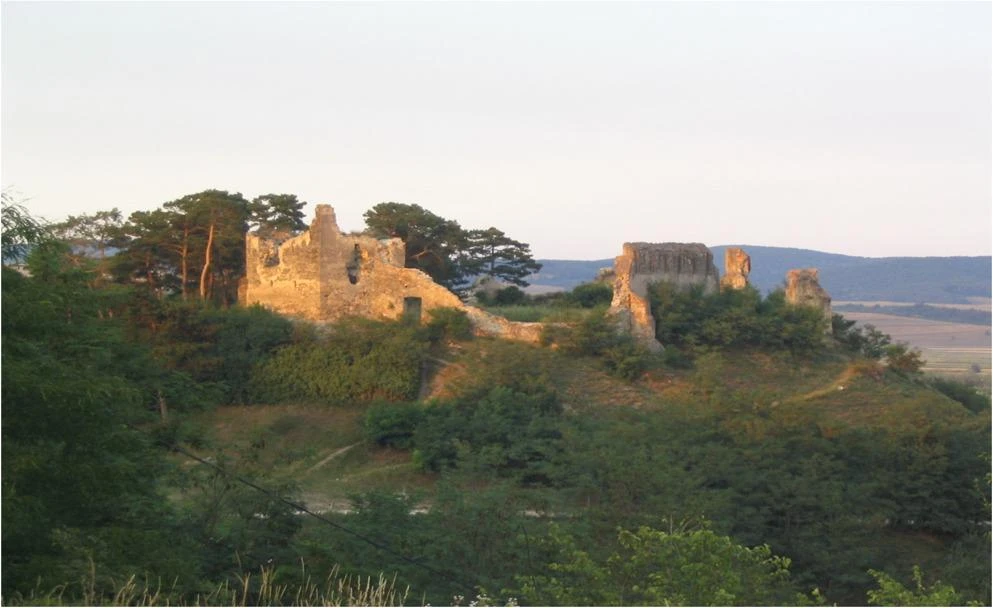
For decades, a ruined fortress in southeastern Transylvania, now part of Romania, carried a powerful suspicion: it may have been built by crusader knights who briefly tried to turn this frontier of medieval Hungary into their own stronghold.
Now, science has given that story its clearest evidence yet.
A new archaeometric study published in Archaeological and Anthropological Sciences confirms that the earliest stone defenses of Feldioara Fortress, also known as Marienburg, date to the early 13th century. That timing matches the short but politically explosive period when the Teutonic Knights controlled Burzenland, or Ţara Bârsei, between 1211 and 1225.
The discovery matters because the Teutonic Knights were not ordinary castle builders. They began as a crusading hospital order in the Holy Land, but soon became one of medieval Europe’s most ambitious military-religious powers. Their years in Transylvania were brief, yet the new dating shows they left behind more than a historical rumor. They built in stone.
A fortress long suspected, but never proven
Feldioara occupies a strategic plateau above the Olt River, with wide visibility toward the Carpathian Mountains. In the Middle Ages, this was not an isolated village but a frontier zone of the Kingdom of Hungary, positioned between Latin Christendom and the lands of the Cuman steppe.
The site was already known under the name Castrum Sanctae Mariae in 1240, when it was granted to the Cistercian Order. Its German name, Marienburg, also pointed to a possible Teutonic connection, since the order was devoted to the Virgin Mary.
Yet the evidence remained frustratingly incomplete. Written sources showed that King Andrew II of Hungary invited the Teutonic Knights to settle in the region in 1211 to defend the border against the Cumans. Archaeologists had also uncovered early medieval walls, a church, towers, spurs, bridle bits, buckles and other material remains. But none of this could firmly tie the fortress walls to the short Teutonic period.
That gap has now narrowed.
Mortar becomes the key evidence
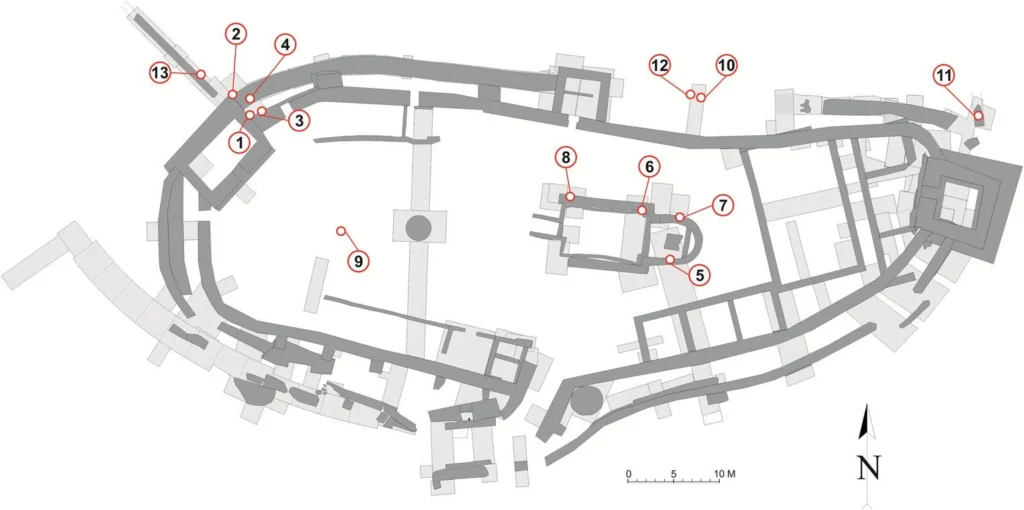
The research team examined 13 lime mortar samples collected from the oldest parts of the fortress during excavations linked to restoration work carried out between 2013 and 2017. Dating mortar is difficult because it does not behave like wood, bone or charcoal. Lime mortar hardens over time as it absorbs carbon dioxide from the air, and contamination from later repairs can distort the result.
To reduce that risk, the scientists focused on sub-micron calcite fractions from the mortar binder. They used FT-Raman spectrometry to check the samples before accelerator mass spectrometry radiocarbon dating. The dates were then modeled with OxCal, allowing the team to compare the laboratory results with the historically known Teutonic window of 1211 to 1225.
The most important samples came from the so-called “Teutonic” wall and early foundations of the western tower. Several matched the simulated early 13th-century interval. The study concludes that the earliest masonry foundations of Feldioara were indeed laid when the Teutonic Knights controlled the region.
In practical terms, chemistry has supplied what traditional archaeology could only suggest.
The knights who tried to build a frontier state
The Teutonic Order began during the Third Crusade as a hospital brotherhood caring for pilgrims in the Holy Land. By the early 13th century, however, it had become a military-religious institution with political ambitions.
King Andrew II’s decision to bring the order into southeastern Transylvania was meant to reinforce a vulnerable frontier. The knights were granted land and the right to build wooden fortifications. But the arrangement soon became dangerous for the Hungarian crown.
According to medieval sources, the order crossed the Carpathians into Cuman territory, sought papal protection, and began building stone fortifications without royal approval. To Andrew II, this looked less like border defense and more like the formation of an autonomous power inside his kingdom. In 1225, after only 14 years, the Teutonic Knights were expelled.
Their time in Transylvania was brief, but the new study shows it left a permanent architectural mark.
Feldioara’s deeper medieval story
The research also complicates the story of the fortress. Feldioara was not a single-phase military site. Excavations show long occupation from prehistoric periods onward, followed by several medieval building stages.
A small church inside the fortress may have older roots than previously thought. Some samples suggest construction activity before or around the Teutonic period, possibly linked to early Saxon settlement. Other evidence points to a later Cistercian phase after the knights were expelled, especially after the 1240 royal donation.
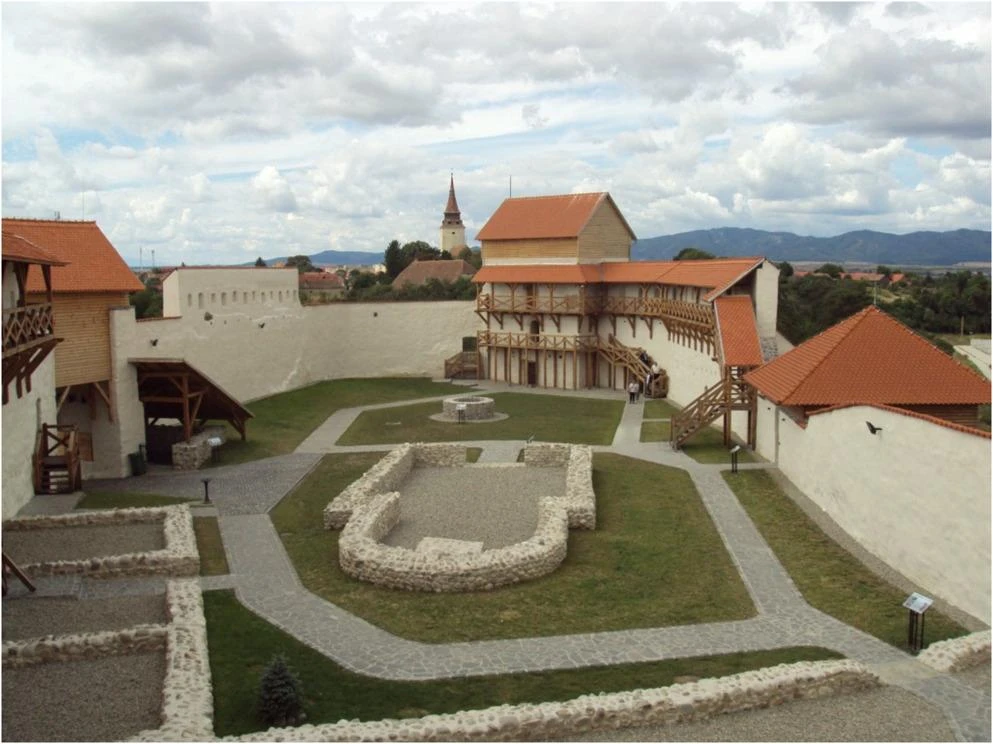
The standing fortress developed further in the 14th and 15th centuries, with stronger towers and defensive walls. Later modifications continued into the early modern period. By the late 17th century, Feldioara had become part of a broader fortified landscape connecting the outer fortress with the nearby settlement.
This layered history matters because it shows how a short crusader episode became embedded in the longer political and religious transformation of Transylvania.
A small fortress with European importance
The study’s main conclusion is clear: Feldioara’s earliest stone defenses can now be placed in the Teutonic period with scientific support. That makes the site a key piece of evidence for understanding how crusading military orders moved from the eastern Mediterranean into continental Europe.
Feldioara also helps explain the order’s later trajectory. After its expulsion from Hungary, the Teutonic Order shifted north, where it would eventually build a much larger territorial power in Prussia and the Baltic region. The Transylvanian experiment failed, but it foreshadowed the order’s broader strategy: frontier defense, fortified settlement and political autonomy under religious authority.
Feldioara was a historical suspicion built on names, documents, and ruined walls. Now, its mortar has spoken. The fortress was not merely associated with the Teutonic Knights. It was one of the places where their European ambitions first took stone form.
Marcu-Istrate, D., Stanciu, I.M., Simion, C.A. et al. The fortress of the Teutonic Order in South-eastern Europe: Feldioara/Marienburg from early foundation to present-day; preliminary archaeometric studies. Archaeol Anthropol Sci 18, 118 (2026). https://doi.org/10.1007/s12520-026-02480-y
Photo: A. Ioniță. Credit: Marcu-Istrate, D., et. al., 2026
