
Rare gold hoard discovered in Prahova
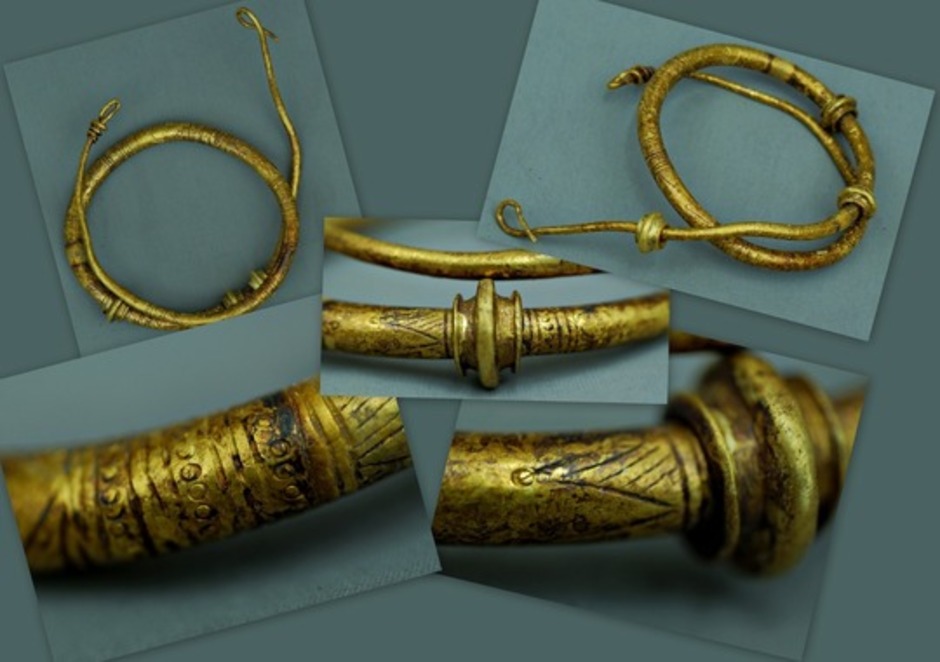
Bronze Age gold necklaces have been discovered in Romania as part of a 3,000-year-old hoard unearthed in Prahova County, northeast of Bucharest.
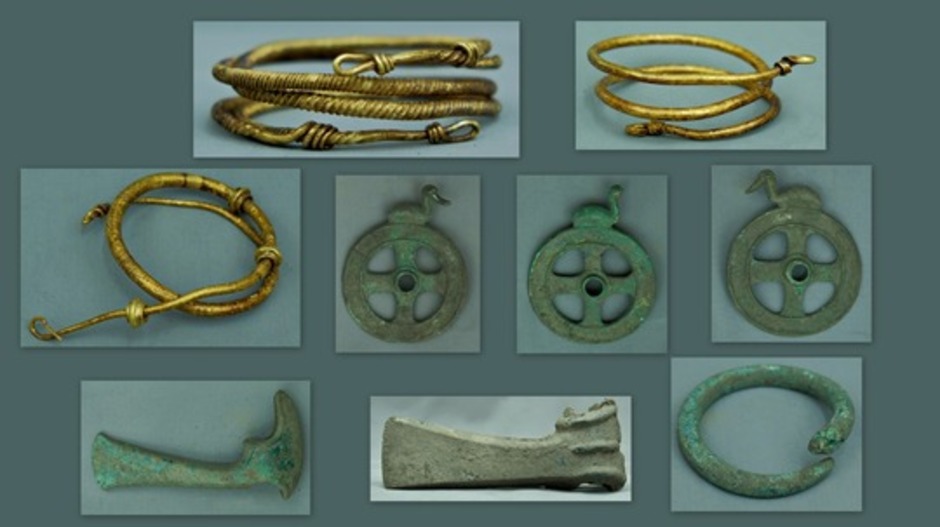
The treasure, found on an isolated hill near Marginea Pădurii and close to the town of Urlați, includes three massive gold neck ornaments weighing more than 300 grams in total. Alongside them were iron wheels, two small axes and a bronze bracelet, creating a rare group of objects that specialists say may force a reassessment of Bronze Age and early Iron Age chronology in the region.
The discovery was first made by an authorized metal detectorist during a Sunday afternoon search. His detector reportedly gave a strong signal near a large stone in a remote area with no visible road or settlement nearby. At a depth of only about 25 centimeters, he uncovered the first objects: small iron wheels placed above and around a compact group of artifacts.
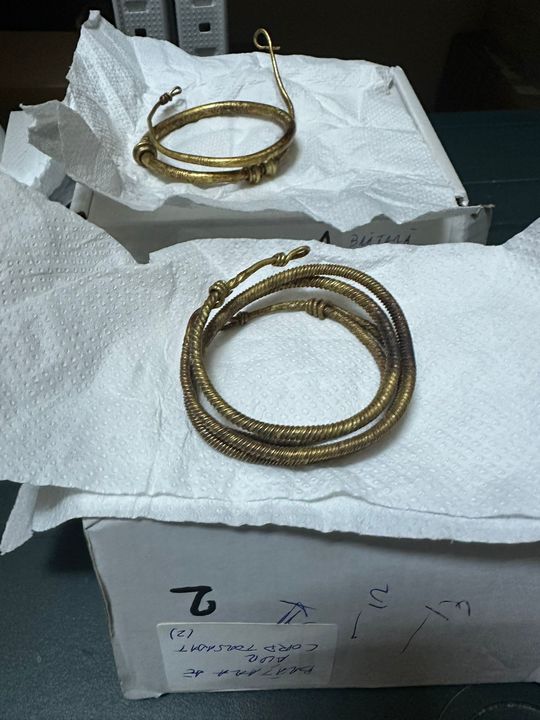
Inside were three heavy gold spirals. At first, they appeared to be bracelets. Later analysis showed that they were actually gold collars or neck rings, rolled tightly so they could fit into a small space.
A legal handover and an exceptional find
The finder checked the surrounding area but found no additional buried objects. The next morning, he handed the hoard over to the Prahova County Directorate for Culture, following Romanian heritage law.
The artifacts were then transferred to the Prahova Museum of History and Archaeology, where specialists began their first examination. Archaeologist Alin Frînculeasa, a prehistoric archaeology specialist and researcher active in Prahova, described the discovery as exceptional for Romania.
The difficulty is not only the richness of the hoard, but its dating. According to Frînculeasa, the objects appear to belong to a wide chronological range covering the middle and late Bronze Age and the beginning of the first Iron Age. That raises a major question. Were these objects made centuries apart and later gathered together, or do existing ideas about the dating of similar artifacts need to be revised?
For archaeologists, that uncertainty is exactly what makes the discovery important.
Objects placed with care
The arrangement of the hoard suggests that the artifacts were not lost casually. The gold collars seem to have been deliberately rolled and deposited in a small space. The three iron wheels appear to have framed or protected the group, while a bronze bracelet lay at the bottom of the pit.
Researchers also suspect that the objects may once have been placed inside a container, although no preserved box has yet been confirmed. The position of the pieces points to an intentional act of deposition, not a scattered accidental loss.
One of the gold necklaces bears stamped decoration similar to patterns seen on Bronze Age ceramics. The style of the other pieces recalls forms known from silver objects belonging to different periods. This mixture of materials, forms and decorative traditions is one reason the hoard has caused such interest.
The small axes and iron wheels add another layer to the puzzle. Their presence beside the gold ornaments may indicate symbolic meaning, ritual practice, elite status, or a carefully hidden personal or community treasure.
Hidden wealth or sacred offering?
Archaeologists are now considering two main possibilities. The hoard may have been a votive deposit, placed intentionally in a meaningful location as part of a ritual act. Another possibility is that it was hidden during a moment of danger, perhaps by a small prehistoric community trying to protect its wealth from conflict or displacement.
The landscape itself may help answer that question. The hill where the hoard was found has now been placed on the list for future archaeological investigation. Specialists hope to determine whether a settlement, burial area, cult place or other prehistoric activity existed nearby.
If traces of habitation are found, the hoard could be linked to a community living in the region around 3,000 years ago. If no settlement is discovered, the site may have been chosen for another reason, perhaps as a marked place in the landscape.
Gold that may reveal ancient connections
The next stage of research will focus on the gold itself. By studying the composition of the metal, archaeologists hope to learn where the gold came from and how it was worked. Such analysis could offer clues about trade, mobility and craft traditions in prehistoric Romania.
If the gold came from a distant source, the hoard may point to wider exchange networks linking communities across the Carpathian region and beyond. If it was local, it could strengthen evidence for regional goldworking traditions during the Bronze Age and early Iron Age.
For now, the Prahova hoard remains both spectacular and difficult to classify. Its gold collars are visually striking, but its real importance lies in the questions it raises about prehistoric wealth, ritual and chronology.
After research and conservation are completed, the artifacts are expected to be displayed to the public, most likely at the Prahova Museum of History and Archaeology. Until then, the hoard stands as one of the most intriguing archaeological discoveries recently reported in Romania.
Cover Image Credit: Prahova Museum of History and Archaeology
