
More than a century ago, archaeologist Flinders Petrie examined a group of unusual burials surrounding some of Egypt’s earliest rulers and reached a disturbing conclusion. He believed members of the royal court may have died so they could accompany their ruler into the afterlife, and he even suggested that some of them might have been buried alive.
Petrie could not identify clear evidence of lethal trauma on their skeletons, however, and that absence kept the question open for generations. A new forensic study now provides the strongest physical support yet for the idea that at least some of Egypt’s earliest royal retainers were deliberately killed, after researchers identified potentially lethal injuries in 18 of 46 surviving skulls.
Hundreds of graves surrounded Egypt’s earliest rulers
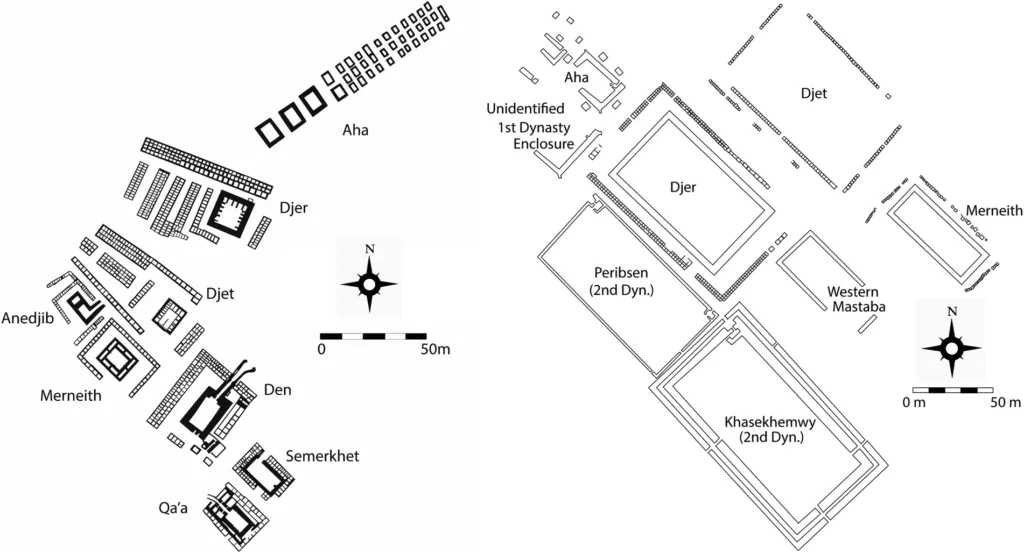
The burials come from Umm el-Qaab at Abydos in southern Egypt, one of the most important royal cemeteries of the First Dynasty, around 3078–2900 BCE. Egypt’s earliest rulers built chamber tombs and separate funerary enclosures there, while rows of smaller graves surrounded many of these royal monuments.
Some rulers had hundreds of people buried around their tombs and enclosures. Archaeologists have generally linked these individuals to the royal household and court, including administrators, craftspeople and other officials who served the king during life.
Many graves contained only a few objects, although some included ivory combs bearing royal names, copper tools, stone and pottery vessels and flint knives. Occasionally, stelae preserved names and titles, giving researchers rare glimpses of the people who occupied these subsidiary graves.
Their number and arrangement created an obvious question from the beginning. Did these people die naturally and receive privileged burial near the ruler, or did the king’s death also bring death to members of his household?
Petrie thought some of them may have been buried alive
Petrie favored the second possibility because many graves appeared to belong to the same funerary episode. He struggled, however, with the lack of obvious lethal injuries and tried to explain how so many people might have died without leaving clear marks on their bones.
Some bodies lay with arms extended, knees raised or heads turned in unusual positions. Petrie interpreted these postures as possible evidence that people had moved after burial, and he even suggested that some may have been stunned before burial and regained consciousness inside the grave.
Modern archaeology treats that idea much more cautiously because a body can move considerably during decomposition. Coffins, burial fill, the gradual collapse of surrounding material, and the loss of soft tissue can all change the position of limbs, so poses that once looked like desperate movement no longer provide reliable evidence for live burial.
The new study does not confirm Petrie’s most dramatic theory. Instead, it points toward a different and more measurable form of violence: serious injuries that occurred around the time at least some of these people died.
Modern forensics found trauma in 18 skulls
Bioarchaeologist Roselyn A. Campbell of Purdue University reexamined 46 skulls preserved in the Duckworth Collection at the University of Cambridge. The remains came from subsidiary burials associated with the funerary enclosures of the First Dynasty rulers Djer, Djet and Merneith.
Campbell identified perimortem, potentially lethal cranial trauma in 18 of the 46 skulls, or about 39 percent of the sample. Linear fractures across the skull formed the most common injury pattern, while several individuals also showed sharp-force trauma, including a penetrating injury to the side of the head and a chopping injury near the eye.
Modern forensic anthropology can distinguish much more effectively between damage that occurred while bone still contained moisture and fractures that formed long after death. That distinction helps explain why Petrie may have seen some of these cracks without recognizing what they represented.
In several cases, Petrie applied paraffin wax around fractured areas to stabilize the skulls. Campbell argues that this may show he noticed the damage but interpreted it as breakage caused by burial conditions rather than trauma sustained close to death.
The injuries do not fit Egypt’s famous mace imagery
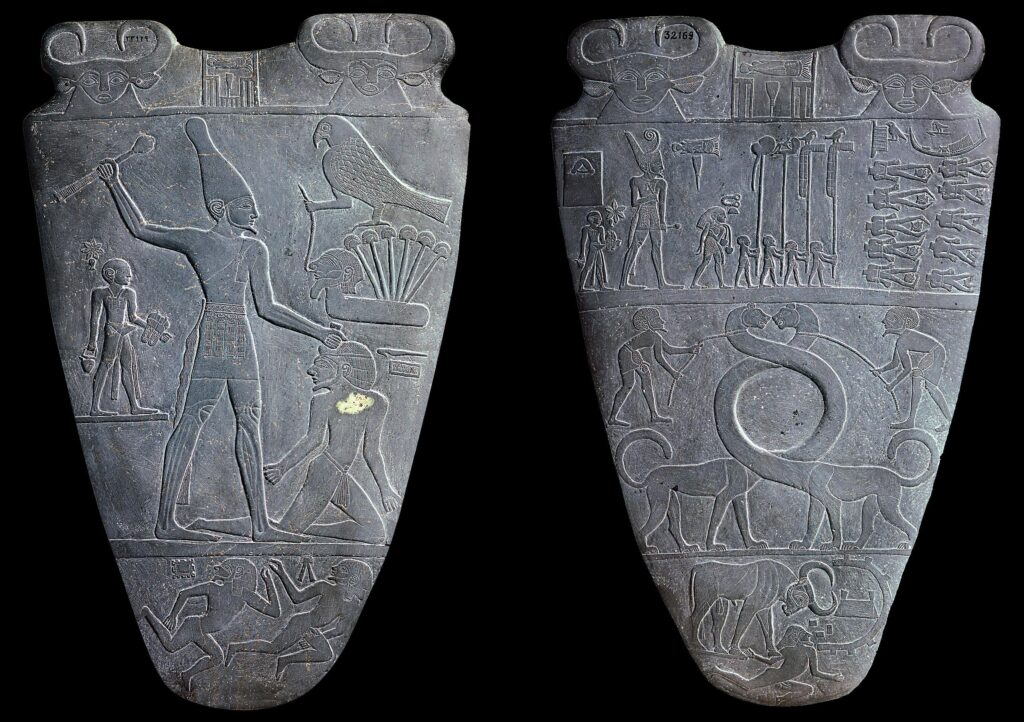
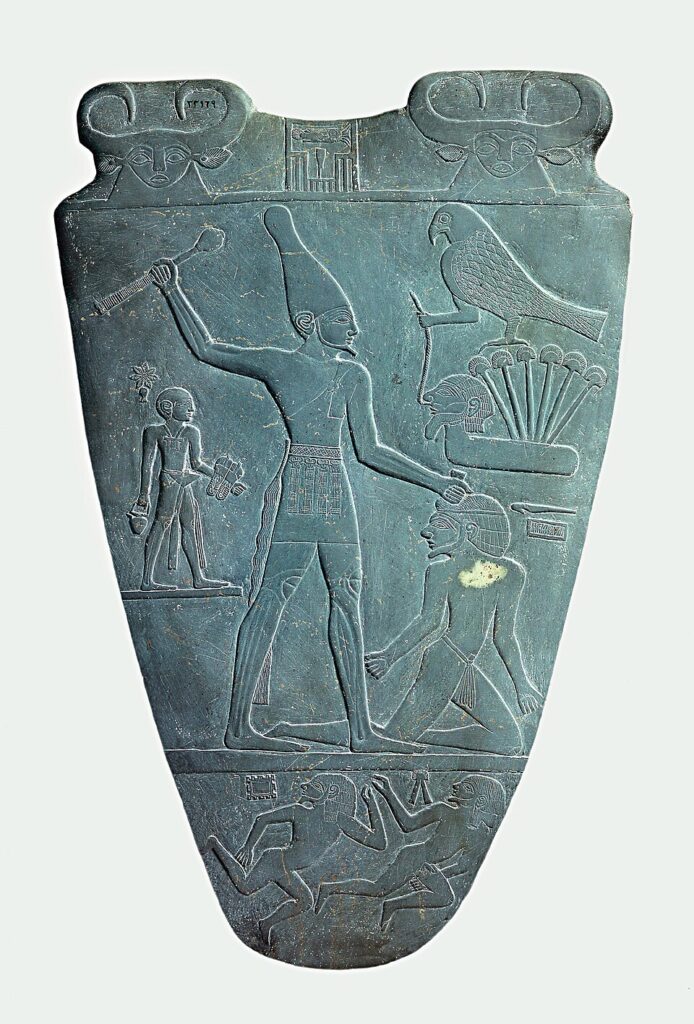
Ancient Egyptian art frequently shows kings raising a mace over defeated enemies, making ritual execution by mace an obvious possibility to consider. The Abydos skulls, however, do not closely match the injuries that heavy stone maces normally produce.
Experimental studies show that such weapons usually create depressed fractures because their curved, heavy heads concentrate force in a relatively small area. Most of the Abydos injuries instead take the form of linear fractures, which fit better with blows from broad, relatively flat objects made from lighter materials such as wood or antler.
Accidental falls can also produce linear fractures, so the study does not treat every injury as proof of execution. Campbell nevertheless notes that it would be unusual for so many individuals in a relatively small sample to suffer comparable severe head injuries by accident.
Forensic research also gives the location of the injuries some significance. Fractures above the so-called hat-brim line occur more often with intentional blows than with ordinary falls, adding another piece of evidence that some of the violence may have been deliberate.
A stronger case for sacrifice, but not a solved mystery
The findings do not prove that all 46 people were executed, and they do not show that all 18 injured individuals died directly from their head wounds. “Perimortem” describes trauma that occurred close to death, which can include a period shortly before death as well as some time afterward.
The surviving skulls also represent only about 5 to 15 percent of the original burial populations from these funerary enclosures. Most of the rest of the skeletons no longer survive as complete, identifiable individuals, which prevents researchers from checking for injuries elsewhere on the body or determining how people without skull trauma died.
Some individuals may have died naturally, while others could have died through methods such as strangulation or suffocation that left little evidence on the skull. The incomplete collection therefore makes any single explanation for every burial impossible.
Even so, the new analysis changes the balance of a century-old debate. Petrie suspected that these people had died as retainers for Egypt’s earliest rulers but lacked the physical evidence to demonstrate violence; modern forensic analysis now shows that many of them did suffer serious trauma around the time of death.
Campbell’s conclusion remains deliberately cautious. Petrie’s broader idea about retainer sacrifice may have been correct, but the evidence suggests that the deaths and funerary rituals surrounding Egypt’s first rulers were more varied and complex than early archaeologists imagined.
The evidence still cannot explain every death around the royal enclosures, but it makes one point increasingly difficult to dismiss: violence formed part of the funerary world surrounding at least some of Egypt’s earliest rulers. What Petrie could only suspect a century ago can now be tested against physical evidence preserved in the bones themselves.
Campbell RA (2026) New data from old bones: using bioarchaeology and forensics to reassess legacy data from ancient Abydos, Egypt. Front. Environ. Archaeol. 5:1858940. doi: 10.3389/fearc.2026.1858940
