
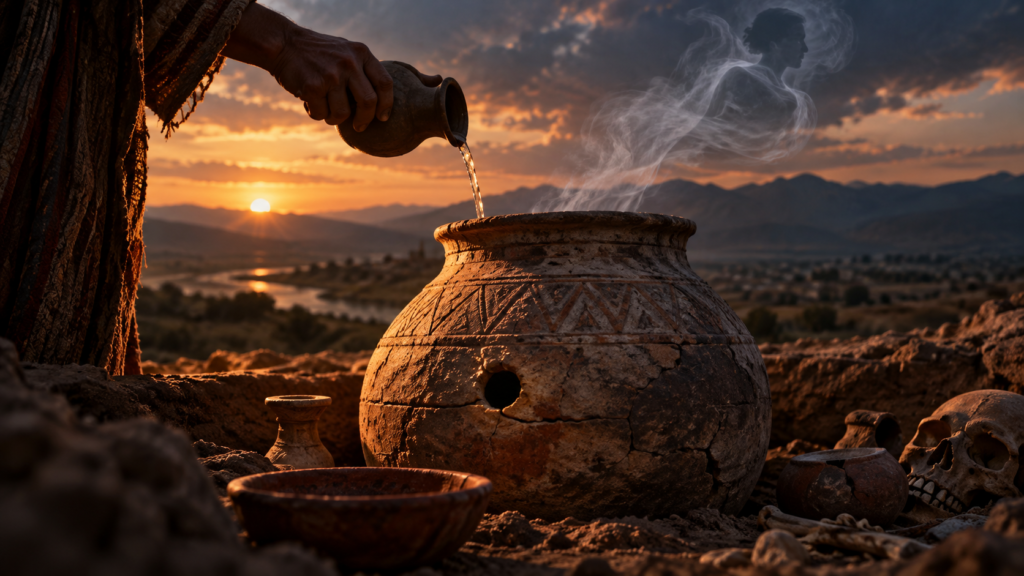
In ancient Anatolia, even death did not always end a person’s need for food, water, or a way into the afterlife. Small holes deliberately pierced into burial vessels may hold clues to how ancient societies cared for their dead—and feared what might happen if they did not.
At ancient cemeteries across Anatolia, archaeologists have encountered burial pots with an unusual feature: someone had deliberately pierced their walls or bases. Some contained cremated human remains, while others belonged to graves in which the body had been buried intact. The holes appear in different regions and periods, raising a question that the vessels themselves cannot answer: what did people expect these small openings to accomplish?
Archaeologists have offered several explanations since the late nineteenth century. The openings have been described as soul holes, passages for offerings to the dead, or deliberate damage intended to remove a vessel from everyday use. In a study published in Arkeoloji Dergisi, researcher Ayşegül Erden Güney revisits these competing interpretations through archaeological evidence from Anatolia and neighboring regions, together with ancient written accounts of death and the afterlife.
Her central argument is that the meaning of a perforation depended partly on the burial practice in which it appeared. The difference between placing an intact body in a grave and collecting its remains after cremation may have shaped how communities understood the relationship between the vessel, the deceased, and the soul.
A Funeral Practice Older Than the Hittite Kingdom
Among the earliest Anatolian examples are cremation vessels from Gedikli-Karahöyük in southeastern Türkiye, dating to the Early Bronze Age. Archaeologists found deliberate holes in the bases and bodies of some urns, but the containers themselves were not specially manufactured funerary objects. People reused ordinary pottery, including vessels that had already been damaged, to hold the remains of their dead.
The practice also appears during the second millennium BCE at Ilıca in western Anatolia and Boğazköy-Osmankayası near the Hittite capital of Hattusa. At Ilıca, the openings occur on the shoulders or bodies of vessels rather than consistently in one position. The variety of containers and the deliberate placement of the holes indicate that this was not simply a feature of a particular pottery type.
Perforations were not confined to cremation urns. At Troy, Alaca Höyük, Ahlatlıbel, Kalınkaya, and Doğantepe, archaeologists documented similar modifications on vessels associated with inhumation burials. Examples from Kültepe and Maşat Höyük extend the evidence into later Anatolian funerary contexts.
The different burial settings are essential to the discussion because the same physical alteration could accompany very different treatment of the dead. To understand why such openings mattered, Erden Güney examines what ancient people believed happened after burial.
When the Dead Still Needed Food and Water
In ancient Mesopotamia, death did not necessarily end a person’s dependence on family. Sumerian literary texts portrayed the underworld as a dark and dusty place where food and water were scarcely fit for consumption. The spirits of the deceased, known as gidim in Sumerian and eṭemmu in Akkadian, could remain dependent on offerings prepared by their living relatives.
These obligations extended beyond the funeral itself. Families were expected to provide food and drink and to maintain rituals commemorating the dead, while neglected spirits were believed capable of returning to trouble the living. The study notes that texts from the Third Dynasty of Ur record three daily offerings for deceased kings, although the frequency of such provisions for ordinary people remains uncertain.
Archaeological discoveries show how some communities arranged for liquids to reach burial spaces. Clay pipes associated with offerings have been documented at Ur and Tell Agrab, while administrative records from Mari mention milk, beer, and water presented through ritual pipes. At Ugarit, installations carried liquids from ground level toward burial chambers or receptacles beside them.
A particularly revealing example appears in the Sumerian composition Lulil and His Sister. Among the instructions concerning the deceased is a direction to pour water through a libation pipe into the dust of the underworld. Such accounts help explain why a community might have considered an opening in a funerary vessel meaningful: caring for the dead could require maintaining a physical connection with the burial place.
Erden Güney therefore interprets some perforations associated with inhumation graves as possible channels for offerings. The interpretation fits wider Mesopotamian practices, although the surviving evidence does not establish that every pierced vessel was used to deliver food or drink.
Fire, the Soul, and the Hittite Afterlife
Cremation presented ancient societies with a different concern: what became of the deceased when fire consumed the body? A Sumerian narrative associated with Gilgamesh and Enkidu offers an unusual glimpse into this question. When Gilgamesh asks about someone whose body was consumed by fire, Enkidu explains that he did not encounter the person’s spirit in the underworld; the smoke had risen into the sky.
The passage forms part of Erden Güney’s discussion of attitudes toward cremation in Mesopotamian religious thought. It indicates that burning the body could be associated with a fate different from the expected journey to the underworld. The text cannot establish what every Mesopotamian community believed, but it illustrates the importance attached to the physical treatment of the dead.
Hittite royal funerals present a different understanding of fire. Hittite texts describe deceased kings and queens with an expression commonly translated as “became a god,” and cremation formed part of royal funeral ceremonies. Fire belonged to a ritual process associated with purification and transformation, rather than necessarily preventing the soul from reaching its destination.
The distinction between royalty and ordinary people also mattered. Royal death carried a particular religious status, while Hittite descriptions of ordinary people going to the “dark earth” point toward another understanding of the afterlife. These traditions provide cultural context for the possibility that holes in cremation vessels symbolized something other than the delivery of offerings.
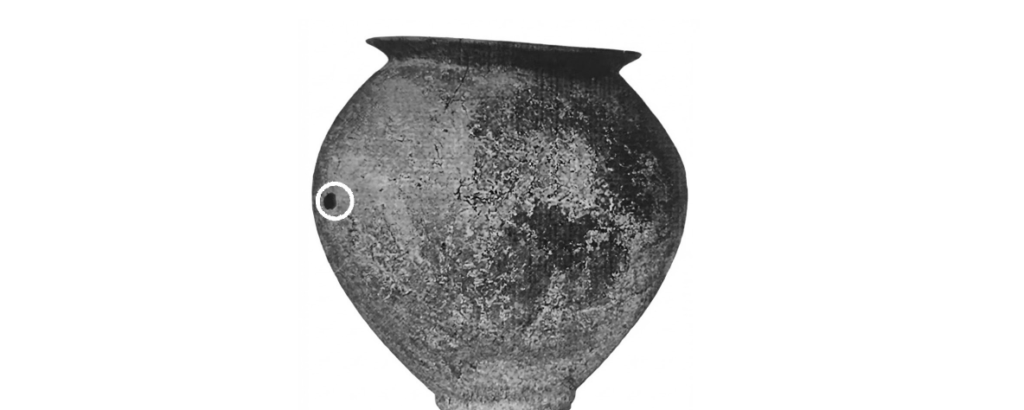
Perforated burial urn discovered at Van-Altıntepe in eastern Türkiye, dating to the Urartian period. Credit: Yiğitpaşa (2010, Fig. 2a), reproduced in Erden Güney, Arkeoloji Dergisi (2026),
The Strange Holes in Urartian Urns
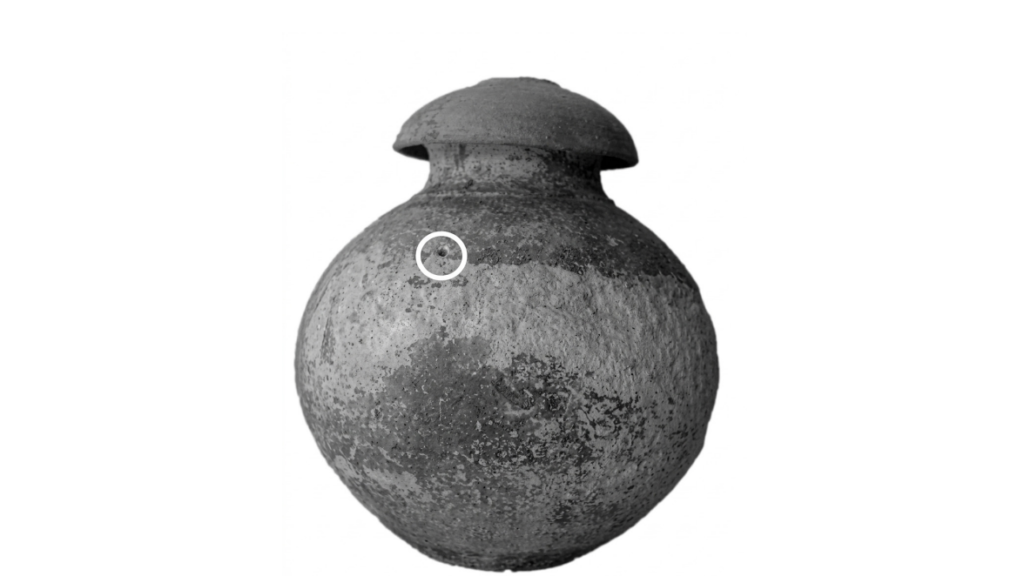
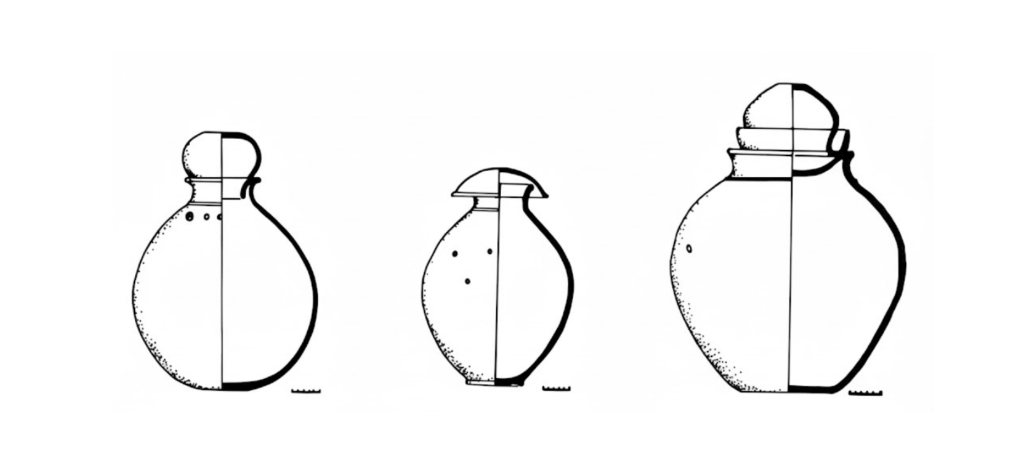
The kingdom of Urartu, which flourished in eastern Anatolia during the first millennium BCE, provides particularly useful archaeological examples. At Ayanis, Van-Altıntepe, and Dilkaya, researchers documented cremation urns with one or several deliberate perforations. The modifications occur on ceramic vessels and, in some cases, metal urns, including a well-preserved example associated with Altıntepe.
Their number and arrangement have inspired competing theories. Archaeologist Taner Tarhan proposed that certain patterns identified men, women who had given birth, women who had not, or siblings placed in the same urn. Erden Güney questions these identifications, arguing that the available archaeological, anthropological, and written evidence does not adequately support such precise associations.
She instead considers the openings in relation to the transformation of the body through cremation. Under this interpretation, the holes symbolized an exit through which the soul could leave the urn and continue its journey beyond the grave. This differs from the possible role of openings in inhumation burials, where families sought to bring offerings toward the deceased.
The Urartian examples are central to the argument, but there is an important limitation. No surviving text from these burial contexts directly explains why the urns were pierced. Their possible connection with the soul’s departure rests on the interpretation of funerary practices rather than direct written testimony.
Similar Holes, Different Traditions
The custom was not restricted to Anatolia. Ancient Egyptian burial contexts also contain vessels that people deliberately damaged or pierced, including finds from Matmar and the royal cemetery of Umm el-Qaab at Abydos. Some scholars understand these actions as the ritual “killing” of objects, removing them from everyday use and assigning them a new role within funerary ceremonies.
Egyptian funerary traditions also included the deliberate breaking of red vessels, a practice associated with the symbolic destruction of enemies or harmful forces. Researchers have debated possible connections between that ritual and perforated pottery, although the two cannot automatically be equated.
Across Central Europe, Bronze Age communities likewise buried cremated remains in vessels with deliberately made openings. Archaeological literature sometimes uses the German term Seelenloch, meaning “soul hole,” for these modifications. At the Moravičany cemetery, associated with the Lusatian cultural tradition, perforated vessels also appeared in graves without human remains, including contexts interpreted as symbolic burials.
These examples show why the term soul hole cannot by itself explain the practice. Similar physical modifications appear in different religious and funerary settings, and the surviving evidence does not establish a common origin or meaning for all of them.
What a Hole Can Tell Us About Death
Erden Güney’s research brings an important distinction into the discussion of ancient burial vessels. A perforation associated with an intact body may have served a different ritual purpose from one made in a container for cremated remains, even if the objects look similar today. The interpretations proposed in the study depend on archaeological context, comparisons with other funerary installations, and written descriptions of the afterlife.
The research does not present a new excavation or a definitive explanation for every perforated vessel. Instead, it examines how a seemingly modest alteration to an ordinary object might have belonged to a much larger set of beliefs and obligations. Whether intended to receive offerings, mark a ritual change, or symbolize a passage for the soul, these openings belonged to ceremonies through which ancient communities confronted what death meant for both the departed and the people who remained.
Erden Güney, A. (2026). Anadolu ölü gömme geleneklerinde mezar kabı üzerine delik açma uygulaması: Arkeolojik ve metinsel bir değerlendirme. Arkeoloji Dergisi, 37, 37–49. https://doi.org/10.51493/egearkeoloji.1887353
