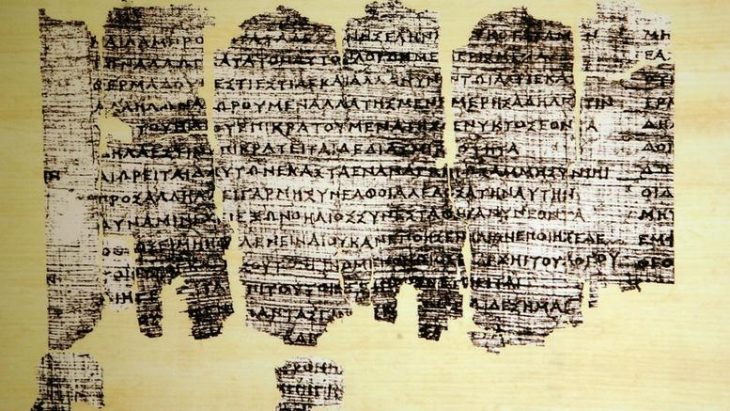
A fragile papyrus fragment, long overlooked in a Cairo archive, has yielded one of the most significant textual discoveries in recent classical scholarship: thirty previously unknown verses by the pre-Socratic philosopher Empedocles.
The manuscript, dating to roughly the 1st century BCE, offers a rare and direct glimpse into a thinker whose ideas have shaped Western philosophy—but whose original words have largely been lost for over two millennia.
A Forgotten Manuscript in Cairo
The breakthrough emerged not from excavation trenches, but from the quiet shelves of the French Institute of Oriental Archaeology (IFAO) in Cairo.
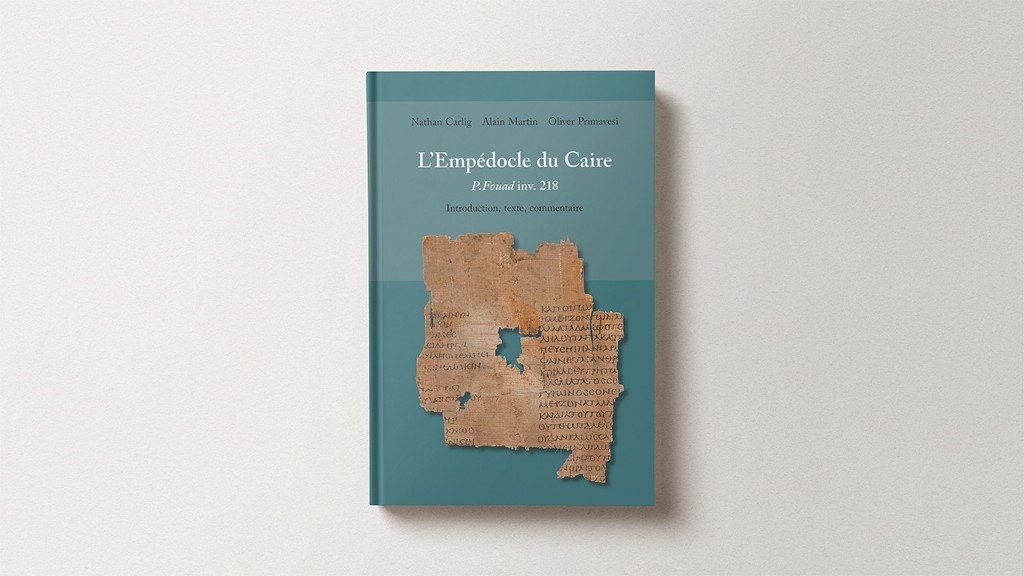
Nathan Carlig, a papyrologist at the University of Liège, identified the fragment—catalogued as P. Fouad inv. 218—as part of Physica, a major philosophical poem by Empedocles of Akragas (modern Agrigento, Sicily).
Until now, Physica was known almost entirely through indirect transmission: quotations, paraphrases, and scattered references preserved in later authors such as Plato, Aristotle, and Plutarch.
📣 Our WhatsApp channel is now LIVE! Stay up-to-date with the latest news and updates, just click here to follow us on WhatsApp and never miss a thing!!
This papyrus changes that dynamic. For the first time, scholars can read Empedocles in his own voice, without the distortions or reinterpretations introduced by centuries of intermediaries.
What the Newly Discovered Verses Reveal
The newly uncovered lines focus on one of Empedocles’ most intriguing intellectual concerns: how humans perceive the world.
The text elaborates on his theory of effluvia—tiny particles emitted by objects that interact with the senses, particularly vision. This early attempt to explain perception anticipates later scientific thinking and places Empedocles closer to the origins of natural philosophy than previously understood.
Even more striking are the intertextual connections revealed through analysis. The verses appear to illuminate:
A passage in Plutarch
Elements of a Platonic dialogue
A text by Theophrastus, Aristotle’s successor
Researchers also detected subtle echoes of Empedoclean ideas in the works of Aristophanes and the Roman poet-philosopher Lucretius, suggesting a wider and more sustained intellectual influence than previously documented.
A Precursor to Atomism?
The findings strengthen a long-debated hypothesis: that Empedocles may have laid conceptual groundwork for later atomist philosophers such as Democritus.
While he did not formulate atomism in its classical sense, his vision of matter composed of interacting particles—and governed by forces like Love and Strife—resonates strongly with later Greek theories of atomic structure.
This positions Empedocles not just as a poetic philosopher, but as a critical bridge between mythological cosmology and scientific reasoning.
A “Second Renaissance” of Ancient Texts
Scholars involved in the study describe the discovery in unusually vivid terms. They compare it to uncovering lost pages of a canonical modern author—an event that would fundamentally reshape literary understanding.
The analogy is deliberate: imagine reconstructing Victor Hugo from fragments, then suddenly finding original pages of Les Misérables. That is the scale of what this papyrus represents for specialists in early Greek philosophy.
Carlig and his colleagues frame the find within a broader scholarly movement often described as a “second Renaissance” of ancient literature—a renewed effort, driven by papyrology, to recover texts thought lost forever.
Reframing Empedocles’ Place in Intellectual History
Beyond its immediate philological value, the papyrus reshapes how Empedocles is situated within the intellectual history of antiquity.
It clarifies his relationship to both predecessors and successors, strengthens links between philosophical traditions, and offers a more coherent picture of how early Greek thinkers approached questions of matter, perception, and reality.
At a time when interdisciplinary research increasingly connects philosophy, physics, and cognitive science, these verses provide a rare opportunity: to revisit foundational ideas at their source, rather than through centuries of interpretation.
Publication and Ongoing Research
The newly discovered verses have been edited, translated, and analyzed in detail in the volume L’Empédocle du Caire, prepared by Nathan Carlig, Alain Martin, and Olivier Primavesi.
As further study continues, scholars expect additional insights—not only into Empedocles himself, but into the broader transmission of knowledge across the ancient Mediterranean world.
Cover Image Credit: AI-generated illustrative image depicting an ancient papyrus manuscript; not an actual artifact or specific historical document.