
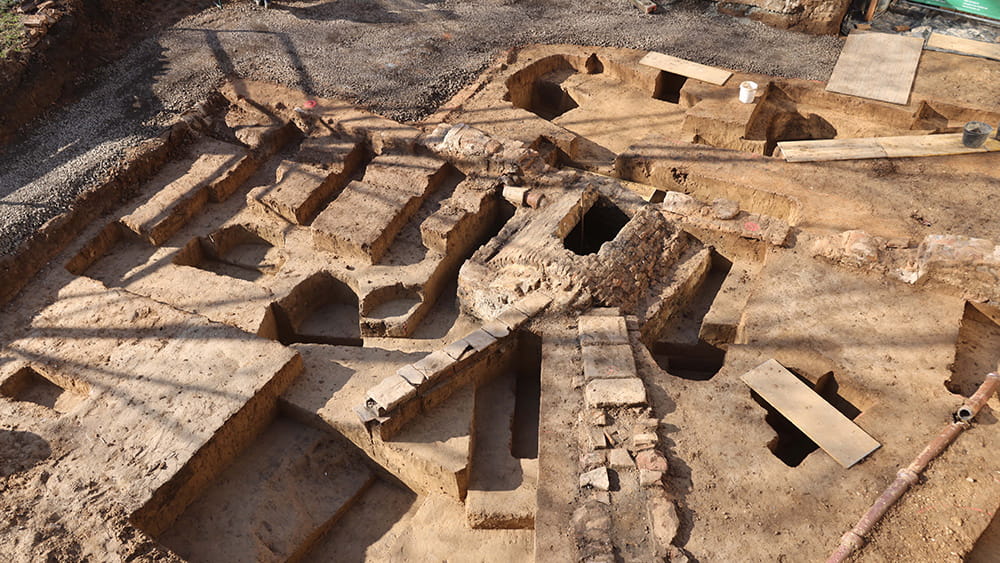
A remarkable archaeological discovery in Frankfurt am Main is shedding new light on the region’s earliest interaction with the Roman Empire. During renovation work at the historic Bolongaropalast in the district of Höchst, archaeologists uncovered the remains of what is now believed to be the earliest Roman military camp in the city.
The excavation, carried out in the adjacent palace garden, revealed a rare and exceptionally well-preserved early Roman site dating back to around the year 0. According to city officials, the findings represent a significant milestone not only for Frankfurt’s local history but also for understanding Roman expansion into Germania under Augustus.
Unique Archaeological Finds Beneath the Palace Garden
The excavation team from Frankfurt’s heritage preservation department discovered a wide range of artifacts that offer valuable insight into the structure and daily life of early Roman military camps. Among the most notable finds are luxury goods such as coins originating from modern-day France and Belgium, as well as fine South Gaulish ceramics.
These objects suggest that the site was not a temporary encampment but rather a strategically important settlement with connections to broader Roman trade networks. The presence of imported goods highlights the integration of the camp into the economic and logistical systems of the Roman Empire.
Mayor Mike Josef emphasized the importance of the discovery, describing it as “a unique testimony of early Roman history in Höchst.” He noted that the site provides crucial evidence for tracing the expansion and development of Roman influence in the region, while also enriching the historical narrative of Frankfurt itself.
A Rare Glimpse into Early Roman Expansion
Early Roman camps from this period are notoriously difficult to identify archaeologically. They were often used only briefly and left behind minimal material evidence. However, the Höchst site stands out as an exception. Archaeologists believe the Romans occupied this location for several years, making it one of the few well-documented early military installations in the area.
Its strategic position played a key role in its selection. Located near the confluence of the Nidda and Main rivers, the camp offered excellent access to waterways, elevated terrain for surveillance, and connections to established transport routes. These advantages made it an ideal base for Roman operations in the region.
The camp likely housed both legionaries and auxiliary troops—meaning it included Roman citizens as well as soldiers from allied tribes and non-citizen populations. This diverse composition reflects the broader structure of the Roman military during its expansion into Germania.
Rethinking Roman-Germanic Relations
One of the most intriguing aspects of the excavation is what it reveals about interactions between Romans and local populations. Contrary to the traditional image shaped by stories like Asterix or historical events such as the Battle of the Teutoburg Forest, the findings suggest a more complex and potentially peaceful relationship.
According to Andrea Hampel, head of Frankfurt’s heritage department, there is no evidence of violent conflict or destruction at the site. Instead, the discovery of local ceramics and dietary traces points to cooperation and cultural exchange between Romans and indigenous communities.
This challenges long-held assumptions about the nature of early Roman contact in the region and suggests that the initial encounters may have been characterized more by curiosity and interaction than by warfare.
Years of Careful Excavation
The excavation is part of a long-term project that began in 2016, accompanying the restoration of the Bolongaropalast and its gardens. Due to the dense urban development in Höchst, opportunities for large-scale archaeological investigations are rare, making this discovery particularly significant.
The project is being led by archaeologist Elke Sichert, along with excavation specialists Denis Neumann and Rolf Skrypzak. Their work combines modern scientific methods with careful preservation techniques to ensure that the site’s historical value is fully documented.
Frankfurt’s Roman Past Comes to Light
Although Frankfurt is better known for its medieval and modern history, this discovery highlights its much deeper past. The area was part of the frontier zone of the Roman Empire, which extended into parts of present-day Germany before stabilizing along the Limes frontier.
The Höchst findings provide tangible evidence that Roman influence reached further into the region than previously documented. They also contribute to a growing body of research that is reshaping our understanding of early Roman presence in central Europe.
As excavation work continues, experts expect further discoveries that could offer even more insights into this formative period. For now, the Roman camp beneath the Bolongaropalast stands as a powerful reminder that even in a modern metropolis like Frankfurt, traces of ancient civilizations still lie just beneath the surface.
Cover Image Credit: The excavation site at Bolongaropalast. City of Frankfurt am Main, Maik Reuß
