

A rare Viking Age burial in western Denmark is preserving something archaeologists almost never get to see: traces of the clothes worn by a young person some 1,300 years ago, still caught between the metal ornaments that once held them in place.
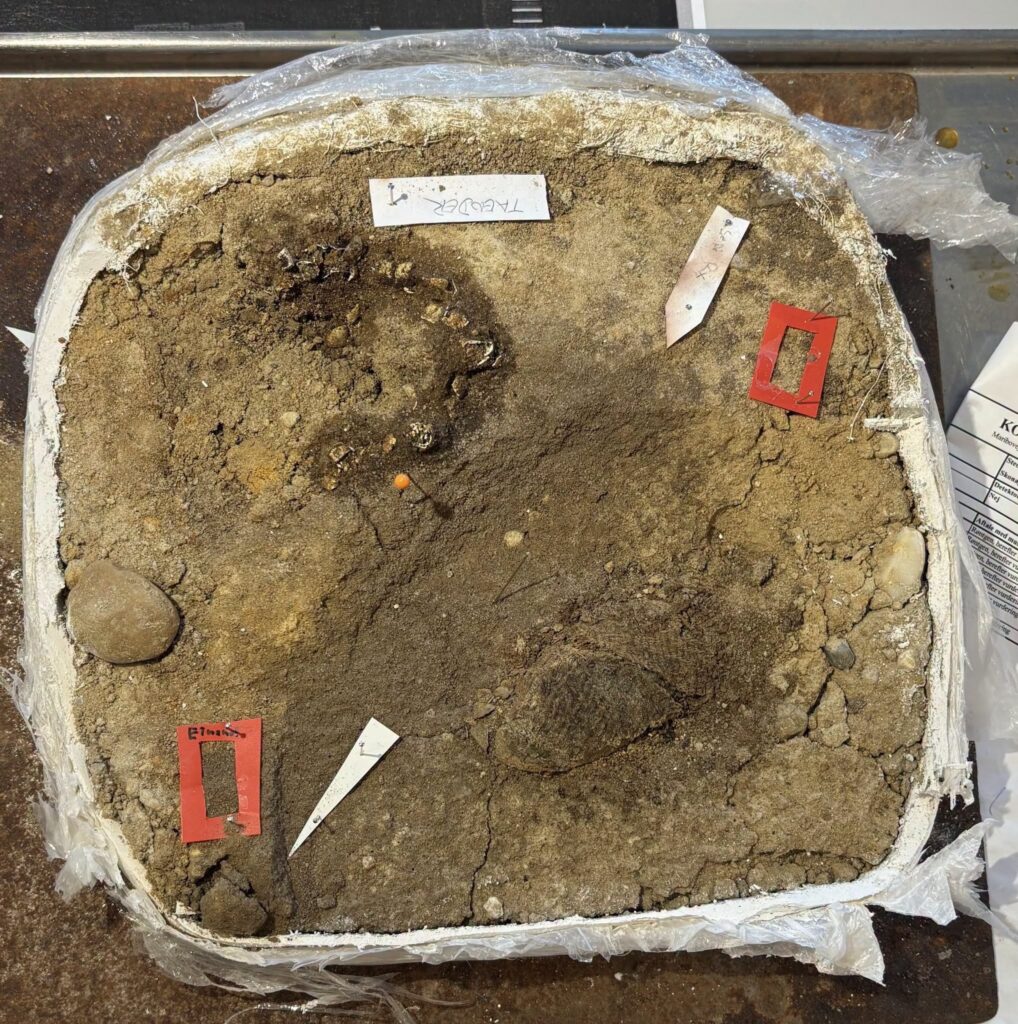
The grave was uncovered at Skonager (ARV 661), near Varde in West Jutland, where archaeologists discovered a Viking Age cemetery in 2024. Among the burials was a child laid to rest with two shell-shaped brooches. Wool and linen survived against the metal, while fragments of fabric remain on both the upper and lower surfaces of the brooches.
That unusual preservation means researchers may be able to do much more than identify a few ancient fibres. The position of the textiles could reveal how several layers of clothing were arranged on the body, from the garment worn closest to the skin to the clothing fastened above it.
Teeth have also survived, while one of the brooches shows evidence of an ancient repair. Radiocarbon dating, textile analysis and dye studies are now being brought together to answer questions that rarely survive with a Viking burial: what the girl wore, what colours surrounded her, and whether one of the ornaments she was buried with was already old when she received it.
The graves changed what was known about Viking Skonager
Skonager was already an important archaeological site before the graves appeared.
Preliminary investigations connected with the ARV 661 excavation had identified occupation extending across several periods, including the Bronze Age, Pre-Roman Iron Age, Germanic Iron Age and Viking Age. Archaeologists also recorded graves, roads and areas associated with craft and other activities.
The 2024 excavation added an entirely different type of evidence: the dead themselves.
When Christina Wølch Jensen and Line Lerke of Arkæologi Vestjylland–Vardemuseerne presented the discoveries in 2025, they described them as the first Viking Age human burials found in Varde Municipality since 1988.
The cemetery was not limited to a single age group. The graves included infants, children, young people and adults, providing a cross-section of the population rather than the burial of one exceptional individual.
Iron knives, amber beads and glass beads were among the objects recovered. But one child burial was different.
Its two shell-shaped brooches had protected tiny portions of the clothing from the destructive effects of more than a millennium underground.
Two brooches may preserve several layers of clothing
Metal objects can create small preservation zones around themselves. As they corrode, metal salts can penetrate adjacent organic materials and slow their destruction or preserve their microscopic structure.
At Skonager, that process saved pieces of fabric that would otherwise have vanished.
Early examination identified wool and linen, two materials widely used in Scandinavian clothing. More important, however, is where the fabrics survived. Textiles are present both above and beneath the two brooches.
This gives researchers a chance to examine the relationship between different fabrics rather than studying an isolated fragment with little information about how it was worn.
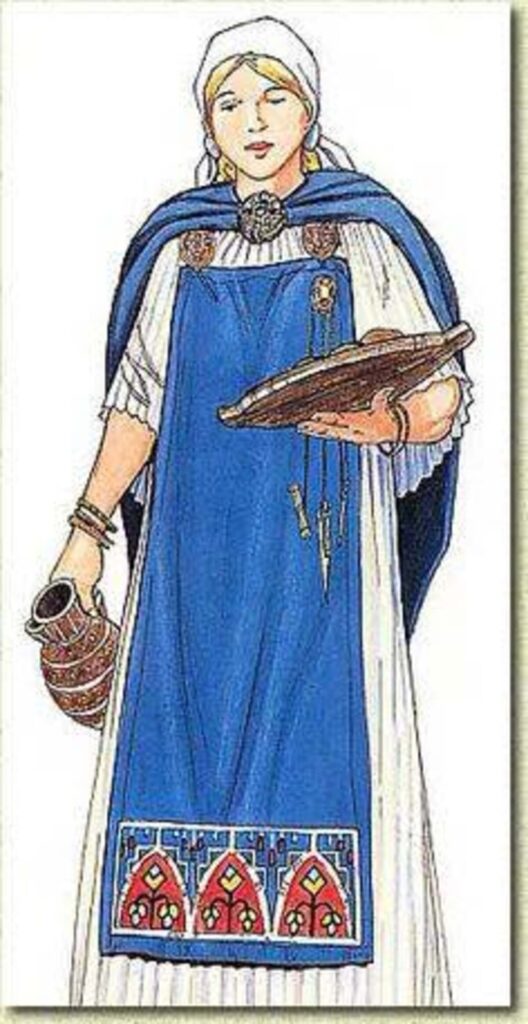
Shell-shaped brooches — also known as oval or bowl brooches — are closely associated with female dress in Viking Age Scandinavia. They are frequently shown in modern reconstructions fastening the straps of an outer garment over an underdress. Archaeological reality was more complicated.
Clothing varied across time and place, and most Viking garments have had to be reconstructed from extremely small fragments preserved beside jewellery. Evidence showing exactly how one layer sat in relation to another can therefore change how an entire costume is interpreted.
The Skonager burial offers that possibility for a part of western Denmark where Viking graves themselves are unusually scarce.
Conservators are excavating the burial grain by grain
Because the surviving textiles are so fragile, much of the investigation is now taking place away from the excavation trench.
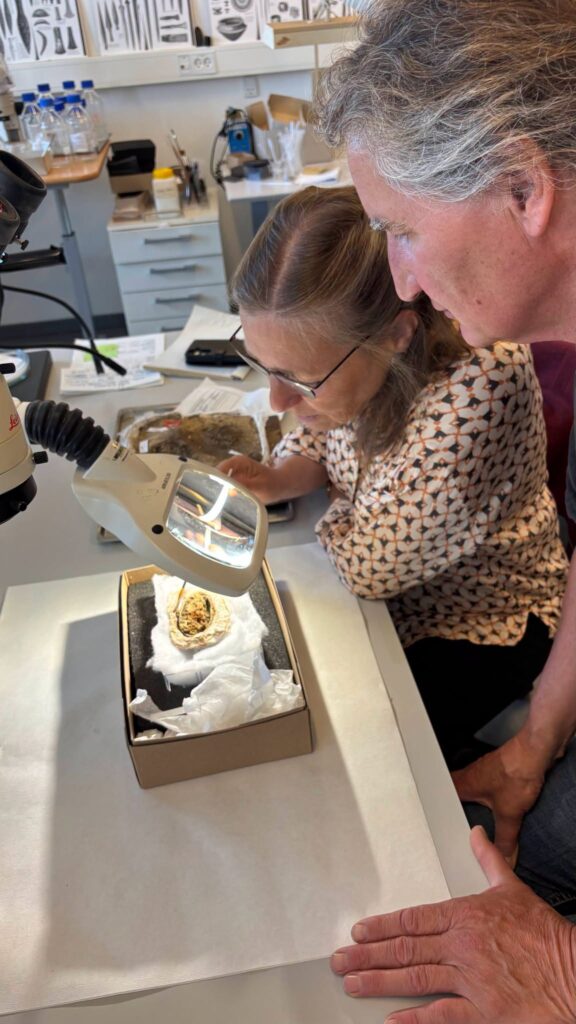
At Konserveringscenter Vejle, specialists are carefully working through the block containing the finds and surrounding soil, removing sediment grain by grain rather than simply extracting the brooches.
Textile specialist Lise Ræder Knudsen is analysing the fabric remains. The preserved teeth are being examined by ADBOU, the Unit of Anthropology at the University of Southern Denmark.
The careful excavation matters because a loose thread or a tiny patch of fabric may retain information that disappears as soon as the object is separated from its archaeological position.
Researchers want to know not only whether a fragment is wool or linen, but which textile lay above another, how it contacted the brooch and whether different fragments belonged to separate garments.
Piece by piece, those relationships could eventually turn scattered fibres into a recognizable sequence of clothing.
Was one brooch an heirloom?
One of the shell-shaped brooches introduces another possibility. It had been repaired.
The repair shows that the ornament had already experienced a period of use before it entered the grave. What archaeologists do not yet know is how long that period lasted.
Samples from the textiles are therefore expected to undergo radiocarbon dating. A more precise date for the clothing can then be compared with the archaeological chronology of the jewellery.
If the dates diverge significantly, the repaired brooch may have been substantially older than the clothes with which it was buried. It could have been an heirloom.
That interpretation remains unproven. A repaired brooch might simply have been worn and maintained for years by the same owner. But the combination of datable textiles and a visibly repaired object gives researchers an unusual opportunity to investigate the biography of a piece of Viking jewellery rather than treating it simply as a grave good.
What colour were the girl’s clothes?
The investigation may eventually add another element that is usually missing from Viking Age reconstructions: colour.
The Skonager textiles are being studied in connection with Textile Colours of the Viking Age, a research project involving Ulla Mannering and Charlotte Rimstad.
Modern chemical analyses of Scandinavian textiles have increasingly challenged the familiar image of Viking clothing as a world dominated by untreated browns and greys.
Danish Viking Age material has produced evidence of deliberately dyed fabrics, including blues and reds, while some high-status textiles contained less common colourants.
No colour has yet been established for the Skonager clothing.
If traces of ancient dyes remain in the fibres, however, researchers may eventually be able to reconstruct not only the structure of the garments but part of their original appearance.
Reconstructing one life from what survived
The project is supported by the Agnes Geijer Foundation for Nordic Textile Research, named after Swedish textile historian and archaeologist Agnes Geijer, a pioneer in the study of archaeological fabrics and Viking Age dress.
Geijer was herself deeply involved in understanding how shell-shaped brooches related to Scandinavian clothing.
At Skonager, researchers are returning to much the same problem with tools unavailable to earlier generations: microscopic textile analysis, modern conservation, radiocarbon dating, anthropology and chemical investigation of dyes.
The result may never be an intact Viking dress laid out on a laboratory table.
What survives is much smaller: fragments of wool and linen, two brooches, teeth and the traces left by the way objects touched one another in the grave.
Together, however, they may be enough to move beyond a generic reconstruction of “Viking clothing” and recover something far more specific: how one young person in West Jutland was dressed when she was buried around 1,300 years ago.
Sources : Arkæologi Vestjylland
