
For centuries, stories of a magnificent city swallowed by the Arabian desert have fascinated travelers and explorers. In the 1990s, satellite technology led archaeologists to an ancient settlement in Oman, reviving the legend of Ubar, the Atlantis of the Sands, while raising questions that archaeology has yet to resolve.
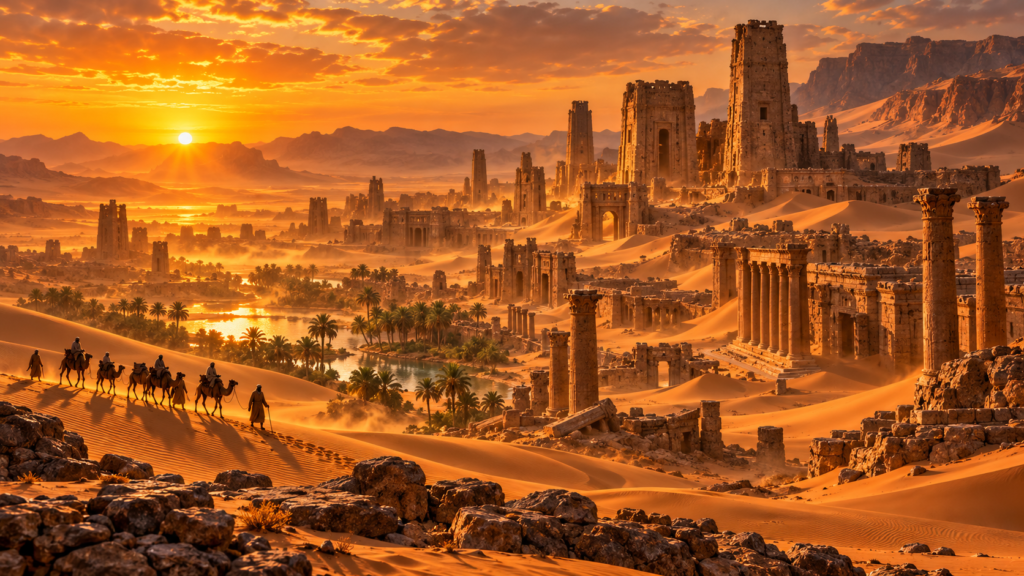
Somewhere beneath the vast sands of southern Arabia, legend places a city of extraordinary wealth, towering columns and magnificent palaces. Caravans reportedly carried precious frankincense through its gates, enriching its inhabitants until the city vanished from the world. Its disappearance became one of the Arabian Peninsula’s most enduring mysteries, inspiring generations of travelers to search for a place that might never have existed as the stories described it.
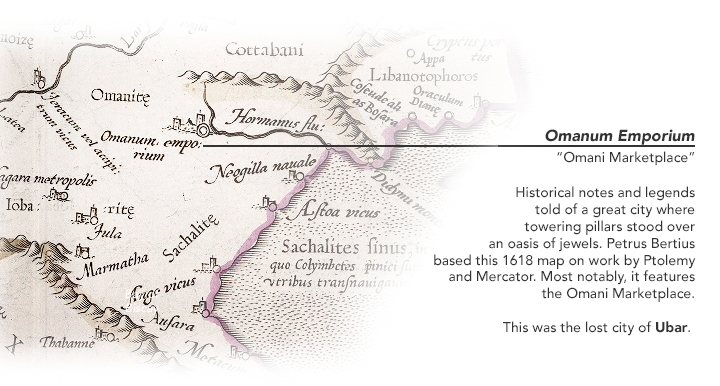
Known as Ubar and often associated with the legendary city of Iram, this lost metropolis eventually acquired a memorable nickname: the Atlantis of the Sands. In 1992, an international expedition announced that it had found the remains of the long-sought city in Oman. The announcement captured worldwide attention, but the archaeological evidence would eventually tell a more complicated story.
The Legendary City of a Thousand Columns
The origins of Ubar’s legend lie in a mixture of religious traditions, medieval Arabic literature, and stories passed down through generations. The Quran describes Iram, associated with the people of ‘Ad, as a place or community distinguished by its pillars. The passage in Surah Al-Fajr helped inspire later accounts of an extraordinary civilization whose power and grandeur surpassed those of its neighbors.
Yet the Quran does not explicitly identify Iram as Ubar, nor does it provide the location of a magnificent city buried beneath the desert. Those connections emerged through later interpretations and storytelling, gradually transforming separate traditions into a single tale of a lost Arabian metropolis.
One particularly elaborate legend tells of Shaddad ibn ‘Ad, a ruler who sought to create an earthly paradise. According to medieval accounts, he commanded the construction of a magnificent city filled with golden palaces, precious stones, and towering columns. His ambition, however, brought divine punishment, and the splendid city disappeared before its inhabitants could enjoy its promised wonders.
These accounts belong to religious interpretation and legend rather than established historical fact. Nevertheless, their vivid descriptions encouraged generations of explorers to imagine that somewhere in the Arabian desert lay the ruins of a wealthy civilization.
The comparison with Atlantis strengthened that fascination. Like Plato’s legendary island, Ubar represented a place of extraordinary prosperity that supposedly vanished through catastrophe, leaving behind a mystery that later generations struggled to explain.
The Desert That Once Carried Fortunes
Behind the legend lies a genuine history of wealth and long-distance trade. For centuries, southern Arabia supplied frankincense, an aromatic resin obtained from Boswellia trees, to markets across the ancient world. Religious communities burned it during ceremonies, while merchants transported it to the Mediterranean, Mesopotamia, and beyond.
The trade depended on a network of ports, caravan routes, and desert watering places. Merchants crossing difficult terrain needed reliable wells where their animals could drink, and travelers could replenish supplies. Settlements controlling these sources of water could become important commercial stations, even without developing into enormous cities.
The Rub’ al Khali, commonly known as the Empty Quarter, appears almost impassable today. Yet its margins once formed part of a much wider trading landscape that connected the Arabian interior with coastal markets.
In southern Oman, the frankincense-producing region of Dhofar played a central role in this exchange. The ancient ports of Khor Rori and Al-Baleed connected inland trading routes with maritime networks, while caravan oases provided essential stopping points farther into the desert.
UNESCO now recognizes these locations as part of the Land of Frankincense World Heritage property. Among them stands Shisr, a fortified oasis that would become central to the modern search for Ubar.
Searching for a Lost City from Space
The modern search for Ubar took an unusual turn in the early 1980s, when filmmaker Nicholas Clapp approached NASA’s Jet Propulsion Laboratory with a proposal to investigate the Arabian desert using satellite technology.
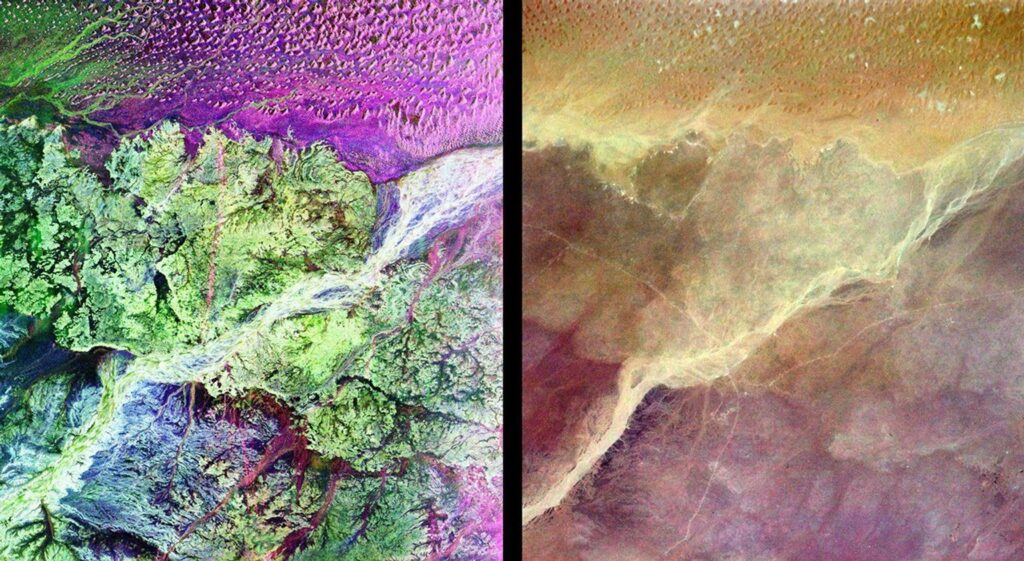
Clapp believed that traces of ancient caravan routes might survive beneath or between the dunes. If researchers could identify where several routes converged, they might locate an important trading settlement associated with the legendary city.
NASA specialists, including geologist Ronald Blom, examined radar data from the space shuttle alongside Landsat and SPOT satellite images. Computer enhancement helped reveal old tracks, some disappearing beneath substantial sand dunes, suggesting that they predated parts of the modern desert landscape.
The technology did not reveal an intact buried city. Instead, it allowed researchers to identify possible ancient routes across an enormous region that would have been difficult to survey entirely on foot.
The satellite evidence guided expeditions in 1990 and 1991 toward a remote well at Shisr, on the edge of the Empty Quarter. There, the team encountered something that seemed to bring the old legends much closer to reality: the remains of a fortified settlement.
The Discovery That Captured the World
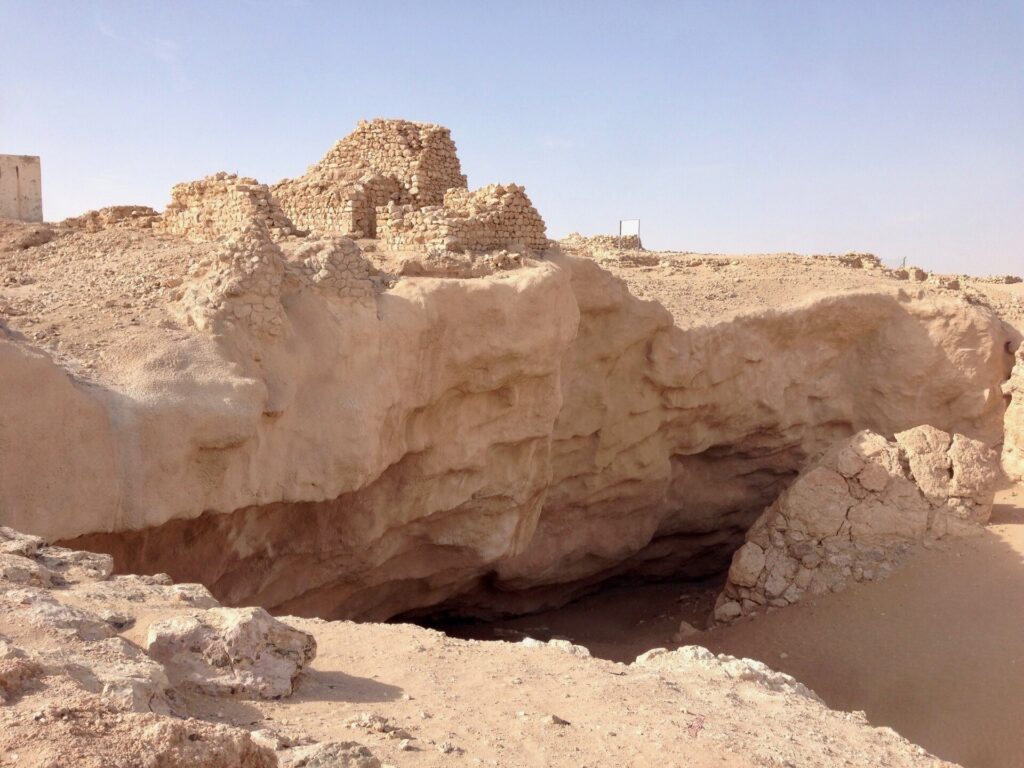
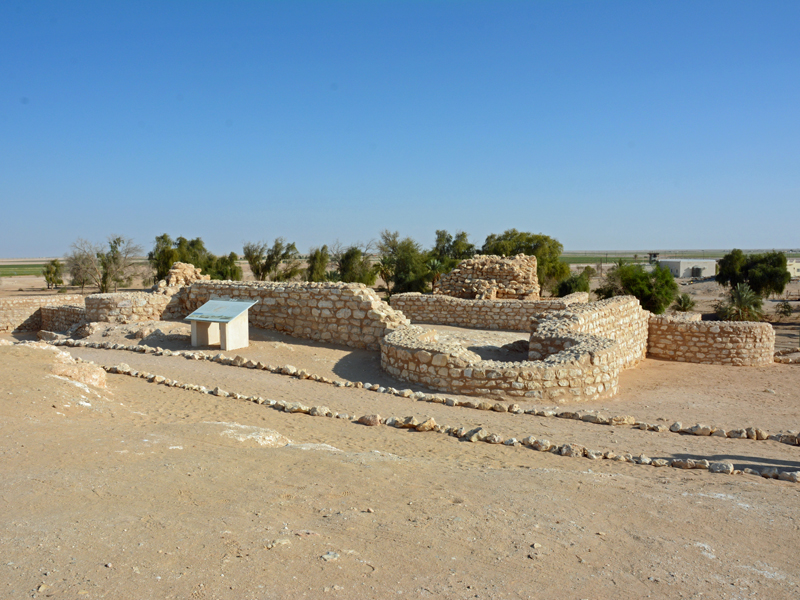
Archaeologists at Shisr uncovered stone walls, towers, rooms, and other structural remains surrounding an important water source. The settlement occupied a strategic location where caravans crossing the desert could obtain water and supplies.
In February 1992, NASA announced that satellite technology had contributed to the discovery of the legendary lost city of Ubar. Newspapers quickly embraced the story, presenting the find as the solution to one of Arabia’s greatest archaeological mysteries.
The site contained genuine archaeological evidence of long-distance commercial connections. Its position near ancient routes, together with ceramics and other artifacts, supported the conclusion that Shisr had served as an important trading center.
Yet the discovery also raised questions. The excavated structures did not resemble the immense metropolis described in medieval legends, and researchers found no inscription explicitly identifying the settlement as the legendary city of Iram.
Another striking feature appeared within the fortified complex: part of the settlement had collapsed into a cavity associated with the site’s geological conditions. The damage offered an intriguing parallel to stories of a city disappearing into the earth, although it could not establish that Shisr had suffered the sudden destruction described in legend.
The discovery was therefore real, but its identification with the Atlantis of the Sands remained open to interpretation.
Was Ubar Ever a Single City?
Years after the announcement, archaeologist Juris Zarins, a member of the original expedition, offered a different interpretation of what the team had discovered.
In a 1996 interview with PBS NOVA, Zarins explained that references to Ubar in classical and Arabic historical sources did not necessarily describe an individual city. Instead, the name may originally have referred to a region or a group of people involved in Arabian trade.
He drew attention to the Iobaritae mentioned in ancient geographical sources and argued that Shisr could have been one of several important centers associated with this population. Later storytelling, he suggested, gradually transformed the name of a people or region into the image of a magnificent lost metropolis.
The excavated pottery also challenged some expectations. Rather than reflecting exclusively western commercial connections, several ceramic forms displayed Parthian influence, pointing toward exchanges with regions linked to Mesopotamia and Iran.
This evidence suggested that the traders associated with Ubar operated within a more extensive network than the familiar image of caravans supplying the Mediterranean world alone.
For Zarins, Shisr remained a significant discovery connected to the world behind the Ubar traditions. What he questioned was the assumption that archaeologists should expect to find one enormous city matching every detail of the legend.
The Enduring Legend of the Atlantis of the Sands
Today, the ruins of Shisr stand as a reminder of a time when caravans crossed the Arabian desert carrying frankincense, precious goods, and stories between distant civilizations. The settlement’s ancient walls and water source offer a glimpse into a trading world where survival depended on knowing the desert’s routes and the location of its rare oases.
The discovery also gives the legend of Ubar a fascinating historical setting. The wealth generated by Arabian trade, the importance of isolated settlements, and the disappearance of once-busy caravan routes may all have contributed to stories of a magnificent city lost beneath the sands. Over generations, memories of real places could have merged with accounts of powerful rulers, extraordinary palaces, and sudden destruction.
Whether Shisr was Ubar itself, one of its trading centers, or simply part of the wider landscape that inspired the legend remains an open question. Yet the archaeological discoveries have brought the search far beyond speculation, revealing a world whose history is every bit as compelling as the stories it inspired.
