

19 June 2026 The Future is the Product of the Past

Artificial intelligence is Detecting New Archaeological Sites in the Arabian desert

A team of researchers at Khalifa University in Abu Dhabi has developed a machine-learning algorithm to help them trawl vast tracts of the Rub al-Khali, or ‘Empty Quarter’— a desert spanning 250,000 square miles on the Arabian Peninsula.

Recently, artificial intelligence has emerged as a groundbreaking tool for uncovering hidden archeological treasures in the region, revolutionizing the field of desert archeology.

The desert is home to the site of Saruq Al-Hadid, which holds evidence of 5,000 years of human activity. The team used data from this site to train their algorithm to identify additional possible excavation sites in the vicinity.

Traditional ground surveys are challenging and expensive in the desert, and dune patterns and sandstorms have proven to be obstinate challenges for satellite imagery interpretation. The algorithm can analyze images obtained using synthetic aperture radar (SAR), a powerful radar system capable of penetrating sand and vegetation, allowing researchers to see hidden structures beneath the surface.
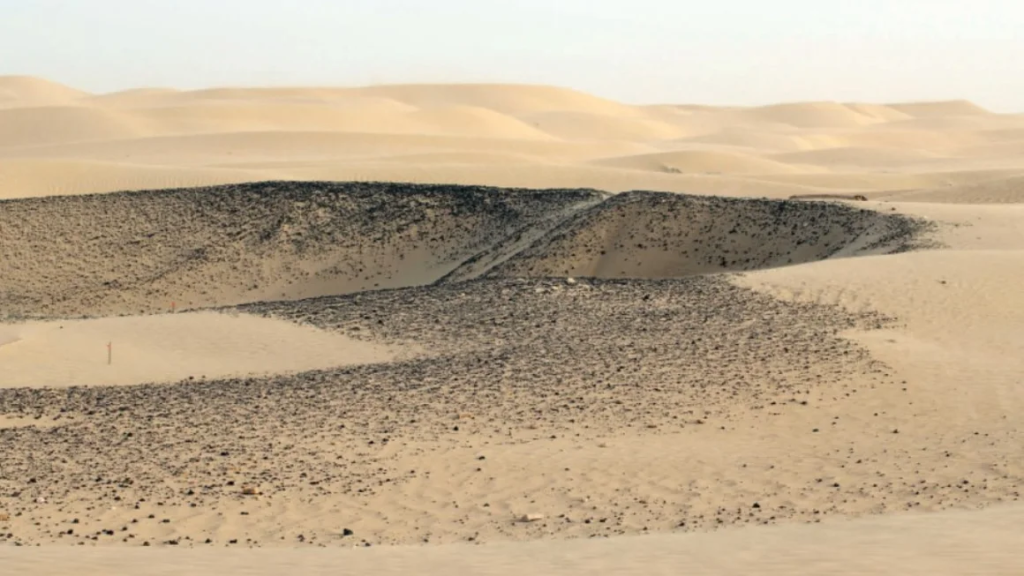
A view over the central sector of Saruq al-Hadid, showing the dark surface layer of copper slag that distinguishes the site from the surrounding desert landscape. Image Credit: Weeks et al., 2019

Satellite-borne SAR, which can cover a larger area than is feasible from the ground, was employed by the archaeologists. The team also used radar to perform a ground survey to replicate the satellite’s findings, thanks to funding from Dubai Culture, the government agency in charge of Saruq Al-Hadid. Both technologies are not new: machine learning has been gaining popularity in archaeology, and SAR imagery has been around since the 1980s.


📣 Our WhatsApp channel is now LIVE! Stay up-to-date with the latest news and updates, just click here to follow us on WhatsApp and never miss a thing!!


 But the use of the two together is a novel application, says Diana Francis, an atmospheric scientist and one of the lead researchers on the project., and to her knowledge, is a first in archaeology.

Through the use of machine learning and deep learning techniques, the team has developed an algorithm that can automatically detect features in the landscape with an accuracy of within 50 cm and generate 3D models of the expected structure.

Now, Dubai Culture plans to excavate the newly identified areas — and Francis hopes the technique can uncover more buried archaeological treasures in the future.
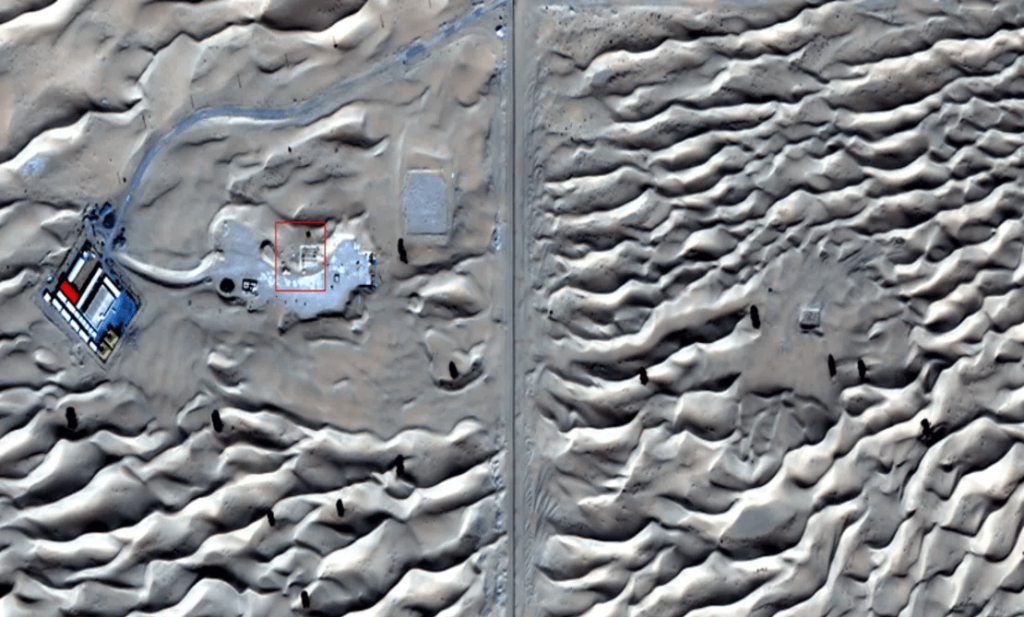
A satellite view of the Saruq al-Hadid site showing the western zone that was under excavation (right) and the eastern zone which is not excavated yet. Khalifa University/Ben Romdhane et al., 2023

If the project is successful, it will expand the use of artificial intelligence in archaeology. The Arabian Peninsula is not the only place where artificial intelligence is being used in archaeology. For instance, A.I. demonstrated its worldwide potential in archaeological exploration when it helped uncover four new Nazca petroglyphs in Peru.

Some experts have urged caution against “over-reliance” on the technology, however. Hugh Thomas, an archaeology lecturer at the University of Sydney, told CNN that there remains nothing better than a “trained archaeological eye” to detect sites.

DOI:10.3390/geosciences13060179

Cover Image Credit: Wikipedia Commons

Related Articles

Undeciphered Rongorongo Script from Easter Island may Predate European Colonization

12 February 2024

12 February 2024

From the depths of history, a wooden tablet bearing the mysterious “rongorongo” script has been unearthed from the small, remote...

Burial Cave in Israel May Belong to Herodian Princess Salome: From Royal Tomb to Christian and Islamic Pilgrimage Site

6 July 2025

6 July 2025

A recently reexamined Second Temple-period burial cave in southern Israel—long revered as the resting place of a Christian saint—may actually...

4,000-year-old Snake-Shaped Pottery Handle Found in Taiwan

20 February 2024

20 February 2024

National Tsing Hua University archaeologists in Taiwan have discovered a snake-shaped pottery handle dating back approximately 4000 years. Researchers uncovered...

The camel carvings in Saudi Arabia are 8000 years old!

15 September 2021

15 September 2021

Life-size animal reliefs found in Saudi Arabia were carved almost 8,000 years ago, during the Neolithic period, when the desert...

Norwegian couple found a Viking Age Grave And Sword in their garden

3 July 2023

3 July 2023

While trying to expand their home, a Norwegian couple found a Viking Age grave and sword in their garden. It’s...

The 1,000-year-old surgical kit found in Sican tomb, Peru

28 March 2022

28 March 2022

A set of surgical tools indicating that the deceased was a surgeon was found in a funerary bundle found in...

Tajik Buddha in Nirvana – the Largest in the World: 42 feet long and 9 feet high

31 December 2023

31 December 2023

In the past, while Taliban soldiers in Afghanistan destroyed two immense statues of Buddha, art historians in neighboring Tajikistan meticulously...

A unique gold brooch talisman with inscriptions in Latin and Hebrew was found in the UK

19 February 2022

19 February 2022

A Medieval gold annular brooch with prayerful inscriptions has been discovered in the parish of Manningford in Wiltshire, in the...

In Fraueninsel in Lake Chiemsee: Romanesque a central building hidden underground for 1,000 years discovered

25 February 2024

25 February 2024

On Fraueninsel, an island in Germany’s Lake Chiemsee, archaeologists discovered a cult site that may have been slumbering underground for...

A huge artificial lake in Sicily is an ancient sacred pool that was aligned with the Stars and used 2,500 years ago, study reveals

17 March 2022

17 March 2022

A sacred freshwater pool on western Sicily’s San Pantaleo Island that dates back some 2,500 years was aligned with the...

2,000-Year-Old Wooden Roman Bridge Discovered in Aegerten, Bern, Switzerland

3 September 2025

3 September 2025

Archaeologists in Switzerland have uncovered the remains of a 2,000-year-old wooden Roman bridge during construction work in Aegerten, a municipality...

1,500-Year-Old Anglo-Saxon Sword Discovered in Kent, England

8 February 2026

8 February 2026

A remarkably well-preserved sixth-century Anglo-Saxon sword discovered near Canterbury is offering archaeologists new insights into early medieval power, migration, and...

First Large Iron Age House Found on Spain’s Cíes Islands Reveals a Settlement Before Rome

12 May 2026

12 May 2026

A windswept hillfort on Spain’s Cíes Islands has yielded the clearest evidence yet that people lived there long before the...

Viking Tomb Discovery in Denmark May Reveal Elite Family Linked to King Harald Bluetooth

20 June 2025

20 June 2025

A stunning archaeological discovery near Aarhus, Denmark, has revealed 30 Viking Age graves that may belong to a powerful aristocratic...

Anthropologists say humans have been using personal ornaments to communicate about themselves without the fuss of conversation – for millennia

24 September 2021

24 September 2021

Anthropologists believe that for millennia, individuals have used personal decorations to communicate about themselves without the hassle of dialogue. They...