
9 December 2025 The Future is the Product of the Past

Rare Viking Armlet and 2,000-Year-Old Golden Neck Ring Discovered in Sweden

Recently, two extraordinary archaeological finds have captivated the attention of historians and enthusiasts alike in Sweden. The first discovery, an exceptionally rare Viking armlet, was uncovered by a private individual in a wetland near Löt on the island of Öland.

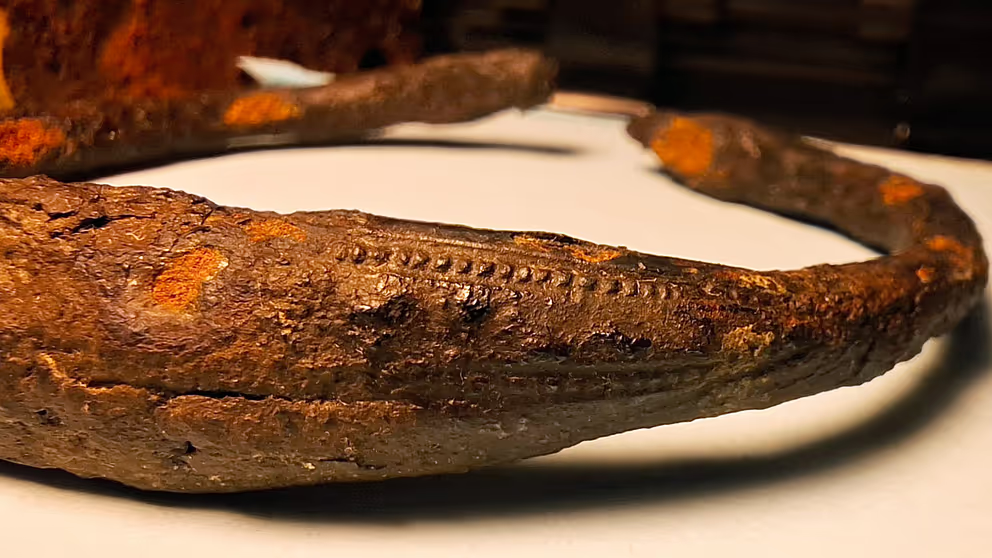
This armlet, dating back over 1,000 years, is notable for being crafted from iron, a material rarely used for such artifacts. According to Karl-Oskar Erlandsson from the County Administrative Board of Kalmar County, only three iron arm rings exist in the State Historical Museum’s collections, making this find particularly significant.

The armlet features intricate decorations, including animal heads at both ends and detailed rows of dots along its length. Its remarkable preservation is attributed to the oxygen-poor environment of the wetland, which has helped prevent corrosion. Erlandsson speculates that the wetland may have served as a sacrificial bog, suggesting the possibility of more artifacts waiting to be discovered in the area.

Plans are underway for a metal detector survey in the spring to explore the site further and determine whether the armlet was lost jewelry or part of a larger offering to the gods.
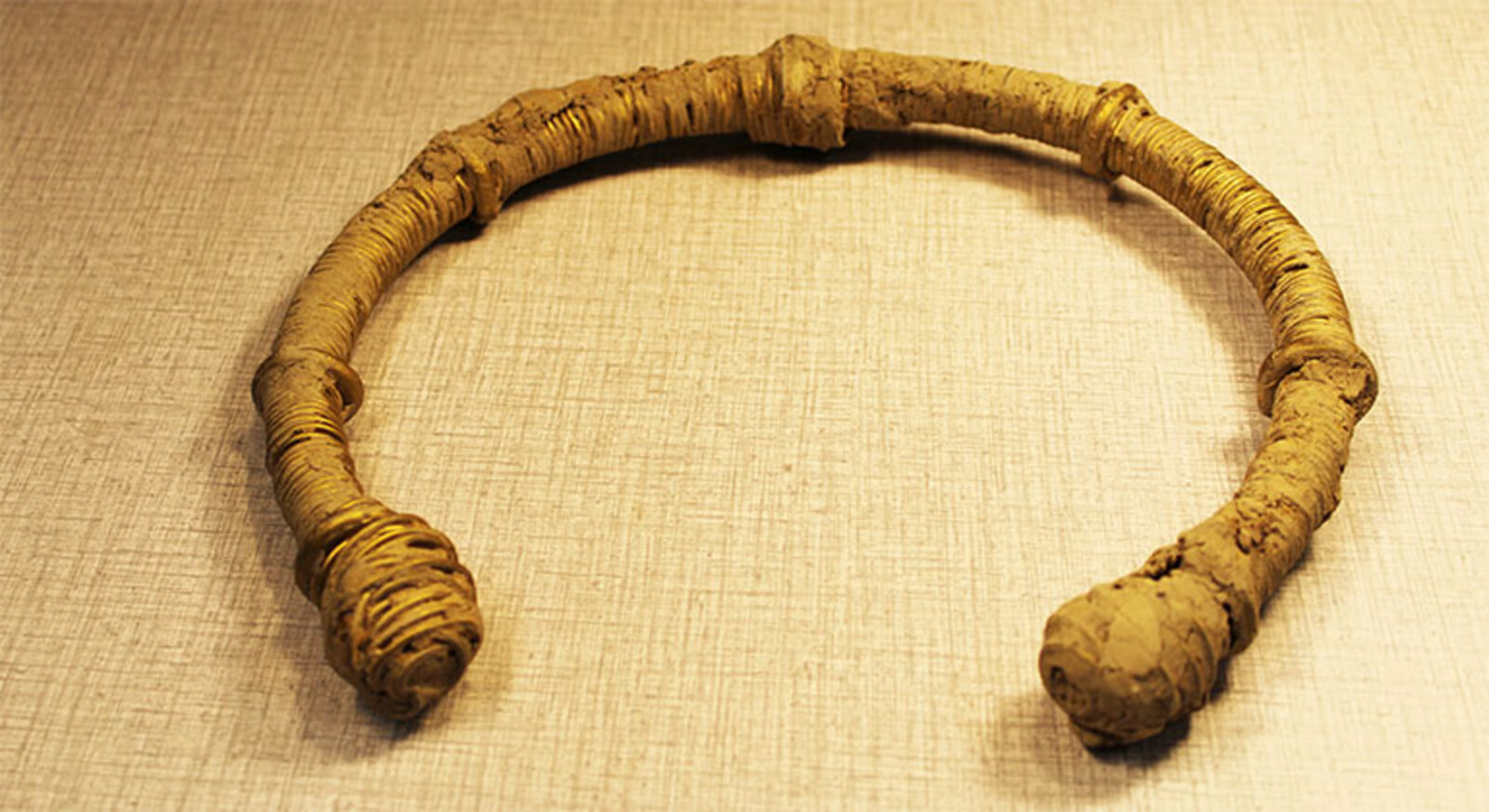

 The neck ring, which was found at a depth of approximately two meters, weighs 916 grams and is estimated to be over 2,000 years old. Credit: länsstyrelsen Västra Götaland.
The neck ring, which was found at a depth of approximately two meters, weighs 916 grams and is estimated to be over 2,000 years old. Credit: länsstyrelsen Västra Götaland.

In a separate but equally fascinating discovery, a 2,000-year-old golden neck ring was found during excavation work in Trollhättan, Västra Götaland County. This exclusive neck ring, made of precious metal and adorned with gold wire and rings, was unearthed at a depth of about two meters. Niklas Ytterberg, an antiquarian from Västra Götaland County, described the find as highly unusual, noting that such jewelry was typically worn by the most powerful individuals of the time.


📣 Our WhatsApp channel is now LIVE! Stay up-to-date with the latest news and updates, just click here to follow us on WhatsApp and never miss a thing!!


The neck ring, known as a torque, measures 23.5 centimeters at its widest point and weighs nearly a kilogram. Unlike similar artifacts found in the British-French region, which are usually solid bronze, this neck ring is believed to have been produced domestically in Scandinavia, showcasing the unique craftsmanship of the era.

Both discoveries highlight the rich archaeological heritage of Sweden and the importance of preserving these artifacts for future generations. The County Administrative Board plans to report these findings to the National Heritage Board, which will determine the next steps, including potential rewards for the finders and conservation measures.

As investigations continue, these remarkable finds promise to shed light on the cultural practices and craftsmanship of ancient Scandinavian societies, offering invaluable insights into their history and traditions.

Cover Image Credit: Länsstyrelsen Kalmar län (County Administrative Board of Kalmar County)

Related Articles

First European farmers’ heights did not meet expectations

9 April 2022

9 April 2022

A combined study of genetics and skeletal remains shows that the switch from primarily hunting, gathering and foraging to farming...

A stone statue (Balbal) with height up to 3 meters found in the Issyk-Kul region of Kyrgyzstan

18 October 2022

18 October 2022

A balbal (stone statue) with a height of up to 3 meters was found during agricultural work in the Ak-Bulun...

Oldest found human traces on Roof of the World, Is it art?

21 October 2021

21 October 2021

Dr. David Zhang and his team’s investigations of Quesang on the Tibetan Plateau in 2018 and 2020 sparked controversy, along...

Archaeologists have discovered a treasure trove of sixth-century coins in ancient Phanagoria in Russia

27 July 2021

27 July 2021

Archaeologists have discovered 80 coins known as Copper staters dating back to the sixth century at Phanagoria on the Black...

Exceptional Intact Etruscan Rock-Cut Tomb Discovered in Italy’s San Giuliano Necropolis

30 June 2025

30 June 2025

A remarkable discovery has emerged from the heart of Etruria: an intact Etruscan rock-cut tomb, sealed for over 2,700 years,...

Medieval gold ‘lynx’ earrings from Ani Ruins

29 December 2022

29 December 2022

A pair of lynx-shaped gold earrings have been unearthed near the ruins of Ani, the once great metropolis known as...

A Baptismal Surprise: Triton Baths in Southeastern Rome Converted into Early Christian Church

7 May 2025

7 May 2025

Recent archaeological excavations within the monumental complex of the Villa di Sette Bassi, situated in the southeastern outskirts of Rome,...

Excavations in Haldensleben, Germany Reveal A Lost Settlement

9 November 2024

9 November 2024

Excavations at Haldensleben in the German state of Saxony-Anhalt provide important information about a lost settlement. Since May 2024, the...

490-Million-Year-Old Trilobites Could Solve Ancient Geography Puzzle

22 November 2023

22 November 2023

The humble trilobites may be extinct, but even as fossils, they can teach us much about our planet’s history. Indeed,...

Stone Age Farmers Settled Near Dortmund Airport 7,000 Years Ago

24 August 2025

24 August 2025

Archaeological discoveries at Dortmund Airport reveal that early Neolithic farmers lived and built houses in the region nearly 7,000 years...

Climate Change Negatively Impacts 45 000-year-old Cave Paintings in Indonesia

13 May 2021

13 May 2021

Cave paintings from 20,000 to 50,000 years ago in Indonesia are in danger of extinction due to climate change. Indonesia...

Archeological study shows unearthed Byzantine warrior had gold-threaded jaw

30 September 2021

30 September 2021

A Byzantine warrior who was beheaded after the Ottomans captured his fort in the 14th century had a jaw threaded...

A 13th-Century Italian Fresco Reveals the Medieval Church’s Use of Islamic Altar Tents

3 February 2025

3 February 2025

A recently rediscovered 13th-century fresco in Ferrara, Italy, offers significant insights into the medieval practice of utilizing Islamic tents to...

Archaeologists Find One of the Long-Lost Holy Cities in Jordan

13 July 2025

13 July 2025

A remarkable archaeological discovery in Jordan has brought one of the Holy Land’s long-lost cities back to light. Researchers now...

Gold coin hoard discovered in a cup beneath a North Yorkshire kitchen floor is being auctioned off

7 September 2022

7 September 2022

A couple in North Yorkshire found an early 18th-century gold coin hoard buried under the floorboards of their kitchen. The...