
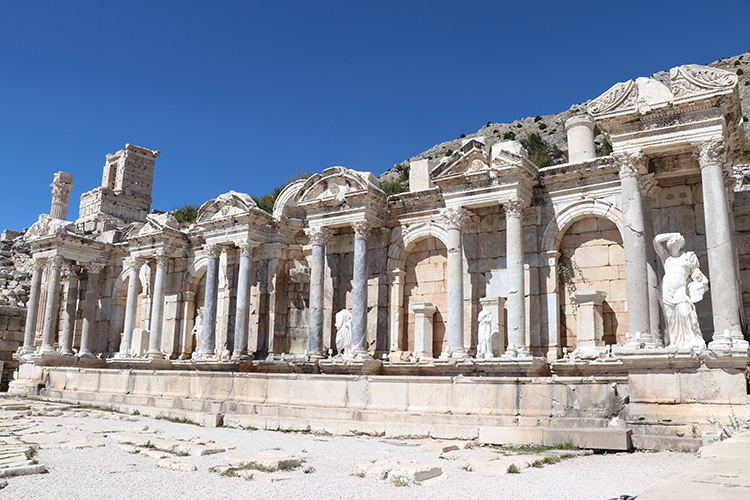
Archaeologists excavating the ancient site of Sagalassos in the Ağlasun district of Burdur have made a striking discovery: a relief panel carved in Afyon marble featuring the Egyptian sphinx-god Tutu, artfully executed using incision techniques. The reliefs, part of a decorative programme inspired by Egyptian motifs, were found in a Roman bath complex and reveal previously unrecognized cultural exchanges between ancient Anatolia and Egypt.
A Unique Find in a Roman Bath
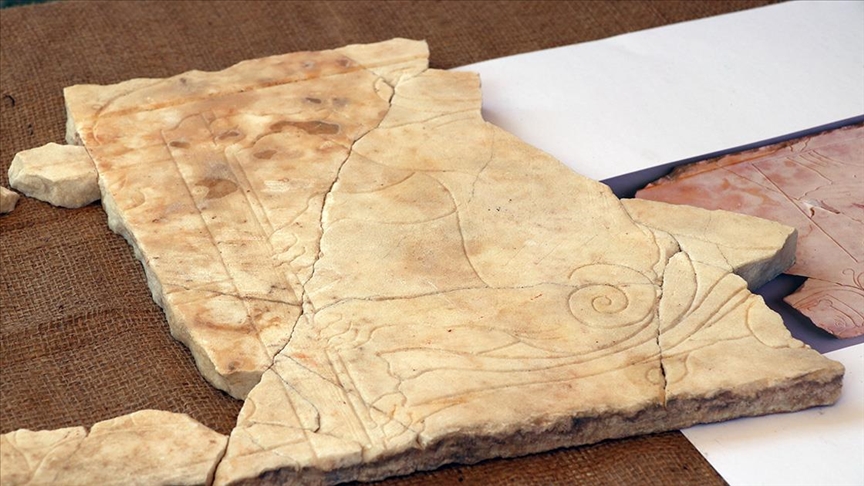
The relief panels were first uncovered in 2004 during excavations in the northern frigidarium (cold room) of the Bath-Gymnasion complex. Recent re-examination by the excavation team, led by Prof. Dr. Peter Talloen of Bilkent University, has now confirmed that the images are part of an “Egyptianizing” décor. What makes them especially remarkable is not only their iconography but the material and technique: they are carved in Afyon (also known as Docimian) marble, and were produced using an incision (engraving) technique rather than in full high relief.
Talluen states, “Because examples of such iconography outside Egypt are unknown, this scene sheds unique light on decorative programmes of sanctuaries devoted to Egyptian deities beyond the Nile lands.” The relief seems not to be part of a cult temple to Tutu, but rather decorative, underlining themes of protection, kingship, and symbolic power.
Iconography: Tutu, Horus, and Sobek
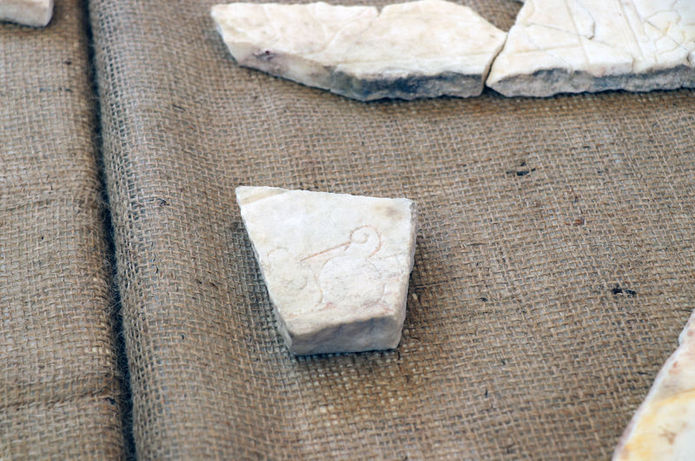
The central figure in the scene is the sphinx-god Tutu. In this relief, Tutu is flanked by symbolic figures representing Egyptian royal and divine power. Among them are Horus, the falcon god associated with kingship and royal authority, and Sobek, the crocodile god symbolizing the power of the Nile. According to the archaeologists, the composition evokes themes of divine kingship and protective strength, with Tutu acting as a guardian, Sobek as the embodiment of the Nile’s life-giving force, and Horus affirming the royal or quasi-royal dimension of the imagery.
Furthermore, the architecture of the relief itself — with a stylized doorway or lintel motif, crowns of Upper and Lower Egypt, and the positioning of figures — suggests a sophisticated knowledge of Egyptian royal symbolism, adapted into a Roman Anatolian setting.
Material, Technique, and Local Marble
One of the most striking aspects is the choice of material: the panels are made of Afyon marble (also known historically as Docimian marble), quarried in what is now Afyonkarahisar. This establishes clearly that the marble did not come from Egypt; rather it was a local (or regional) stone used to represent Egyptian gods. The technique used is incision (or engraving) on thin marble sheets or veneers rather than high-relief or full sculpture, which indicates a more subtle and decorative use.
This usage of local marble reinforces how Sagalassos was deeply embedded in regional building and sculptural traditions while also participating in broader Mediterranean cultural currents. Afyon marble had long been prized in Roman Anatolia for its quality, and is known from many earlier imperial statuary and architectural décor in Sagalassos.
Significance: Anatolia Meets Egypt
The discovery is important for several reasons. First, representations of Egyptian deities so far outside Egypt are rare. The relief at Sagalassos appears to be among the few if not only examples of such iconographic programme in Anatolia combining the sphinx-god Tutu with Horus and Sobek. Second, it shows that under Roman rule, Sagalassos was not only economically prosperous—exporting goods like wine, ceramics, and agricultural produce—but culturally receptive: ideas, motifs, and styles from Egypt travelled into Anatolia and were adapted in local contexts.
Prof. Talloen noted that the people of Sagalassos exported ceramics, wine, and agricultural products to Egypt, while in return they brought back fish species and cultural influences to Anatolia — a clear example of two-way exchange between the regions. This relief vividly testifies to those interactions.
Site & Preservation Context
The site of Sagalassos itself is exceptional. Built on the slopes of the Akdağ Mountains, its first evidence of settlement goes back some 12,000 years. The Roman remains are particularly well preserved because the city was buried by seismic activity and covered by soil layers, helping protect ruins from looting and destruction. Excavations there have been ongoing since 1989, with strong institutional backing and involvement from local and international archaeologists. Sagalassos is included in UNESCO’s Tentative List of World Heritage Sites, underscoring its global importance.
Implications for Research
This newly documented relief panel prompts new questions: Was this kind of Egyptianizing décor more widespread in Roman Anatolia than previously understood? Were there workshops or artisans in Anatolia trained in Egyptian iconography or influenced by imported craftsmen or manuals? Could these motifs signal religious syncretism, political statements, or simply fashionable exoticism?
Archaeologists plan further technical analyses, including marble sourcing, tool-marks and pigment traces, to better understand how the panels were made and how they might have looked in their original, possibly painted or colored state. The research also helps refine dating of the bath complex and its decorative phases, potentially placing this relief in the broader context of Roman decorative art in the 2nd-3rd centuries CE.
Conclusion
The discovery of the Afyon marble relief of the Egyptian god Tutu in Sagalassos represents a rare convergence of local material, Roman architectural setting, and Egyptian iconography. It enriches our understanding of how ancient Anatolian cities like Sagalassos were nodes not only of trade and economy, but of artistic and symbolic exchange. As investigations continue, this relief may prove a key to unlocking further evidence of cross-cultural artistic flows in the Roman Mediterranean.
Cover Image Credit: Public Domain
