
23 January 2026 The Future is the Product of the Past

A First in Anatolia: Rare Egyptian God Statue Unearthed in Commagene’s ‘Stairway to Eternity’ Tomb

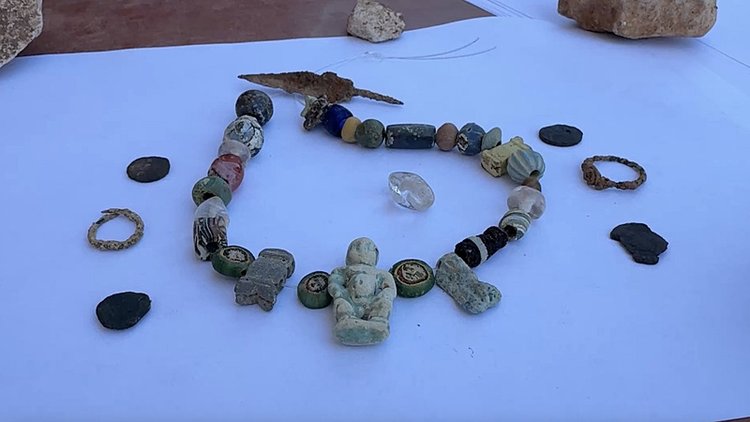
In the ancient city of Perre, once a flourishing capital of the Commagene Kingdom in southeastern Türkiye, archaeologists have uncovered a 2,100-year-old rock-cut tomb containing the remains of 14 individuals. Inside the chamber, researchers found amulets, beads, and — most strikingly — a rare statue of the Egyptian god Pataikos.

Believed to be the first of its kind ever discovered in Anatolia, the find sheds new light on how deeply Commagene was connected to the wider ancient world.

The burial chamber, dramatically referred to as the “stairway to eternity,” underscores the cultural richness of Commagene, a kingdom famed for blending traditions from East and West. Together, the tomb and the Egyptian deity provide a rare glimpse into the cosmopolitan world of this ancient crossroads.

A First in Anatolia: Pataikos Emerges in Commagene

Excavation teams led by the Adıyaman Museum Directorate uncovered the tomb filled with beads, amulets, and protective figures. Among these artifacts, the faience statue of Pataikos stood out as a historic first for Anatolia.

Pataikos, a protective dwarf-god in ancient Egyptian religion, was often associated with warding off evil and guiding souls safely into the afterlife. For Mehmet Alkan, Director of the Adıyaman Museum, the find is nothing short of extraordinary.


📣 Our WhatsApp channel is now LIVE! Stay up-to-date with the latest news and updates, just click here to follow us on WhatsApp and never miss a thing!!


“This is the first time such a figure has been encountered in excavations in Anatolia,” Alkan explained. “Its presence in Perre expands our understanding of how far Egyptian beliefs and symbols traveled during the Hellenistic period.”
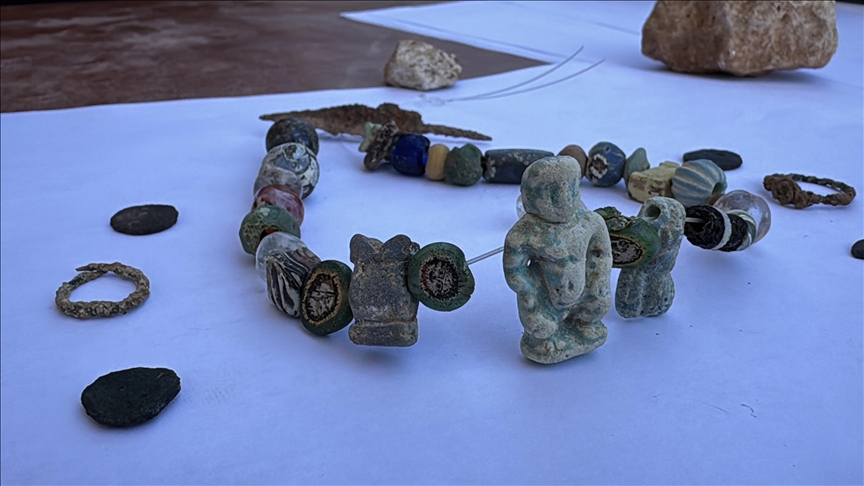
A First in Anatolia: Rare Egyptian God Statue Unearthed in Commagene’s ‘Stairway to Eternity’ Tomb. Credit: Ali Gazel

The Tomb: A “Stairway to Eternity”

Equally fascinating is the tomb itself. Carved into rock in a hypogeum style, the 2,100-year-old chamber housed the remains of 14 individuals, likely members of Commagene’s elite. The site is part of a sprawling necropolis where corridors and chambers create a monumental burial complex.

Archaeologists have poetically dubbed the site the “stairway to eternity” — a striking reflection of the belief in an afterlife journey. The combination of local Anatolian burial traditions with foreign symbols such as Egyptian amulets illustrates the cultural fluidity that defined Commagene’s worldview.

Provincial Director of Culture and Tourism Mehmet Yelken stressed the importance of careful excavation:

“Each discovery here adds to our understanding of how Commagene connected with the wider ancient world. The stairway to eternity is more than a tomb; it is a cultural bridge.”
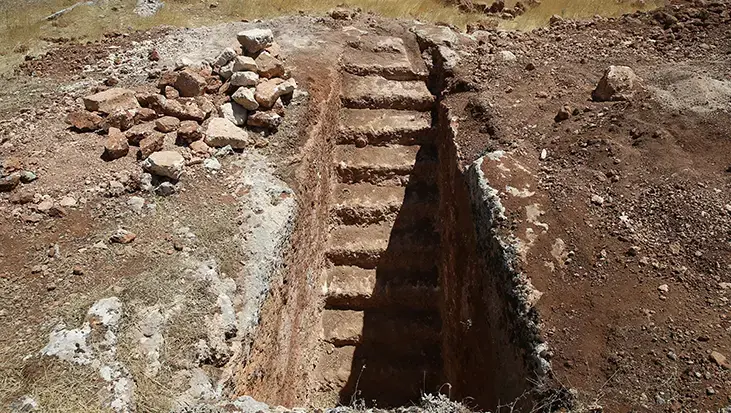
The tomb, known as the ‘Stairway to Eternity,’ takes its name from the stepped architecture that inspired its designation. Credit: Ali Gazel

Perre: A Gateway Between Civilizations

Perre, located in present-day Adıyaman in southeastern Türkiye, flourished as a key city of the Commagene Kingdom (163 BCE – 72 CE). Known for its elaborate rock tombs and Roman-era remains, the city served as a hub of commerce, religion, and diplomacy at the crossroads of Anatolia, Mesopotamia, and the Mediterranean.

The Kingdom of Commagene itself is famous for blending Persian, Greek, and Anatolian traditions. Its rulers positioned themselves as heirs to both Eastern and Western civilizations, a vision most famously immortalized at Mount Nemrut, where colossal statues of gods bear the features of multiple cultures.

The discovery of Pataikos in Perre reinforces this image of Commagene as a “meeting place of the gods” — where Egyptian symbols could appear alongside Greek and Persian influences.
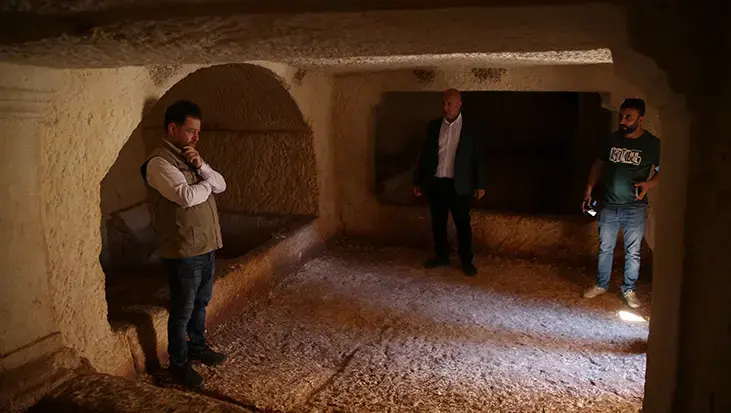
A hypogeum-style tomb, carved underground with multiple chambers, reflecting the funerary practices of the Hellenistic period in Commagene. Credit: Ali Gazel

Unexpected Ties with Egypt

While Commagene is best known for its Greco-Persian syncretism, the presence of an Egyptian deity in its burial grounds reveals that its cultural network may have stretched further than previously thought.

Egyptian amulets and protective figures were widely traded across the Mediterranean, but their appearance deep inside Anatolia is extraordinary. The find suggests that Commagene’s elites, eager to showcase their cosmopolitan identity, may have deliberately incorporated Egyptian symbols of protection into their funerary practices.

The god Pataikos, often depicted as a small, protective dwarf figure, was particularly associated with warding off evil and ensuring safe passage into the afterlife — a belief that resonated strongly with Commagene’s funerary traditions. This symbolic overlap may explain why Egyptian artifacts were welcomed into a tomb in Perre.
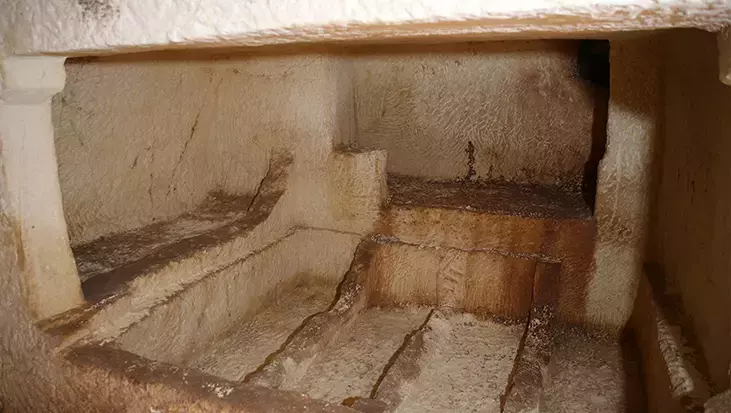
 Another chamber of the hypogeum-style tomb in Perre, Kingdom of Commagene, illustrating the underground burial architecture and funerary practices of the Hellenistic period. Credit: Ali Gazel
Another chamber of the hypogeum-style tomb in Perre, Kingdom of Commagene, illustrating the underground burial architecture and funerary practices of the Hellenistic period. Credit: Ali Gazel

A Crossroads of Cultures Still Revealing Secrets

The find of Pataikos in Anatolia not only enriches Türkiye’s archaeological record but also deepens the narrative of Commagene as a kingdom that thrived on cultural fusion. From Mount Nemrut’s colossal statues to Perre’s Egyptian amulets, the legacy of Commagene lies in its ability to weave together diverse traditions into a unique identity.

As excavations continue, experts believe further surprises may emerge — perhaps more evidence of Egypt’s symbolic presence in Commagene or other artifacts reflecting the kingdom’s vast cultural web.

For now, the tiny figure of Pataikos stands as a powerful reminder: in the ancient world, even gods traveled.

Anadolu Agency (AA)

Cover Image Credit: Ali Gazel – Anadolu Agency (AA)

Related Articles

Ancient Latin texts written on papyrus reveal new information about the Roman world

11 January 2023

11 January 2023

Researchers funded by the European Union have deciphered ancient Latin texts written on papyrus. This work could reveal a lot...

46 Ice Age Animals Found in a Northern Norway Cave: “Extremely Rare” Discovery Reveals a Frozen Past

22 October 2025

22 October 2025

A remarkable discovery in northern Norway has uncovered the remains of 46 species from the last Ice Age — from...

The Artificial Intelligence Revolution: The Dark Age of Ancient Scrolls Ends

2 May 2025

2 May 2025

Artificial intelligence, often envisioned for future applications, is now playing a pivotal role in unraveling the mysteries of the past....

Secrets of the Skull Room: 12 Ancient Human Skulls Unearthed in Sefertepe Excavations

16 September 2025

16 September 2025

Archaeologists have uncovered 12 new human skulls during ongoing excavations at Sefertepe, one of the most important sites of the...

The 890-million-year-old sponge fossil may be the oldest animal yet discovered

1 August 2021

1 August 2021

890-million-year-old fossil sponges found in the “Little Dal” limestones of northwest Canada may be the oldest animal ever found. According...

Discovery Shedding Light on the Mysteries of Anatolia: 3500-year-old Double-Headed Eagle Seal

21 October 2024

21 October 2024

A grain silo and two different seal impressions, one of which is a double-headed eagle, were found during the excavation...

Medieval ship found off the west coast of Sweden

5 February 2022

5 February 2022

A previously undiscovered wreck has been found outside of Fjällbacka on the Swedish west coast. Analysis of wood samples shows...

The 1000-year Curse of the Croatian King Zvonimir

26 September 2023

26 September 2023

Croatia is a fascinating country that continually rises up people’s must-visit lists thanks to its sparkling Adriatic coastline, 1,244 islands,...

Archaeologists Uncover Previously Unknown Large-Scale Prehistoric Hunting Architecture in Europe

16 October 2025

16 October 2025

In a stunning discovery that reshapes our understanding of prehistoric Europe, archaeologists have uncovered monumental stone hunting megastructures hidden in...

Unique Gold Ring and Crystal Amulet among 30,000 Medieval Treasures Uncovered in Sweden

7 March 2024

7 March 2024

In the Swedish medieval city of Kalmar, archaeologists from the State Historical Museums unearthed the remains of over 30,000 objects...

Archaeologists discover Ice Age human footprints in the Utah desert —may be more than 12,000 years old.

26 July 2022

26 July 2022

Daron Duke and Thomas Urban, a Research Scientist with Cornell University, discovered 88 preserved human footprints on alkaline plains at...

The oldest fortification system in Anatolia is about 8000 years old “Kuruçay Höyük”

14 May 2022

14 May 2022

Kuruçay höyük is located near the village Of Kuruçay, fifteen kilometers south of Burdur. The mound itself is situated upon...

Karahantepe will shed light on the mysteries of the Prehistoric period

7 October 2021

7 October 2021

Karahantepe’s ancient site, which is home to Neolithic-era T-shaped obelisks similar to the ones in the world-famous Göbeklitepe, will reveal...

Radar Detects Long-lost River in Egypt and Could Explain How The Pyramids Were Built

22 May 2024

22 May 2024

More than 30 pyramids in Egypt are located in an unremarkable strip of barren desert far from the shores of...

42,000-year-old Shell Jewellery Workshop Discovered – The Oldest in Western Europe

27 September 2025

27 September 2025

Archaeologists have made a groundbreaking discovery in Saint-Césaire, Charente-Maritime, uncovering what is now considered the oldest shell jewellery workshop in...