
11 November 2025 The Future is the Product of the Past

An ancient necropolis and coins discovered in Kastel Fortress, a national monument of Bosnia and Herzegovina

During excavations at Kastel Fortress, the national monument of Bosnia and Herzegovina, students and professors of Archaeology and History found an ancient coin and, more importantly, they think they have discovered an ancient necropolis.

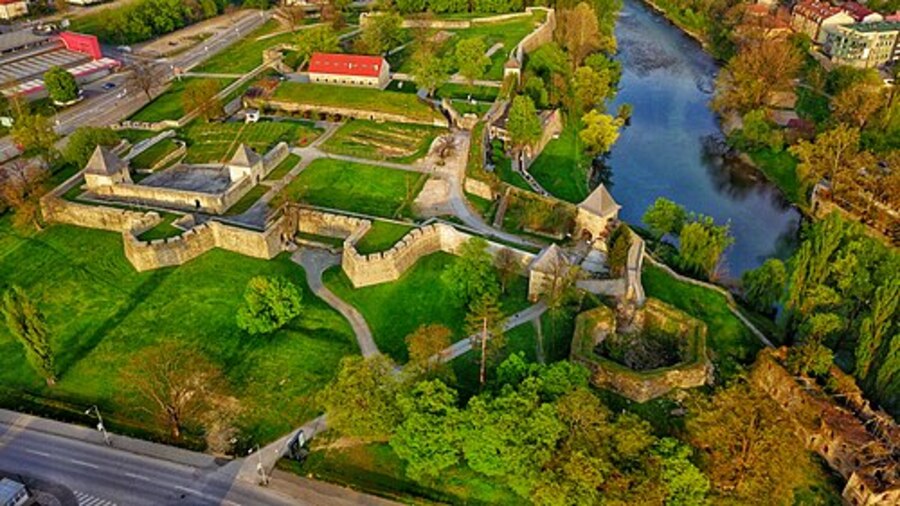
Kastel Fortress the oldest historical monument in Banja Luka, is situated on the left bank of the Vrbas River, between the City Bridge and the month of the Crkvena River. It is believed to have been constructed on the remains of a Roman settlement known as Castra.

Boris Radic, Senior Associate at the Republican Institute for the Protection of Cultural and Historical Heritage, told Sarajevo Times that the discovery took place at an archaeological school attended by students of Archaeology and History from both public universities in Republika Srpska (RS).

According to Boris Radic, they found an ancient cemetery in Kastel, the existence of which was not even known. The exact results will become clear after Carbon 14 dating. The excavations also uncovered a late antique coin from the 4th century.

Excavations were carried out at the site in the 1980s. On-site, flint tools from the Gravettiena period—the youngest stage of the upper Paleolithic period, which spanned from the XIX to the first quarter of the XII millennium BCE—were discovered. Also, a settlement was discovered, dating back to the Eneolith period, containing ceramics of the Baden culture group and a small number of ceramic fragments from the Vučedol culture. Later, on the basis of methodological studies, ancient geographical maps, and mostly accidental discoveries, it was established that an ancient Roman settlement called Castra existed here.


📣 Our WhatsApp channel is now LIVE! Stay up-to-date with the latest news and updates, just click here to follow us on WhatsApp and never miss a thing!!


Assuming that the site had been completely excavated in the 1980s, the archaeology school started out as a cleaning project six years ago.
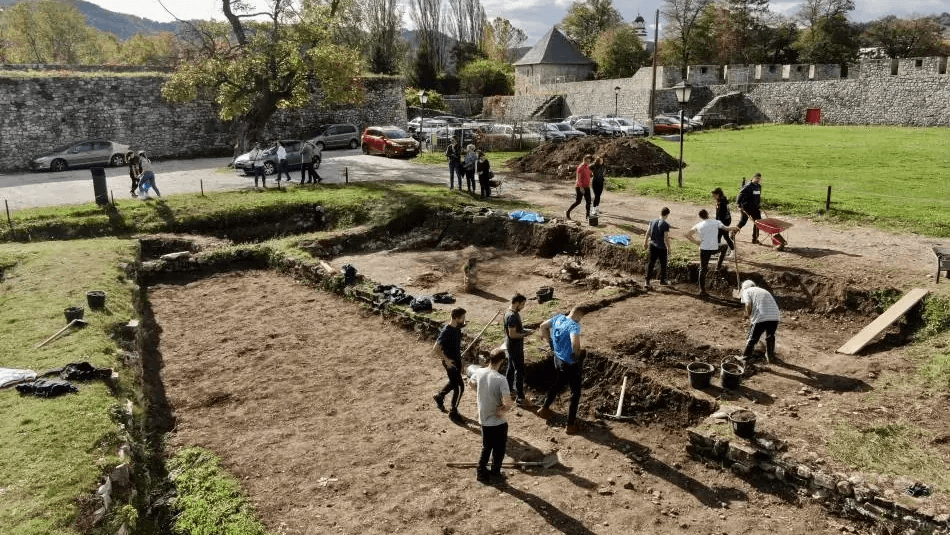
Photo: N1

“During the first cleaning, six years ago, we found that it was not fully examined and that additional archaeological layers remained. We then decided to make this a regular archaeology school, which now serves as practical instruction for History and Archaeology students,” explains Radic.

He points out that because Kastel was continuously inhabited, both professors and students have the chance to observe how the layers mix there, but it also makes their job challenging because it is challenging to distinguish between the layers.

“So now we unexpectedly came across a necropolis, and each year, we come across human skeletons. This isn’t a conventional cemetery; based on the orientation of the deceased, we assume they are from an earlier period, as they do not align with Christian or Muslim burial customs. Moreover, these graves are embedded into ancient walls, and this year, we discovered that people disregarded the walls, digging graves and thereby destroying walls that could date to the 2nd century,” Radic said.

However, it is not possible to say anything definite until the Carbon 14 dating results are determined. The researcher stated that there were also many ancient pottery in the layer they uncovered, but they were mixed with Turkish pottery. They also found a 4th-century coin, but this alone does not mean anything.

This project was carried out in cooperation with the Museum of Republika Srpska, the Association of Archaeologists of Republika Srpska, the Faculty of Philosophy of the University of Banja Luka, and the Faculty of Philosophy of the University of East Sarajevo. The project was co-financed by the Ministry of Education and Culture of Republika Srpska and the city of Banja Luka.

Cover Image Credit: Tomas Damjanovic Banjaluka – CC BY-SA 4.0

Related Articles

New finds in ancient Rome’s Pompeii show ‘conditions of precarity and poor hygiene, in which people of lower status lived during that time

20 August 2023

20 August 2023

Archaeologists have discovered a small bedroom in Civita Giuliana villa near Pompeii that was almost certainly used by slaves, throwing...

Underfloor Heating System Discovered in 1,700-Year-Old Roman Bath

25 August 2025

25 August 2025

Archaeologists in eastern Türkiye have uncovered a 1,700-year-old Roman bathhouse equipped with an advanced underfloor heating system, shedding new light...

Turkey’s Urartian Altıntepe Castle transforms into open museum

25 May 2022

25 May 2022

Altıntepe Castle, one of the most important centers of the Urartians and the Eastern Roman Empire, is now set to...

Genetic Analysis Reveals A Woman As The Highest-Ranking Individual In Copper Age Spain: ‘Ivory Lady’

6 July 2023

6 July 2023

According to a study published Thursday (July 6) in the journal Scientific Reports, the highest-status individual in ancient Copper Age...

World treasure that cannot be displayed in the Local Museum in Pljevlja, Montenegro

30 July 2023

30 July 2023

Despite representing one of the most valuable portable cultural assets of Montenegro, the Pljevlja Diatreta is not accessible to visitors. The...

Altar site for Greek goddess Demeter unearthed in Turkey’s ancient city of Blaundus

21 December 2021

21 December 2021

An altar site for the Greek goddess Demeter was unearthed during the ongoing excavations in the ancient city of Blaundus,...

A new study shows that the cave paintings at Cueva Ardales are the work of Neanderthals

21 August 2021

21 August 2021

A study of pigments used in murals in the Cueva Ardales caves in southern Spain has revealed that Neanderthals, long...

3500-year-old grape seed remains found in western Anatolia

12 September 2023

12 September 2023

Archaeologists at the Aşağıseyit Höyük (Aşağıseyit Mound) site in western Anatolia’s Denizli have uncovered a 3,500-year-old grape seed. Aşağıseyi Höyük...

Statue Head of Goddess Tyche Discovered in Bulgaria

8 December 2024

8 December 2024

A remarkably crafted head of a large statue of the Greek goddess Tyche was recently unearthed during the excavations of...

Ancient city site unearthed in Central China produces fortune-telling relics

8 February 2024

8 February 2024

Bone slips used for “fortune-telling activities” and “ancient sacrificial ceremonies” were unearthed during excavations at an archaeological site in Puyang,...

More than 1,300 prehistoric burial mounds in western Azerbaijan systematically surveyed for the first time

2 January 2025

2 January 2025

Over 1,300 archaeological sites in Azerbaijan were systematically surveyed and documented in two field campaigns in 2021 and 2023 by...

A rare 2,500-year-old shipwreck found off the Greek island of Kythera

5 November 2021

5 November 2021

A rare shipwreck from the ancient era was discovered during the maritime survey for the Crete-Peloponnese subsea link. The Independent...

Bosphorus Was Frozen, People Crossed By Walking

14 February 2021

14 February 2021

The calendars showed the year 1954. Istanbul was experiencing an extremely freezing winter after many years. Heavy snowfall, hard enough...

Archaeologists discovered floor mosaics with early Christian designs in Roman town of Marcianopolis, in Bulgaria

16 January 2024

16 January 2024

Archaeologists discovered floor mosaics with early Christian designs and nearly 800 artifacts in the archaeological reserve of Marcianopolis in Devnya,...

2,000-year-old financial record uncovered on Pilgrimage Road in the City of David, Jerusalem

17 May 2023

17 May 2023

A financial record dating back 2,000 years has been unearthed on the Pilgrimage Road in the City of David, Jerusalem’s...