
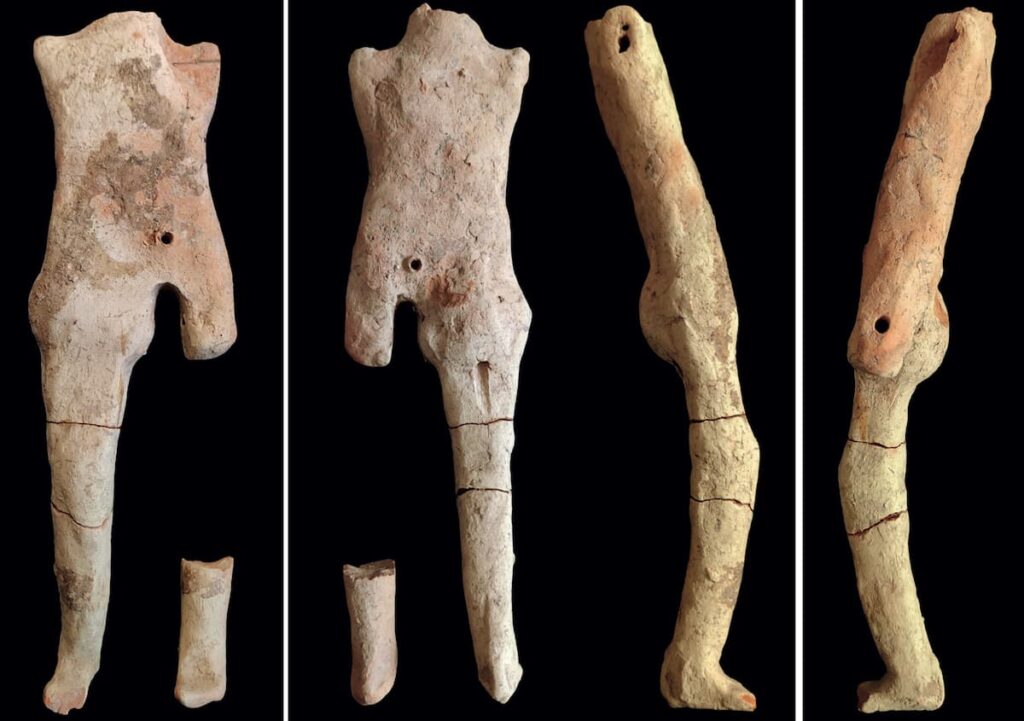
Archaeologists working at the Torreparedones Archaeological Park in Baena, Córdoba, Spain, have made a remarkable discovery: a rare Roman-era articulated terracotta doll. Unearthed in the eastern baths of the site, this fragile yet extraordinary find offers new insights into the daily lives of children in Hispania nearly 1,700 years ago.
The jointed doll, dating from the 3rd to the 5th centuries AD, is missing its head and arms but still reveals intricate craftsmanship. Alongside it, researchers also uncovered other doll fragments — including a right leg, a left foot, and an unidentified limb — suggesting that multiple toys may once have been discarded in the area. According to archaeologists, these items were found in a large refuse dump that formed after the public baths were abandoned in the late 2nd century AD.
A Glimpse Into Childhood in Ancient Rome
While Roman history often highlights emperors, armies, and monumental architecture, this discovery sheds light on an often-overlooked group: children. Play was an essential part of childhood in antiquity, just as it is today. Dolls such as the one found at Torreparedones were not only toys but also objects that allowed children to imitate adult life, practice social roles, and develop creativity.
Articulated dolls are particularly significant because of their scarcity in the Iberian Peninsula. Known examples from Hispania are few, with most being isolated finds from funerary contexts. The Torreparedones specimen, discovered in a non-funeral urban setting, provides an even more valuable piece of evidence for how Roman children spent their leisure time.
The Torreparedones Archaeological Site
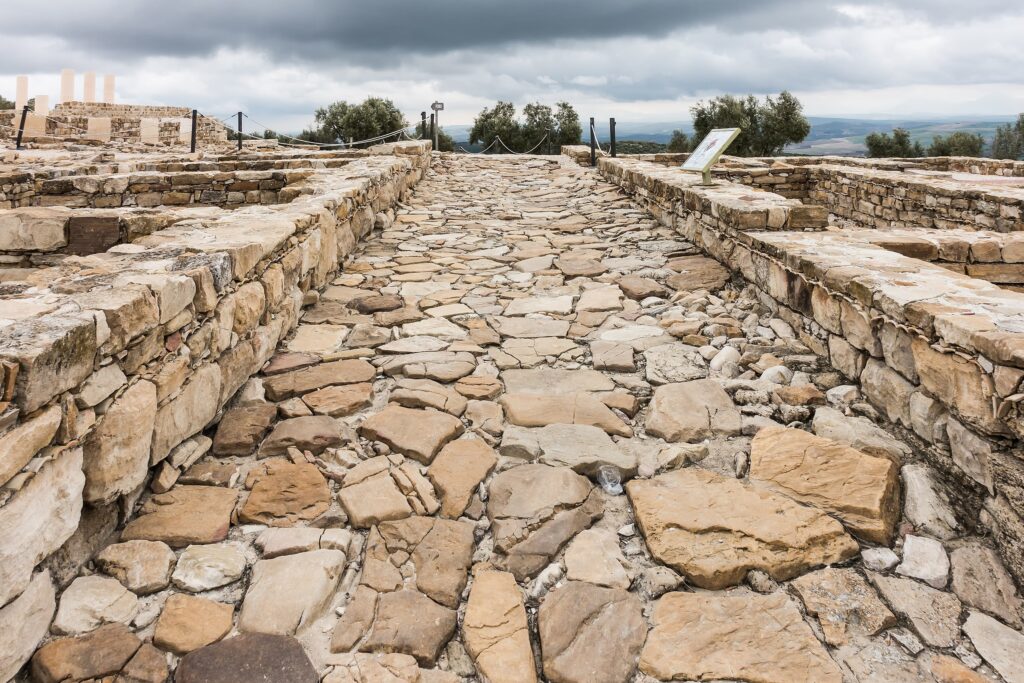
The setting of this discovery is just as fascinating as the artifact itself. The Torreparedones Archaeological Park is one of southern Spain’s most important Roman sites. Known since the early modern period for its abundance of ancient remains, Torreparedones flourished during the Roman Empire as Ituci Virtus Iulia, a municipium of the province of Baetica.
Excavations have revealed a well-preserved forum, a curia (city council building), sanctuaries, necropolises, and an extensive urban layout. Among its standout features are the eastern baths, also called the “Baths of Health,” discovered in 2017. This public bath complex covered about 500 square meters and included the classic Roman sequence of frigidarium, tepidarium, and caldarium, as well as a latrine, vestibule, service areas, and even a well to supply water.
Built in the first half of the 1st century AD and renovated at the end of the same century, the baths were abandoned in the late 2nd century. Over time, they became a dumping ground for domestic refuse, animal remains, and discarded objects — including the terracotta doll fragments.
The Significance of Terracotta Toys
Terracotta was a widely used material in Roman craftsmanship. Artisans produced not only architectural decorations but also small figurines of humans and animals. These figurines often had dual purposes: some were used in rituals, while others served as children’s playthings.
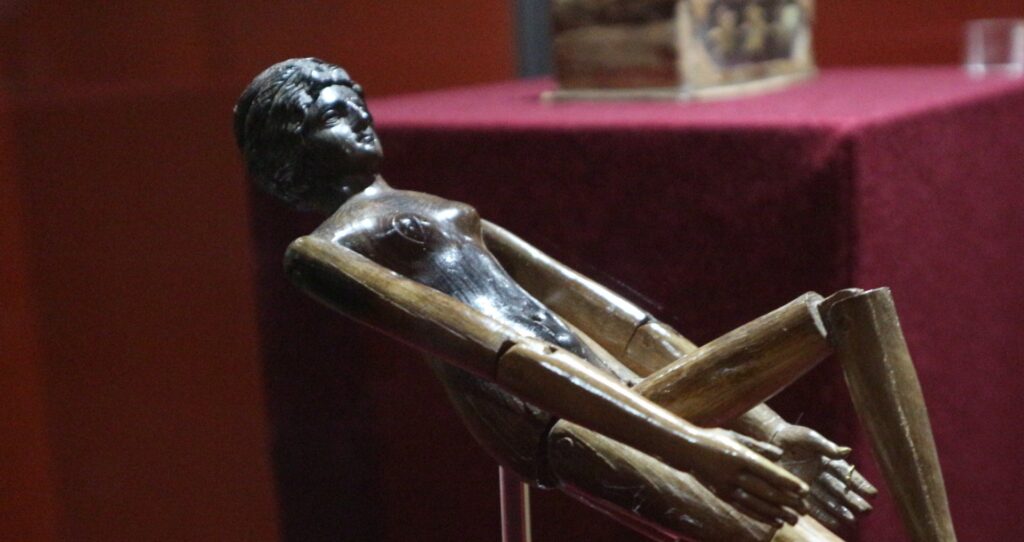
Dolls, however, are rare compared to toy animals, carts, or gladiator figurines. Most known Roman dolls were made from bone, ivory, or terracotta, often with movable limbs connected by pegs. Wealthier families sometimes gifted girls luxurious ivory dolls, like the famous one found in the sarcophagus of a young girl in Tarragona. The Torreparedones terracotta doll, though simpler, reflects the widespread Roman practice of providing children with miniature companions.
Additional Finds at the Site
The doll was not the only children’s object discovered at Torreparedones. Archaeologists also recovered a miniature terracotta theatrical mask, believed to be another toy. Its small dimensions suggest it was intended for play rather than ritual use. Such finds confirm that Roman children in Baetica, just like those across the empire, enjoyed a variety of toys.
Fragments of ceramics, glass, coins, and animal bones found in the same dump further illustrate the everyday life of the community. Together, these discoveries paint a vivid picture of a bustling Roman town where family life, public bathing, and children’s laughter coexisted.
A Discovery of Rare Value
Experts emphasize that the Torreparedones doll is not only an archaeological curiosity but also an important cultural treasure. In Hispania, examples of articulated dolls are extremely scarce, making this find crucial for understanding childhood in Roman society. It also helps counter the tendency in archaeology to overlook children, who are often treated as passive figures in historical reconstructions.
The terracotta doll, though fragmented, will likely undergo conservation and be displayed as part of Torreparedones’ growing collection of artifacts. For visitors to the Archaeological Park, it provides a touching reminder that even in the grandeur of Rome, childhood joys and simple toys played a role in everyday life.
Torreparedones: A Window Into the Past
Today, Torreparedones is open to the public as an archaeological park where visitors can walk through the remains of a Roman forum, sanctuaries, city gates, and necropolises. The discovery of the terracotta doll adds a deeply human dimension to the site, reminding us that behind the stone ruins were real people — families, children, and communities.
With each excavation, Torreparedones continues to reveal new chapters of its long history, from its Iberian origins to its peak under Roman rule and later transformations during Late Antiquity. The Roman doll is not only a testament to ancient craftsmanship but also a bridge connecting modern visitors with the intimate lives of children nearly two millennia ago.
Morena López, J. A. (2025). La muñeca romana articulada de terracota de Torreparedones (Baena, Córdoba). Antiqvitas, 37, 107–118.
Cover Image Credit: Wikimedia Commons
