

Archaeologists excavating a 3,600-year-old kurgan in western Azerbaijan have uncovered a rare stone mace head, a bronze dagger and a collection of arrowheads that point to the burial of a person who held considerable military and social status during the Middle Bronze Age.
The finds came from Kurgan No. 4 in the Sariyokhush area of the Keshikchidagh State Historical and Cultural Reserve in the Agstafa district. Archaeologists date the burial approximately to the 17th–16th centuries BCE, a period that remains important for understanding the political organization and social hierarchy of Bronze Age communities in the South Caucasus.
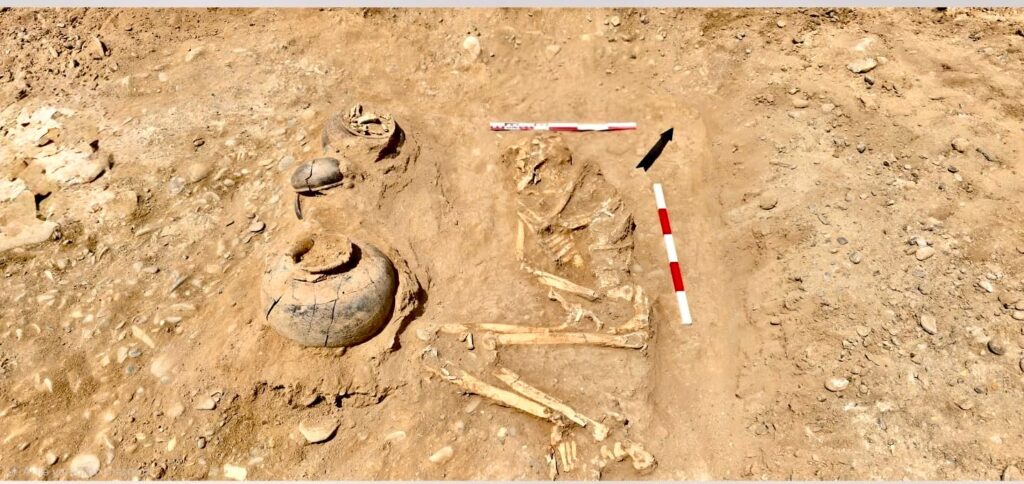
A Burial Built for a High-Status Individual
The stone-covered kurgan measures approximately 12 meters in diameter and rises around 80 centimeters above the surrounding ground. Its burial chamber extends to a depth of roughly 1 to 1.2 meters.
What makes the grave particularly significant is the combination of weapons and prestige objects recovered from the chamber. Researchers believe the assemblage belonged to an individual who occupied a high position within the military and social structure of the community, possibly as a warrior, commander or member of a ruling elite.
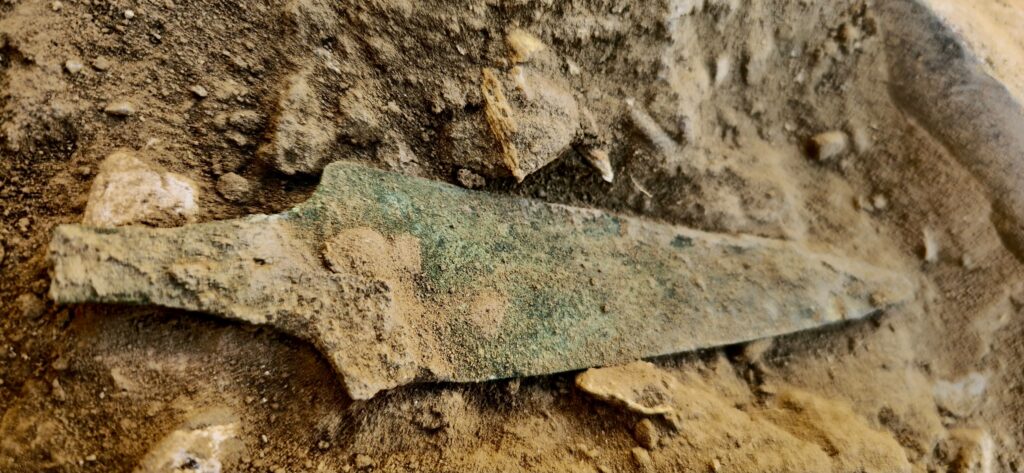
Among the finds is a bronze dagger, an object directly associated with close combat. Archaeologists regard its presence in the grave as one of the clearest indications that the deceased had a military role rather than simply possessing weapons as personal valuables.
The dagger, however, is only part of the picture.
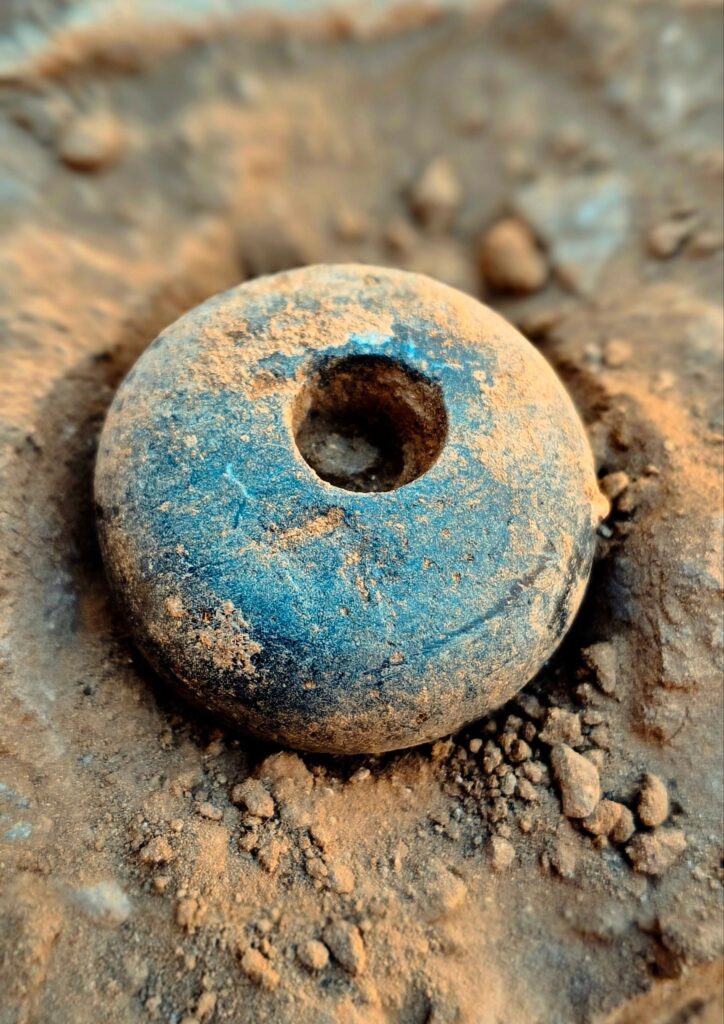
A Stone Mace That May Have Signified Authority
One of the most distinctive objects recovered from the kurgan is a mace head made from diorite. Weighing approximately 400–500 grams, the carefully shaped and polished stone has a central hole drilled from both sides, allowing it to be mounted on a wooden or bone handle.
Researchers suggest that objects of this kind could have served more than a practical function. In Bronze Age societies, a mace could also communicate rank and authority, becoming a ceremonial or symbolic object associated with military aristocrats, tribal leaders or commanders.
Its carefully balanced and symmetrical form is also significant. The workmanship provides evidence for a developed tradition of stone crafting in the South Caucasus, where artisans were capable of producing objects that combined practical design with visual expressions of status.
When considered alongside the dagger, the mace strengthens the interpretation of the burial as that of an individual whose identity was closely connected with warfare and authority.
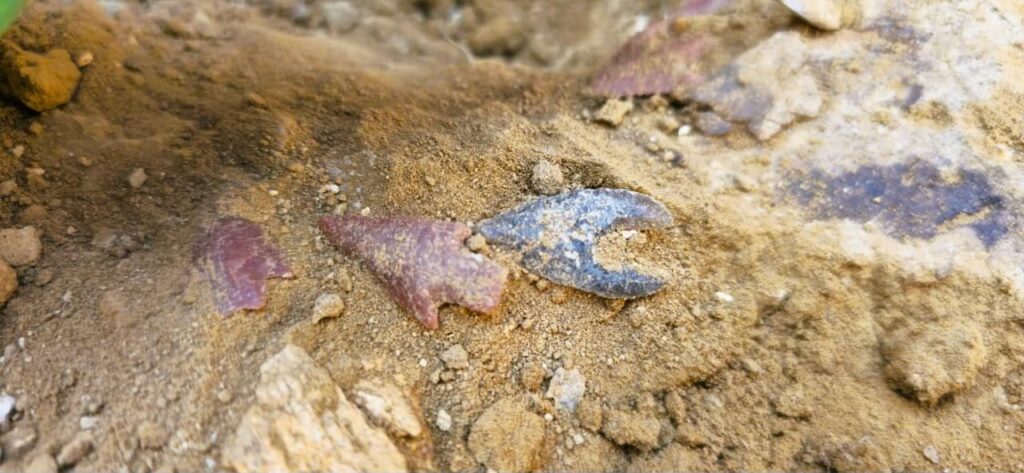
Obsidian and Flint Arrowheads Add to the Picture
Archaeologists also recovered several types of arrowheads from the grave. Among them are unusual winged examples, as well as two black obsidian arrowheads and nine finely worked flint specimens.
The obsidian finds are particularly informative because they point to the use of volcanic raw materials circulating within the region. Researchers believe they may help clarify how communities obtained and exchanged stone suitable for weapon production.
The flint arrowheads, distinguished by dark reddish tones and careful workmanship, add another element to the burial’s unusually rich weapon assemblage. Rather than relying on a single prestige object, the grave contained several categories of military equipment, reinforcing the interpretation that the deceased occupied an elevated position.
Dating the Kurgan More Precisely
The current chronology places the burial in the Middle Bronze Age, approximately the 17th–16th centuries BCE, but researchers are seeking a more precise absolute date. Samples collected during the excavation are expected to undergo radiocarbon analysis at laboratories in Japan, Türkiye and the United States.
Ceramic material and other finds from the kurgan are also undergoing preliminary conservation and laboratory processing before entering the collection of the Keshikchidagh reserve.
The excavation forms part of the “Scientific Archaeological Excavations and Summer School 6 in Keshikchidagh” project, carried out with the Institute of Archaeology and Anthropology of the Azerbaijan National Academy of Sciences and the Keshikchidagh reserve. The fieldwork is led by archaeologist Vagif Asadov and also involves students and young volunteers receiving practical archaeological training.
For researchers, the importance of Kurgan No. 4 lies not simply in the survival of individual weapons. Together, the mace head, dagger and arrowheads provide a rare archaeological glimpse into how military identity, social rank and authority may have been expressed through burial practices in the South Caucasus more than three and a half millennia ago.
