
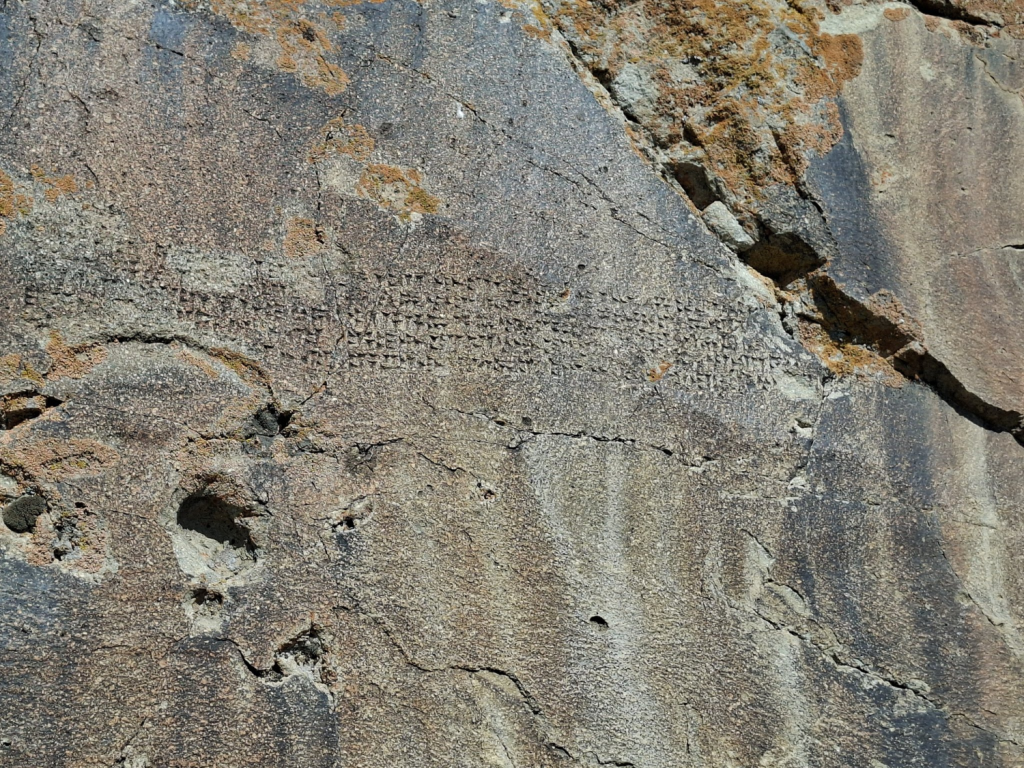
A Urartian cuneiform inscription carved into a rock face in Azerbaijan’s Nakhchivan region has been located by researchers, resolving a long-standing question around one of the rarest Iron Age texts known from the South Caucasus.
The inscription, dated to the 8th century BCE, records the names of the Urartian kings Ishpuini and Menua and refers to military victories, conquered cities, and a ritual offering made under the protection of the god Haldi. According to the Azerbaijan National Academy of Sciences’ Institute of Archaeology and Anthropology, the text is considered the first known written example linked to Urartian culture found in Azerbaijan.
A Known Inscription Whose Location Had Been Lost
The find is not a newly discovered text in the strict sense. The rock inscription in the Ilandagh area, also known in scholarship as Ojasar-Ilandagh, was first recorded in the late 1980s and entered academic circulation. But its exact position had not been clearly documented. For years, repeated attempts to locate the monument in the landscape reportedly failed.
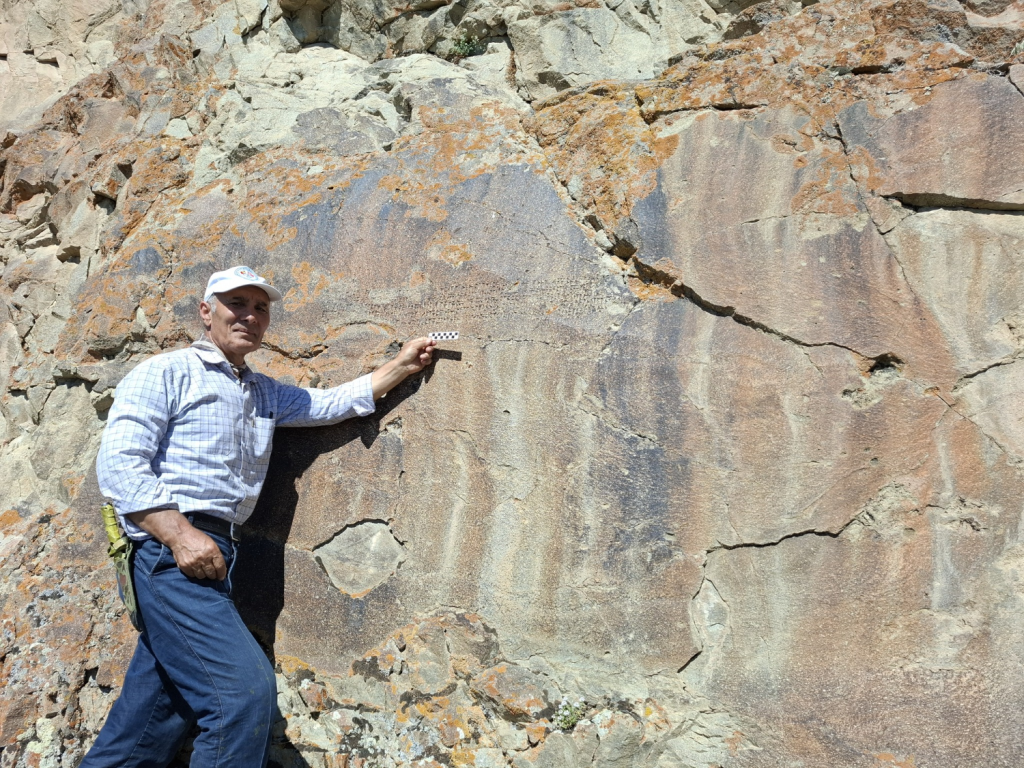
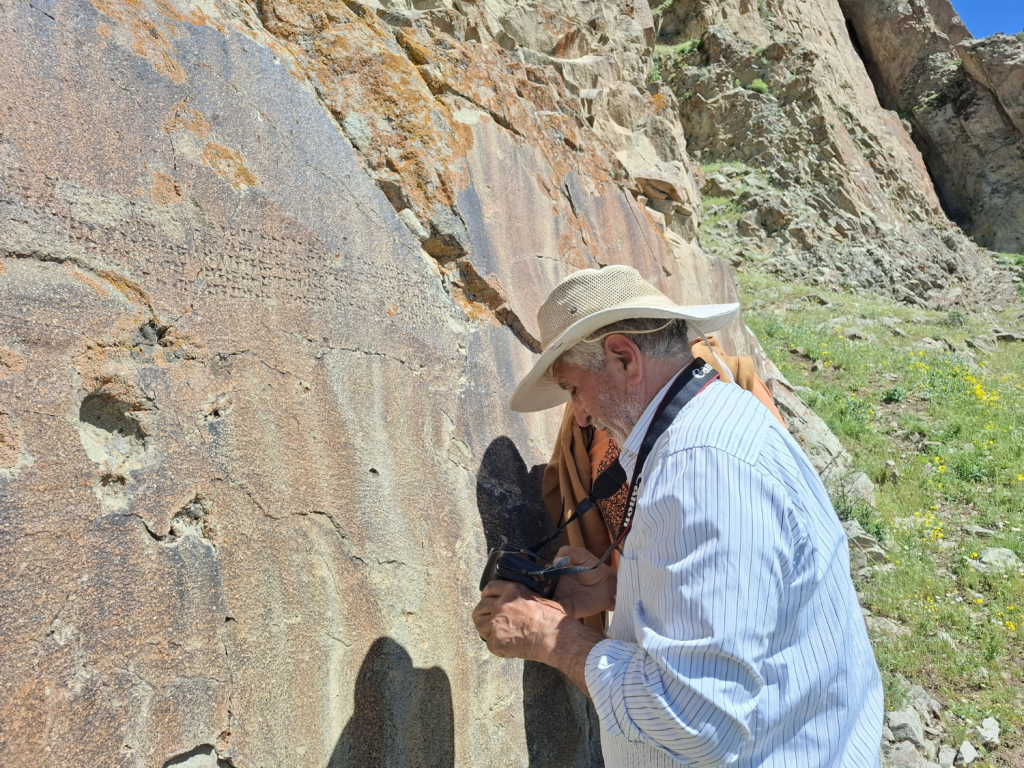
That changed on June 1, 2026, when a team of Azerbaijani researchers identified the site in the Ilandagh area. The group included Professor Vali Bakhshaliyev, deputy director for scientific affairs at the Institute of History, Ethnography and Archaeology of the Nakhchivan Branch of ANAS; Associate Professor Bahlul Ibrahimli, head of the Kharaba-Gilan archaeological expedition of the Institute of Archaeology and Anthropology; and researcher Huseyn Jafarov.
For archaeologists, this matters because a text without a secure location is only partly useful. Once the exact place is known, the inscription can be studied together with the terrain, nearby archaeological remains, routes of movement, and the wider political geography of the period.
Kings, Campaigns, and the God Haldi
The inscription mentions Ishpuini, son of Sarduri I, and Ishpuini’s son Menua, two rulers who belonged to the formative phase of the Kingdom of Urartu. Urartu was one of the major Iron Age powers of the highlands around Lake Van, expanding across parts of eastern Anatolia, the South Caucasus, and northwestern Iran.
The existing translation says that, “through the protection of the god Haldi,” Ishpuini and Menua conquered the city of Arshini, defeated its land, captured the land of Aniani, and destroyed it. The text also refers to the setting up of a stele for Haldi and to a ritual in the land of Puluadi, involving offerings to Haldi and to the god’s wife.
That religious language is not decorative. In Urartian royal inscriptions, Haldi stood at the center of kingship, warfare, and state ideology. Victory was framed as something granted under divine authority. The Ilandagh inscription therefore does more than name rulers and places. It preserves the political voice of an expanding Iron Age kingdom at the edge of its sphere of influence.
The Kings Behind the Ilandagh Inscription
Ishpuini is often seen as one of the decisive rulers in early Urartian history. His reign strengthened the kingdom after the rule of Sarduri I, who is associated with the rise of Tushpa, the Urartian capital near modern Van. Ishpuini also played a major role in elevating Haldi as the central deity of Urartian royal ideology.
Menua, his son and successor, continued this expansionist and building-oriented policy. His reign is associated with fortresses, inscriptions, irrigation works, and campaigns that helped turn Urartu into one of the most organized powers of the early first millennium BCE.
The Ilandagh text belongs to this world of frontier campaigns and royal messaging. Its reference to Arshini, Aniani, and Puluadi may help scholars examine how Urartian power reached into areas connected with Nakhchivan and the Araxes region. Even where ancient place names remain debated, the inscription shows that this landscape was not peripheral to the political imagination of Urartu.
A Rock Text Back in Its Landscape
The rediscovery of the inscription’s location gives researchers a chance to revisit older readings with modern documentation methods. High-resolution photography, 3D recording, mapping, and landscape survey could help clarify worn signs, assess the condition of the rock surface, and place the monument within a broader archaeological setting.
The inscription itself is relatively small, but its historical weight is considerable. Earlier documentation describes it as engraved on a flattened rock surface, roughly one meter high. Its survival in an open mountain landscape also raises questions about visibility. Was it meant to mark a route, a conquered zone, a ritual place, or a border of royal power? These are the kinds of questions that can now be asked more precisely.
For Azerbaijan’s ancient history, the Ilandagh inscription is especially important because it links Nakhchivan to the written political world of Urartu. In a region where many Iron Age societies are known mainly through material remains, a royal inscription gives names, actions, gods, and places. It turns the landscape into a historical document.
The next stage will be careful study rather than simple announcement. If examined in detail, the Ilandagh inscription could sharpen understanding of Urartian activity in Nakhchivan and illuminate one of the more complex frontier zones of the ancient Near East.
Azerbaijan National Academy of Sciences’ Institute of Archaeology and Anthropology
Cover Image Credit: Azerbaijan National Academy of Sciences’ Institute of Archaeology and Anthropology
