
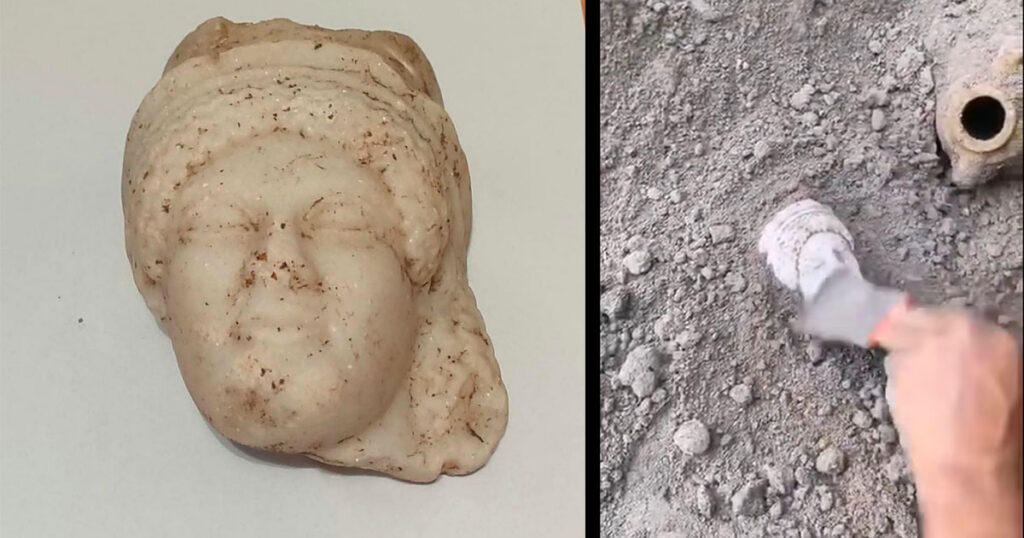
Archaeologists in Tunisia have uncovered a marble mask depicting a woman with a Phoenician-style coiffure, described as “unique in form and symbolism” and dating to the late fourth century BC. The discovery, made at the Tophet sanctuary of ancient Carthage, offers fresh insight into the artistic and spiritual world of the Punic civilization and its devotion to the deities Tanit and Baal Hammon.
The discovery, announced by the Tunisian Ministry of Cultural Affairs, adds a new dimension to the artistic and spiritual life of the Punic civilization, whose culture blended Phoenician, Berber, and Mediterranean influences. Specialists believe the mask may have served as a votive offering—an ex-voto—dedicated to the Carthaginian gods Tanit and Baal Hammon.
An Exceptional Work of Punic Art
Carved from a single block of fine white marble, the mask portrays a serene female face framed by an intricate Phoenician hairstyle composed of plaited locks and curls. Such coiffures, common in Phoenician sculpture and luxury goods, were symbols of status and religious devotion among Punic elites.
According to Professor Imed Ben Jerbania, director of the excavation team at Tunisia’s National Heritage Institute (INP), the mask’s craftsmanship and stylistic purity make it “one of the rarest examples of Punic portrait art ever discovered.” The object likely once hung within a sanctuary wall or stood on an altar as part of a ritual display honoring divine feminine power.
Preliminary laboratory analyses will determine the marble’s origin and the traces of ancient pigments still visible on its surface. Early results suggest a quarry source in the Eastern Mediterranean, supporting the theory of sustained trade between Carthage and Phoenician cities such as Tyre and Sidon.
The Tophet: Sacred Heart of Ancient Carthage
The Tophet of Carthage, situated near the ancient Punic ports, functioned as an open-air sacred precinct from the 8th to the 2nd century BC. Thousands of urns, stelae, and inscriptions have been unearthed there, revealing a complex ritual landscape dedicated to the deities Tanit—symbol of fertility and the moon—and Baal Hammon, lord of the sky and agricultural abundance.
The newly found mask deepens our understanding of this spiritual center. While many offerings at the Tophet were small clay figures or inscribed stones, a marble ex-voto of such refinement implies a commission by an aristocratic family seeking divine protection or expressing gratitude for prosperity.
The excavation forms part of a four-year partnership (2024–2028) between the INP and the Agency for Heritage Promotion and Cultural Development (AMVPPC), aiming to document the site scientifically and expand public access through museum exhibitions and digital archives.
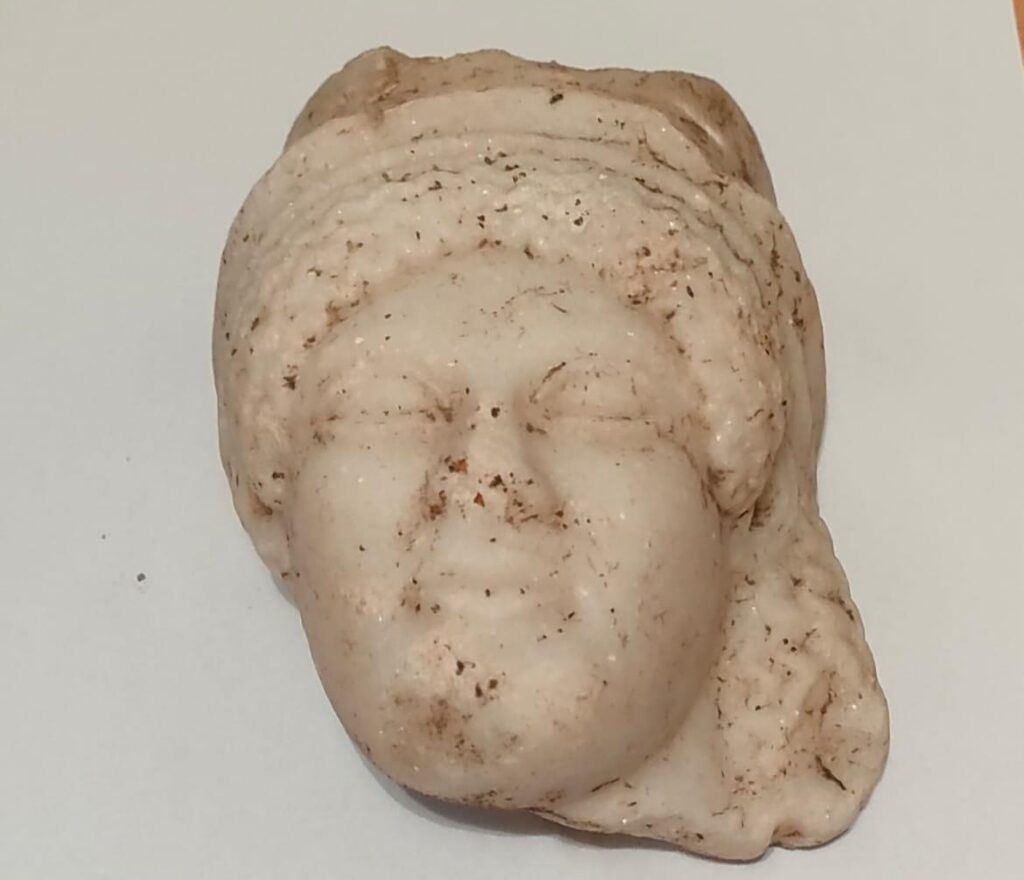
Archaeologists in Tunisia have uncovered a marble mask depicting a woman with a Phoenician-style coiffure, described as “unique in form and symbolism” and dating to the late fourth century BC. Credit: Tunisian Ministry of Cultural Affairs via Facebook
Carthaginian Faith and Symbolism
In Carthaginian religion, Tanit was venerated as the “Face of Baal”, embodying the life-giving forces of nature and maternal guardianship. Her emblem—a triangle topped by a circle and horizontal line—appears on countless Punic stelae. Baal Hammon, her divine counterpart, governed the sun and seasonal renewal. Together they represented balance between creation and destruction, an idea central to Punic cosmology.
The woman’s marble visage may have symbolized a priestess or devotee invoking Tanit’s blessing. Art historians note that the calm expression, delicate lips, and stylized hair align with motifs found in Eastern Phoenician temples, suggesting that Punic sculptors consciously adapted Levantine iconography to local religious contexts.
Continuing Discoveries in Carthage
This find follows other significant Tophet discoveries: Punic inscriptions unearthed in 2014 and nine gold coins associated with elite families in 2023. Together, these artifacts reveal a thriving cultural and religious network that positioned Carthage as a Mediterranean powerhouse before its fall to Rome in 146 BC.
The Ministry of Culture praised the mask as “a tangible witness to the creativity and spiritual depth of Punic Carthage.” After restoration, it will be showcased at the Carthage Museum, expected to attract scholars and visitors eager to explore Tunisia’s ancient heritage.
Carthage’s Enduring Legacy
The marble mask not only illuminates Punic artistry but also highlights Carthage’s role as a bridge between East and West. Its fine workmanship mirrors the cosmopolitan nature of a city that traded across three continents and merged traditions from Phoenicia, Greece, and North Africa.
As Professor Ben Jerbania notes, “Each discovery from the Tophet brings us closer to understanding how the Carthaginians saw themselves—devout, sophisticated, and deeply connected to their gods.”
The serene marble face, preserved through 2,300 years of history, now reemerges as a symbol of Carthage’s enduring dialogue between art, faith, and identity—a conversation still resonating across the Mediterranean world.
Tunisian Ministry of Cultural Affairs
Cover Image Credit: Tunisian Ministry of Cultural Affairs via Facebook
