
18 January 2026 The Future is the Product of the Past

Ancient Eco-Tech Uncovered in Lebanon: Phoenicians Used Recycled Pottery for Hydraulic Lime Plaster 2,700 Years Ago

Excavations at Tell el-Burak Reveal Technological Innovation and Early Sustainable Construction in Iron Age Lebanon

In a major archaeological breakthrough, researchers have identified the earliest known use of hydraulic lime plaster in Phoenician architecture—crafted not from volcanic ash like Roman concrete, but using recycled ceramic pottery. This discovery, made at the Iron Age site of Tell el-Burak in southern Lebanon, sheds light on ancient sustainability practices and high-level engineering previously unattributed to the Phoenicians.

The findings, published in Scientific Reports (2025), come from a multidisciplinary study of plaster samples collected from three installations, including a well-preserved wine press dating to ca. 725–600 BCE.

Ancient Wine Infrastructure Built with Recycled Pottery

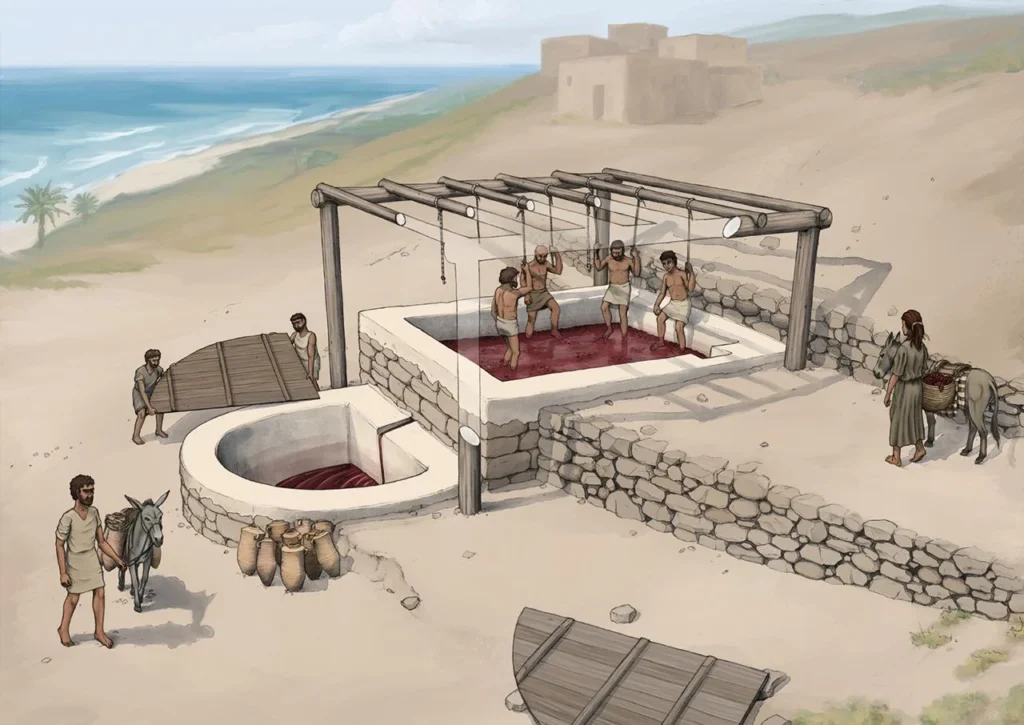
Located just 9 km south of Sidon, Tell el-Burak was a key agricultural hub for the Phoenician city-state. Among its most significant features is a massive wine press, consisting of a large grape treading basin connected to a 4,500-liter fermentation vat—both covered in a specialized lime-based plaster.

What made this plaster extraordinary was its composition: crushed ceramic fragments—likely broken amphorae—intentionally added to the lime binder. These ceramic inclusions acted as pozzolanic material, reacting chemically with the lime to form a hydraulic mortar—a material capable of setting and hardening in wet environments.


📣 Our WhatsApp channel is now LIVE! Stay up-to-date with the latest news and updates, just click here to follow us on WhatsApp and never miss a thing!!


“The presence of ceramic aggregates wasn’t just about recycling waste—it was a technological choice to produce water-resistant, durable plaster,” says lead author Dr. Silvia Amicone.

This practice predates Roman concrete and aligns more closely with early Greek and Aegean technologies, though rarely seen in the Levant before now.
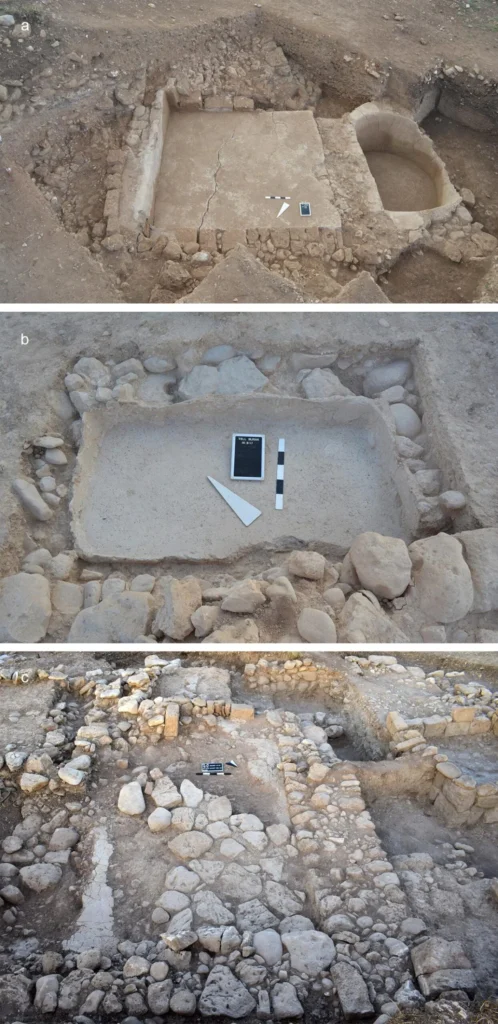
Plastered installations at Tell el-Burak, Lebanon: (a) The wine press in Area 4, viewed from the west; (b) A plastered basin beneath the courtyard floor of House 3 (Area 3), seen from the southwest; (c) A plastered floor in Room 1 of House 4, also in Area 3, viewed from the northeast. Credit: The Tell el-Burak Archaeological Project. Credit: S. Amicone et al., Scientific Reports (2025)

Scientific Evidence: A Multidisciplinary Approach

To confirm the hydraulic nature of the plaster, researchers applied a suite of scientific techniques, including:

Optical Microscopy & SEM-EDS: Identified chemical reaction rims between lime and ceramic, a hallmark of hydraulicity.

X-Ray Powder Diffraction (XRPD): Revealed mineral phases like gehlenite, cristobalite, mullite, and diopside, typically formed at high firing temperatures.

Thermogravimetric Analysis (TGA): Showed bound water levels above 3% and CO₂ losses under 30%, confirming hydraulic classification.

Organic Residue Analysis (ORA): Detected sulphur compounds in the plaster—possibly tied to wine production or amphora use.

These results confirm that Tell el-Burak’s builders knew how to manipulate materials to create durable, water-resistant plasters, long before such knowledge became standardized in Roman construction.

Ceramic Waste as Strategic Resource

The ceramic fragments used in the plaster were not just construction debris. Petrographic and mineralogical analyses suggest they came from pottery production waste, likely from the nearby site of Sarepta, a known Phoenician ceramic center 4 km away.

Interestingly, these ceramic pieces show a mix of firing temperatures:

Type 1: Low-fired sherds (below 850°C), highly reactive.

Type 2: Overfired, vitrified pieces (above 1050°C), less reactive but still used.

Despite being more difficult to source and process, the presence of high-fired fragments suggests intentional selection or reuse of pottery wasters, not accidental inclusion. Moreover, no ceramic production waste has been found at Tell el-Burak itself, reinforcing the idea of specialist labor and material transport.
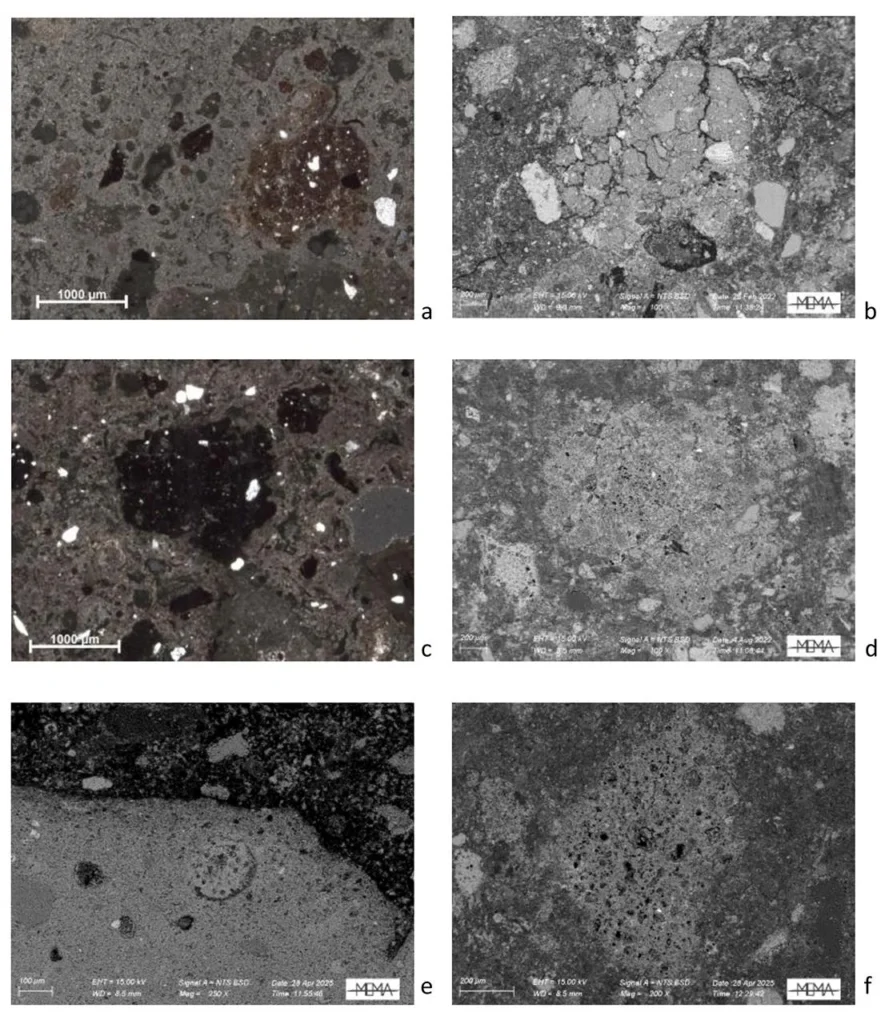
Thin-section microphotographs of ceramic aggregates used in Iron Age plaster at Tell el-Burak: (a, b, e) Type 1 ceramics—low-fired sherds with high porosity—shown under polarising light (XP) and in BSE imaging at high magnification; (c, d, f) Type 2 ceramics—high-fired, vitrified fragments—featuring isotropic matrix and bloating pores, also shown under XP and BSE. Credit: S. Amicone et al., Scientific Reports (2025)

Technological Innovation with Centralized Control

This level of material knowledge, consistency, and effort points to centralized, elite-driven production. The plaster installations at Tell el-Burak reflect more than technical ingenuity—they also suggest an organized economic system, where specialists could access and transport specific materials for construction.

The use of such advanced plaster in wine production infrastructure also aligns with archaeological evidence that viticulture was a key component of the Phoenician economy, both locally and for trade.

Mediterranean Connections and Historical Significance

This discovery significantly shifts the timeline and geographic origin of hydraulic plaster technologies. It supports the idea that Phoenicians—known maritime traders and cultural transmitters—played a vital role in spreading technological innovations like pozzolanic mortars across the Mediterranean during the Iron Age.

While Roman concrete would later dominate ancient architecture, this early Phoenician example illustrates indigenous innovation and environmental adaptation long before the Romans industrialized the method.

Amicone, S., Orsingher, A., Cantisani, E. et al. Innovation through recycling in Iron Age plaster technology at Tell el-Burak, Lebanon. Sci Rep 15, 24284 (2025). https://doi.org/10.1038/s41598-025-05844-x

Cover Image Credit: Reconstruction of the wine press at Tell el-Burak. Credit: A. Orsingher et al., Antiquity (2020)

Related Articles

An Elamite inscription attributed to Xerxes the Great was found at Persepolis

26 February 2022

26 February 2022

During the classification and documentation project of inscribed objects and fragmentary inscriptions in the Persepolis Museum reserves, experts discovered a...

New Study Exposes Origins of Welsh Dragons

7 June 2024

7 June 2024

In a new study conducted by a team from the University of Bristol and published in the Proceedings of the...

Rock Ship of Masuda, Japan’s mysterious monolith

17 April 2023

17 April 2023

Located in the Takaichi District of Nara Prefecture, Japan, the village of Asuka is famous for its mysterious stones. The...

A Rare Design in Roman Military Architecture: Triangular Stone Tower Discovered Near Sofia

22 July 2025

22 July 2025

Bulgarian archaeologists have uncovered a triangular stone tower — a rare architectural form in Roman military design — at the...

The 7th-Century Lombard Kings’ Tombs Found in Pavia, Italy

24 December 2024

24 December 2024

The excavations, conducted between September and October by the Catholic University, uncovered numerous burials attributed, on the one hand, to...

Archaeologists discovered a Thracian tomb from the time of the Odrysian kingdom in southern Bulgaria

13 September 2023

13 September 2023

Archaeologists from the Haskovo Regional Museum of History discovered a third Thracian tomb with murals the likes of those in...

Two Altars Used for Blood Sacrifices and Divinations Discovered in the Ancient Thracian City of Perperikon

14 September 2024

14 September 2024

In the ancient Thracian city of Perperikon, partly carved into the rock in the Eastern Rhodope Mountains of Bulgaria, two...

A burial complex dating to the Second Intermediate Period has been discovered at the Dra Abu el-Naga necropolis at Luxor

12 April 2023

12 April 2023

At the Dra Abu el-Naga necropolis in Luxor, a family burial complex from the Second Intermediate Period has been found....

Sicily: Archaeologists make striking discovery in Segesta

8 June 2021

8 June 2021

Archaeological excavations in the Segesta Archaeological Park, investigating a “monumental edifice” near the portico at the end of the old...

The Cairo University archaeological mission unearths the tomb of Ramses II’s royal treasurer at Saqqara necropolis

1 November 2021

1 November 2021

Archaeologists working at the Saqqara necropolis have unearthed the tomb of Ptah-M-Wiah, a high-ranking ancient Egyptian official and head of...

Gadebridge Park Roman Villa Marks England’s Largest Private Roman Swimming Pool

28 September 2025

28 September 2025

Beneath the grass and walkways of Gadebridge Park lies one of England’s most extraordinary Roman relics: a villa complex with...

Persian plateau unveiled as crucial hub for early human migration out of Africa, study suggests

29 March 2024

29 March 2024

60,000 to 70,000 years ago, our species Homo sapiens walked out of Africa and began to find new homes around...

Archaeologists have unearthed an incredible hoard of over 300 Iron Age ‘potins’ in West London

17 July 2021

17 July 2021

Archaeologists at an HS2 construction site in Hillingdon, West London discovered an astonishing treasure of over 300 Iron Age ‘potins”....

Archaeologists Unearth 2500-Year-Old Settlement in North Macedonia

10 April 2025

10 April 2025

Recent archaeological excavations at Gradishte, near the village of Crnobuki in North Macedonia, have unveiled a significant ancient settlement that...

What Lies Beneath Bor Ovoo? Turkish and Mongolian Researchers Set to Unearth Ancient Nomadic Traditions

20 July 2025

20 July 2025

Renowned historian Prof. Dr. Kürşad Yıldırım, a leading expert in Central Asian nomadic cultures from Istanbul University, is spearheading a...