
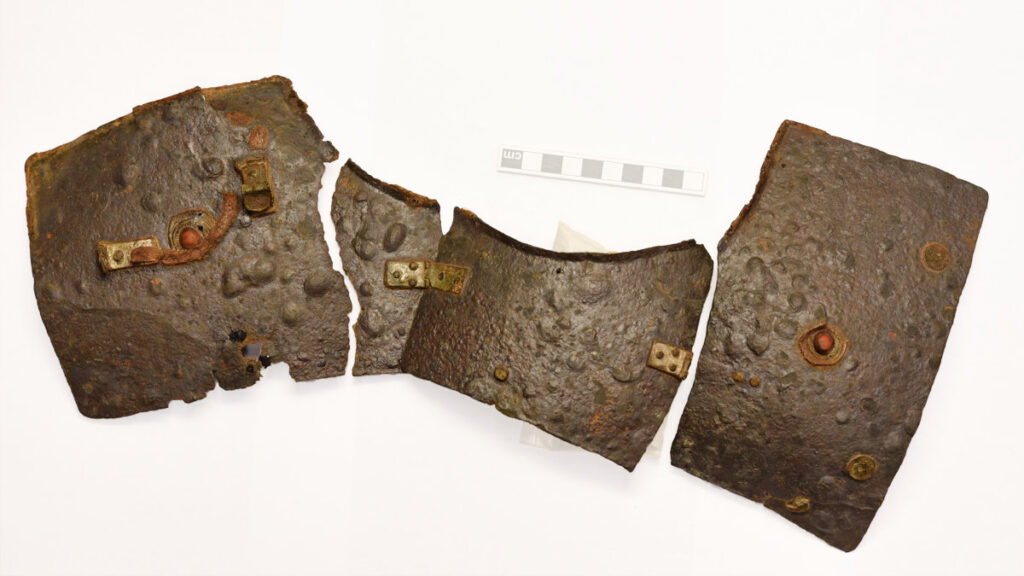
A nearly complete suit of Roman segmental armor recovered from the Kalkriese battlefield in Germany is offering an unprecedented look at how legionaries were protected during the reign of Emperor Augustus.
Dating to the early first century AD, the armor is considered the oldest known and most complete surviving example of its kind. Its importance extends beyond Roman military technology, however. A restraint found near its neck and shoulder area has raised the possibility that the armor may also be connected to the final moments of a Roman soldier captured after battle.
The artifact was unearthed in 2018 at Kalkriese, a site widely associated with the Battle of the Teutoburg Forest. In AD 9, an alliance of Germanic groups led by Arminius destroyed three Roman legions commanded by Publius Quinctilius Varus, bringing Rome’s eastward expansion into Germania to an abrupt halt.
The oldest surviving Roman segmental armor
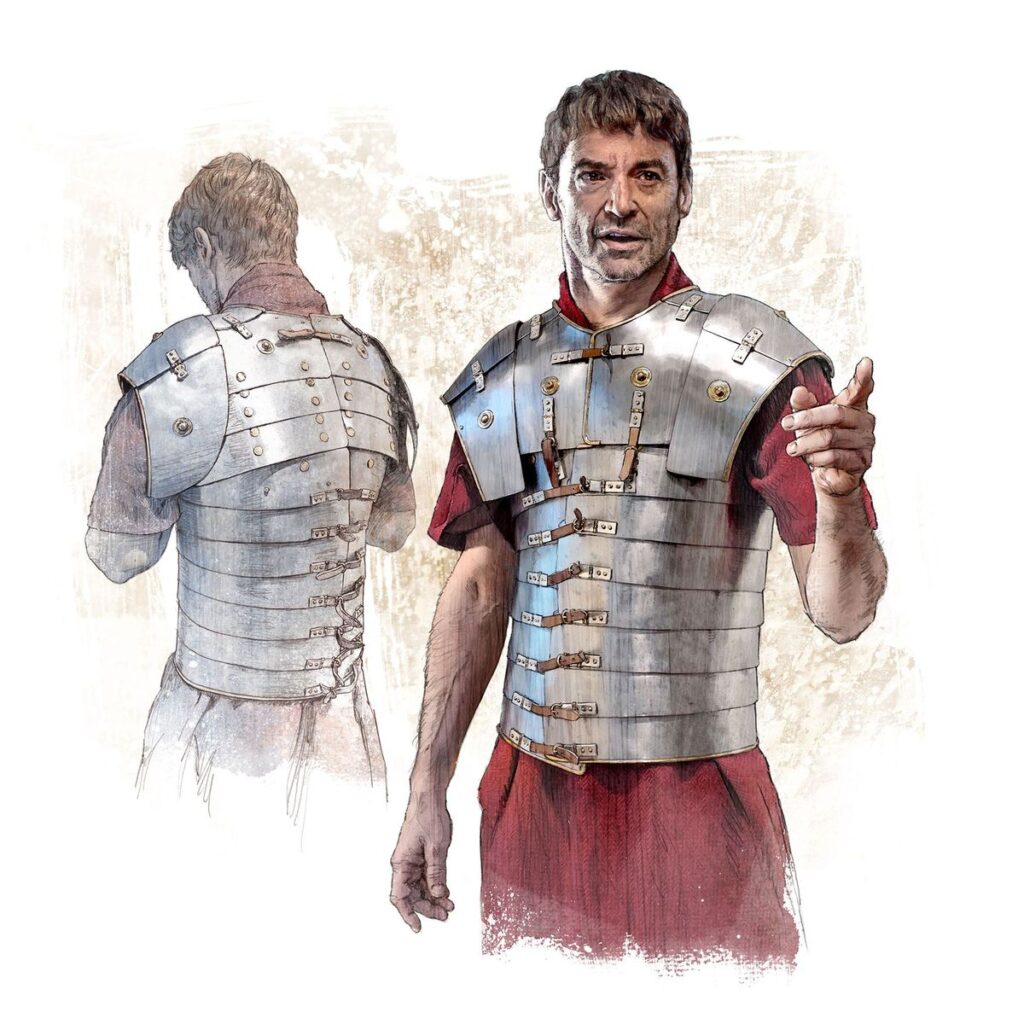
The armor belongs to the type commonly known as lorica segmentata, a protective system made from overlapping iron plates connected by hinges, buckles, and leather fittings.
Although this form of armor appears frequently in Roman reliefs and monuments, physical examples are extremely rare. Before the Kalkriese find, much of what archaeologists knew came from fragmentary remains, including six partial armor sections discovered at Corbridge in northern England.
Those pieces date to the second century AD. The Kalkriese armor is more than a century older, placing it close to the beginning of the segmental armor tradition.
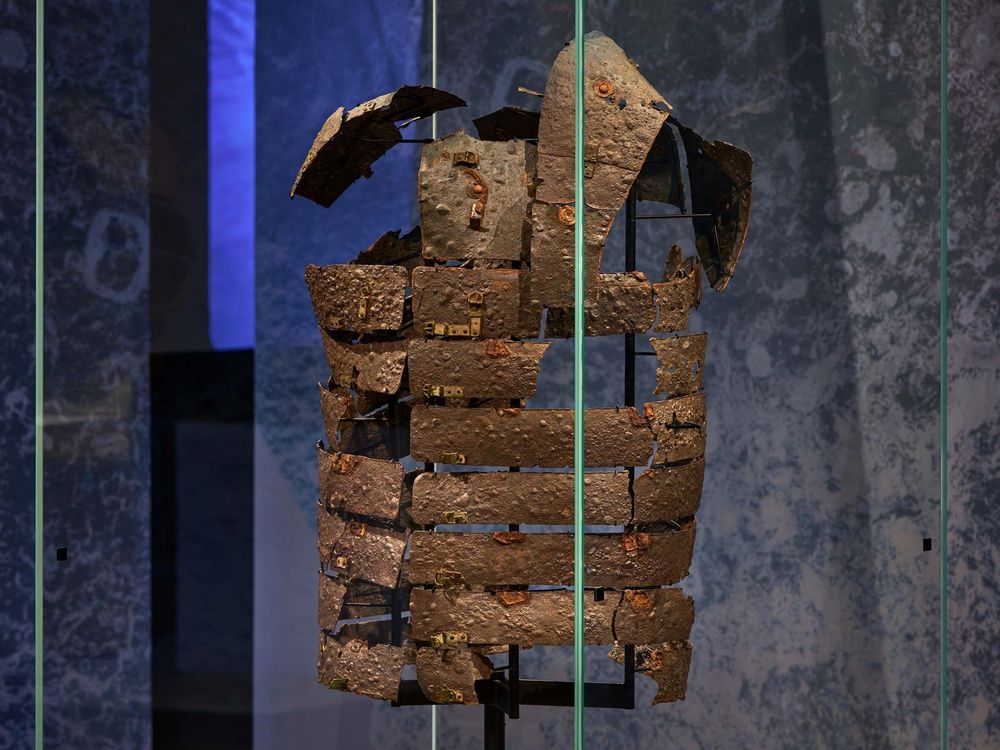
The surviving suit consists of approximately 30 individual plates, with only four or five believed to be missing. Hinges, buckles, bronze fittings, and traces of leather have also survived despite Kalkriese’s acidic and sandy soil.
The degree of preservation allows researchers to examine details that are normally absent from isolated armor fragments. It provides evidence not only for the shape of the plates but also for how the individual components were connected and how the suit moved when worn.
Early Roman armor was already highly developed
The Kalkriese example challenges the idea that early segmental armor was an experimental or technically crude predecessor of later designs.
Its fittings reveal a carefully engineered construction comparable in quality to armor produced more than a century later. The plates were arranged to create a flexible protective shell around the torso while still allowing the soldier to move.
The design was also different from the better-known later versions. The Kalkriese armor had no protective plate sections covering the upper arms. Its shoulder structure more closely resembled a sleeveless vest or supporting shirt.
This suggests that Roman armorers later modified the design by extending protection over the upper arms. Rather than following a single unchanged pattern, segmental armor appears to have developed through several technical stages.
The early Kalkriese suit may even have been more complex and carefully manufactured than some later examples. Researchers have identified a gradual tendency toward simpler construction, possibly as the Roman army sought to reduce production time and costs while equipping large numbers of soldiers.
A 500-kilogram block revealed by CT scanning
When archaeologists first encountered the object, they could only see that a large mass of metal lay beneath the ground. To avoid damaging it, they removed the surrounding soil as a single block measuring approximately 1.25 by 1 meter and weighing around 500 kilograms.
Initial X-ray examinations could not penetrate the dense mixture of soil and corroded metal. The block was therefore taken to the Fraunhofer Development Center for X-ray Technology in Fürth, where it was examined using an industrial XXL computed tomography system.
Around 1,500 images were recorded as the block completed a full rotation over several days. The scan revealed the compressed outline of an almost complete Roman suit of armor before conservators began removing the soil.
Over centuries, pressure from the ground had pushed the plates into one another like a collapsed accordion. Conservators subsequently exposed the armor plate by plate, beginning with the shoulder and chest sections.
Was the soldier taken alive?
The most unsettling part of the find is a Roman restraint discovered close to the armor’s neck and shoulder region.
Sometimes described as a neck fiddle, the device was designed to secure a prisoner’s neck and hands, severely restricting movement. The Roman army carried such restraints for controlling captives, many of whom could eventually be sold into slavery.
Its position has led archaeologists to consider whether the armor belonged to a legionary who survived the fighting but was captured by the Germanic victors. Under this interpretation, the soldier may have been restrained using a Roman instrument of submission taken from the defeated army itself.
The evidence does not prove that a captive soldier died at this exact location. The armor and restraint could also have been deposited during the looting or ritual treatment of objects collected from the battlefield.
Nevertheless, their close association provides a rare human dimension to the archaeological record at Kalkriese. Most finds from the battlefield consist of weapons, equipment, coins, and scattered military objects. The armor and restraint may preserve the trace of one individual caught in the collapse of Varus’s army.
More than an exceptional piece of military equipment, the Kalkriese armor connects Roman engineering with the violence experienced by the soldiers who wore it. Its plates document the advanced skills of imperial armorers, while the restraint beside it leaves open a darker possibility: that the man inside survived the battle only to fall into enemy hands.
VARUSSCHLACHT im Osnabrücker Land gGmbH – Museum und Park Kalkriese
