
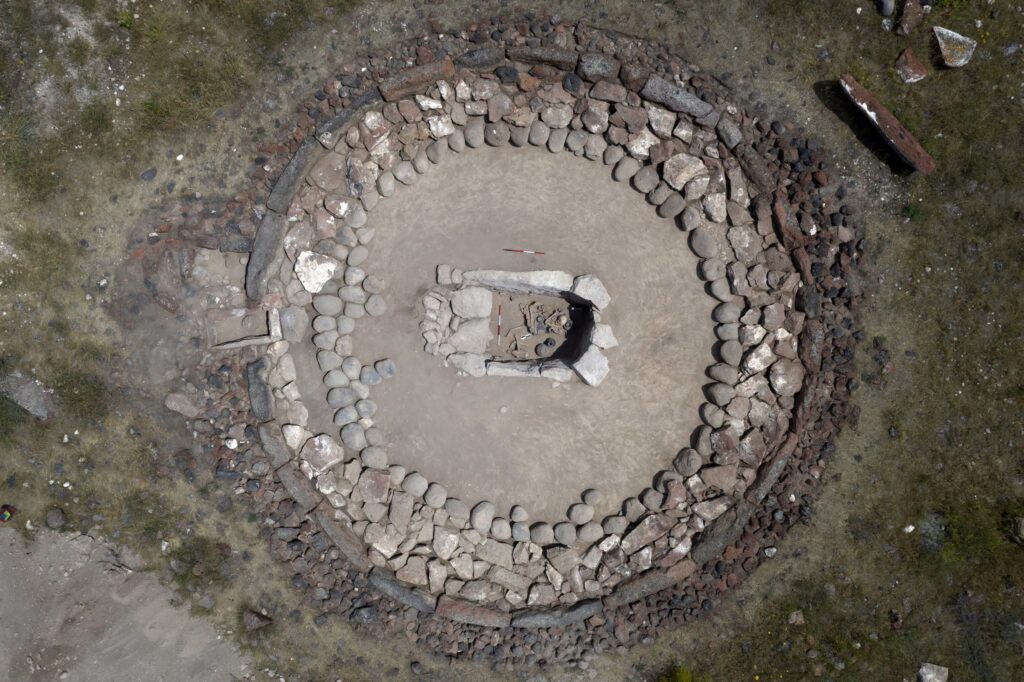
Archaeologists excavating a monumental Late Bronze Age tomb in western Armenia have uncovered bronze weapons, obsidian arrowheads and the remains of a horse sacrificed during an ancient funerary ceremony.
The burial, known as Tomb No. 3, lies within the sprawling archaeological site of Shamiram in Armenia’s Aragatsotn Province. Surrounded by concentric stone circles and built around a central stone chamber, the tomb offers new evidence of the wealth, rituals and social hierarchy of communities that lived in the Armenian Highlands more than 3,000 years ago.
The discovery was among the most important results of the 2026 excavation season conducted by a joint Armenian-Italian archaeological mission. The fieldwork ran from May 26 to June 25 and examined several sections of Shamiram’s fortified settlement, burial grounds and monumental defensive systems.
Weapons and a horse inside a monumental burial
Tomb No. 3 dates to the Late Bronze Age, broadly between 1600 and 1200 BCE. Its design includes several concentric stone enclosures surrounding a central burial chamber, a form of monumental construction that would have required considerable labor and organization.
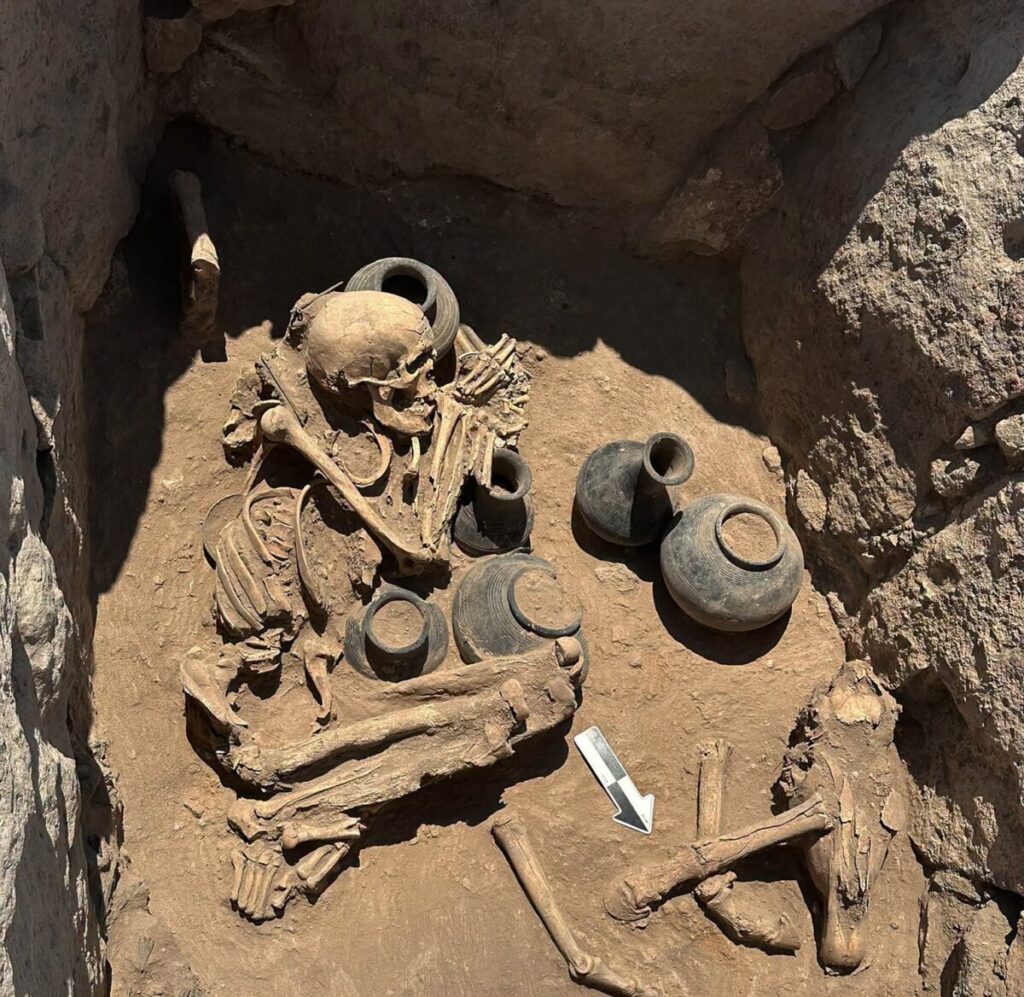
Inside, archaeologists documented rich grave goods including bronze weapons and arrowheads made from both metal and obsidian. The materials suggest that the people buried there were connected with warfare, hunting or displays of authority, although further study will be needed to determine the precise function of each object.
The burial also contained the remains of a horse believed to have been ritually sacrificed as part of the funerary ceremony. According to Armenia’s Institute of Archaeology and Ethnography, the combination of weapons, monumental architecture and animal sacrifice provides valuable evidence for studying local elites and the symbolic importance of horses in Late Bronze Age Armenia.
Horses carried practical and social importance across many Bronze Age societies. They could serve as animals of transport, sources of military prestige, and symbols of status. Sacrificing such an animal during a burial would therefore have represented a costly and highly visible act, possibly intended to emphasize the identity or rank of the deceased.
Researchers have not yet released detailed anthropological findings about the person or people placed inside the tomb. Analysis of the human remains and grave goods is expected to help clarify the burial’s chronology and the social position of its occupants.
Importantly, Tomb No. 3 was not first discovered during the 2026 season. The official Armenian announcement describes this year’s work as the continued excavation of the burial, meaning that the latest campaign expanded earlier investigations rather than revealing an entirely unknown tomb.
Shamiram before the rise of Urartu
The excavations also produced evidence from the centuries before Shamiram became part of the Urartian political world.
Behind one of the towers belonging to the later Urartian fortress, archaeologists found a Middle Iron Age room with distinct traces of fire and destruction. Beneath or associated with this level was an older burial that predates the construction of the Urartian defensive system.
This sequence may allow researchers to reconstruct how a local Iron Age settlement changed before and during the expansion of Urartu, also known as the Kingdom of Van. From approximately the ninth to the sixth centuries BCE, Urartian rulers controlled large parts of the Armenian Highlands and built major fortresses, administrative centers and irrigation systems.
Because the Shamiram layers preserve both pre-Urartian activity and later monumental construction, the site can provide evidence of whether the settlement was destroyed, reorganized or incorporated gradually into the expanding kingdom.
Urartian towers and a rebuilt gateway
Work continued across Shamiram’s fortified areas. At the structure known as Wall 2, archaeologists concluded that the L-shaped entrance visible today was probably reconstructed during the Hellenistic period over an earlier Iron Age gateway.
Excavations and cleaning at Tower 3 exposed a well-preserved Urartian megalithic structure measuring approximately 8.5 by 8.5 meters. Its scale supports the interpretation of Shamiram as an important fortified center rather than a small rural settlement.
Elsewhere, researchers uncovered column bases, structures built beside older Urartian towers, and well-preserved medieval buildings. These later additions show how Shamiram’s ancient walls continued to influence the settlement’s layout long after the fortifications had lost their original military purpose.
A settlement occupied for more than 3,000 years
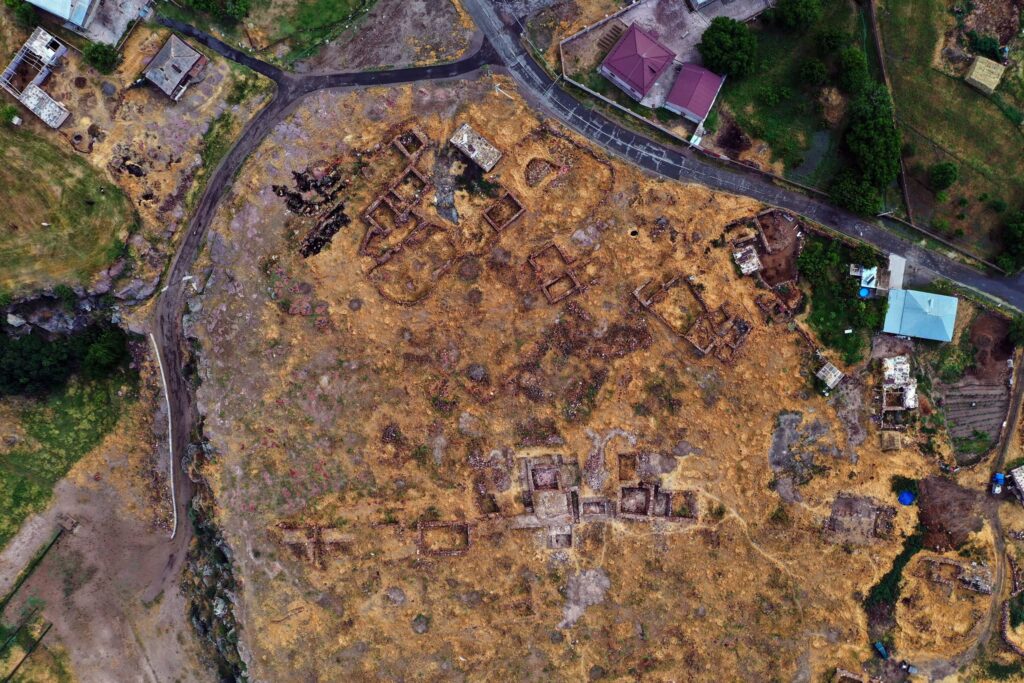
Shamiram occupies a broad fortified rocky plateau and contains defensive walls, habitation areas and extensive burial complexes. Archaeological evidence indicates that the site was repeatedly occupied from the Late Bronze and Iron Ages through the Urartian, post-Urartian, Hellenistic, Late Antique, medieval and post-medieval periods.
The excavations are directed by Varduhi Melikyan for Armenia and Roberto Dan for Italy. The project is a collaboration between the Institute of Archaeology and Ethnography of Armenia’s National Academy of Sciences and ISMEO, the International Association for Mediterranean and Oriental Studies. ISMEO also organized an archaeological workshop at Shamiram during the closing days of the 2026 field season.
Further archaeological, anthropological and scientific analysis will now examine the human and animal remains, weapons and other materials recovered from the site. The results may reveal who was buried in Tomb No. 3—and why a valuable horse was killed and placed beside them more than three millennia ago.
Institute of Archaeology and Ethnography of Armenia’s National Academy of Sciences
Cover Image Credit: Institute of Archaeology and Ethnography of Armenia’s National Academy of Sciences via Facebook
