
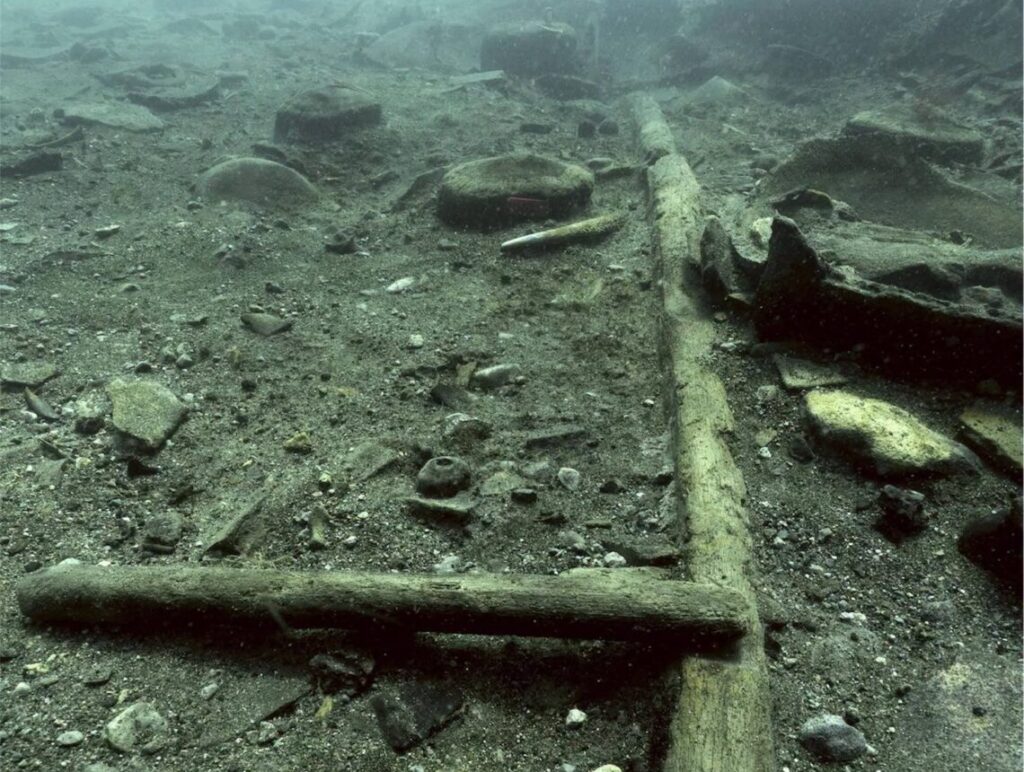
Archaeologists working beneath Lake Bolsena in central Italy have recovered the first textile fragment ever documented at the submerged prehistoric settlement of Gran Carro, more than six decades after investigations at the site began.
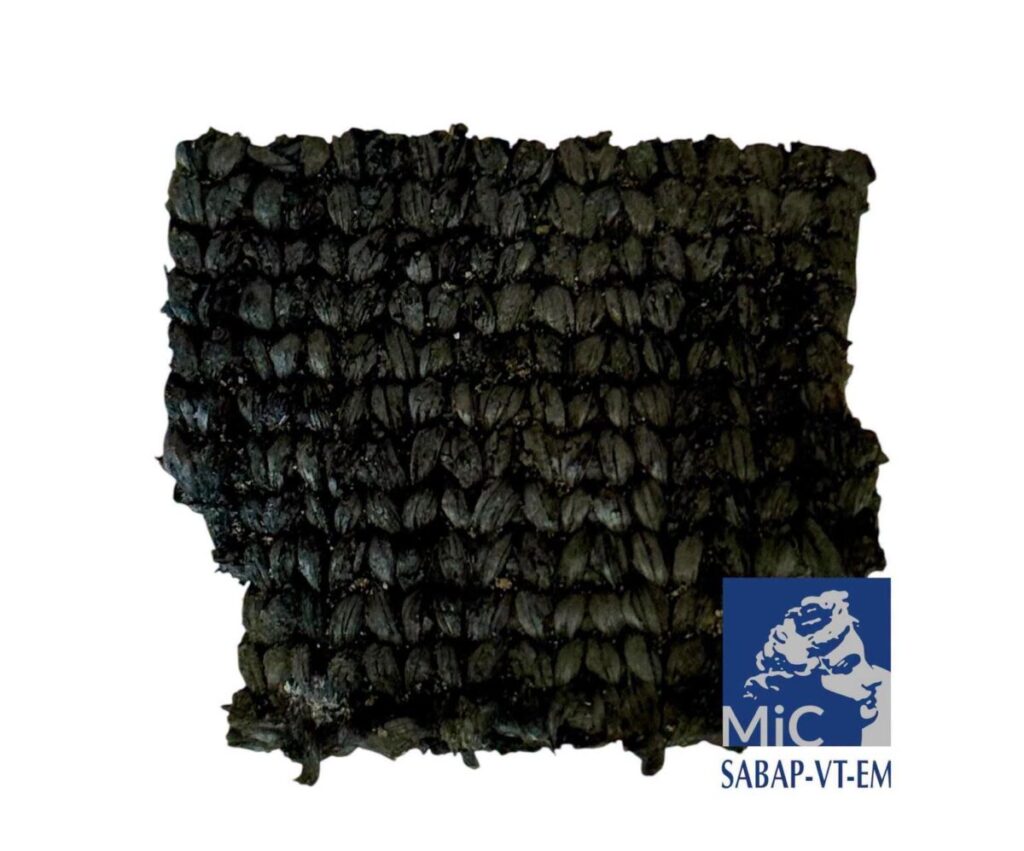
The small piece of fabric was discovered among the charred remains of a building associated with the settlement’s Early Iron Age occupation. Although specialist analysis has yet to begin, archaeologists have already identified a remarkably fine weave that suggests considerable technical skill almost 3,000 years ago.
The discovery was announced by the Superintendency of Archaeology, Fine Arts and Landscape for the Province of Viterbo and Southern Etruria, whose Underwater Archaeology Service is directing the current excavation campaign with L’Anfora SRL Archeologia Mare Ambiente and CSR Restauro Beni Culturali.
First fabric found after more than 60 years
Gran Carro was discovered in 1959 and investigated intermittently from the 1960s to the late 1980s. Archaeological work resumed in 2012 using methods including underwater stratigraphic excavation, photogrammetry and three-dimensional recording. Despite the survival of numerous wooden objects and tools associated with fibre production, no actual textile had previously been recovered.
The newly discovered fragment came from a limited area containing the carbonized remains of one of the settlement’s structures. Its exact material, thread composition and production method have not yet been established.
The fabric will be transferred to Italy’s Central Institute for Restoration, or ICR, for specialist examination. The analysis may identify the fibres used and provide a clearer picture of how the textile was made. Until those results are available, claims concerning its raw materials or possible non-local origins remain speculative.
A domestic loom inside an Iron Age house
The textile was not the only evidence of weaving uncovered during the latest campaign.
Archaeologists further exposed the remains of a domestic loom first identified in 2025. Its position inside one of the structures confirms that weaving was regularly carried out within the settlement’s houses rather than being restricted to a separate production area.
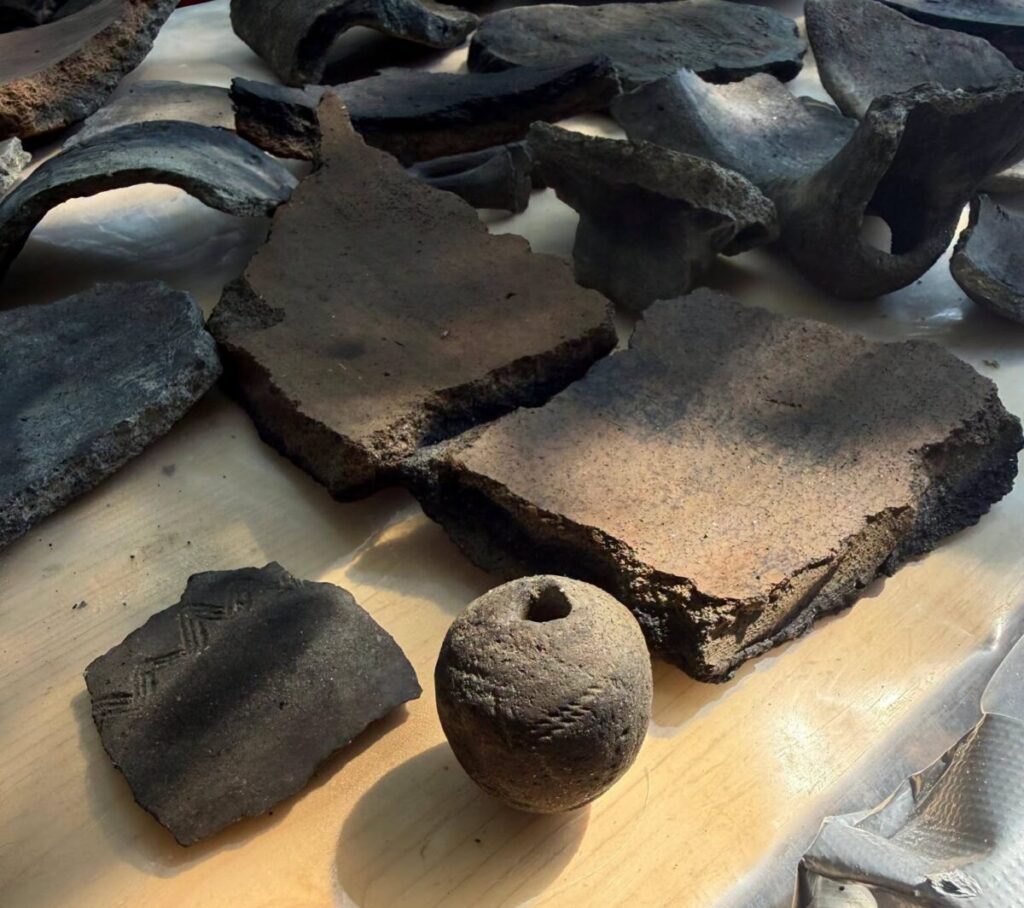
The result supports earlier discoveries from Gran Carro. Excavations in 2024 produced two wooden spindles—one still fitted with clay spindle whorls—and two comb-like objects interpreted as possible weaving tools. An anthropomorphic clay figurine found in the same settlement also preserved the impression of woven material beneath its chest, suggesting that it may once have been dressed.
Together, these finds document several stages of textile production, from preparing and spinning fibres to operating looms and producing finished cloth.
Bone tablet reveals another weaving technique
A perforated bone tablet was also recovered for the first time in Area 1 of the Gran Carro settlement.
The object is associated with tablet weaving, a technique in which warp threads are passed through holes in small tablets. By turning the tablets in controlled sequences, weavers could produce long, narrow and often highly durable bands.
Such bands may have been used as decorative borders, belts, straps, fastenings or structural reinforcements for clothing and other woven objects. The discovery indicates that Gran Carro’s inhabitants were familiar with more than one method of textile manufacture.
The vertical household loom was suited to producing broader fabrics, while tablet weaving allowed artisans to create narrow bands requiring precise control over individual groups of threads.
A settlement repeatedly destroyed and rebuilt
Gran Carro was established during the Middle Bronze Age, around the 15th century BC, but most of its surviving residential remains belong to the late 10th and 9th centuries BC. This period corresponds to the Villanovan culture, generally regarded as the earliest phase of Etruscan civilization.
The houses were originally constructed on dry ground close to the ancient shoreline rather than on platforms permanently standing above water. Rising lake levels later submerged the settlement and helped protect wooden structures, organic objects and occupation layers from later rebuilding.
Archaeologists have identified repeated sequences of fire, structural collapse and reconstruction. After individual buildings burned, their remains were covered with artificial layers of earth before new structures were erected above them. These accumulated deposits now preserve tools, ceramics and architectural remains in their original stratigraphic sequence.
A 2025 tree-ring and radiocarbon study of Gran Carro’s oak posts placed one analysed construction group most probably between 907 and 885 BC. The dating does not apply directly to the newly found textile, but it provides a more precise chronological framework for the settlement’s main Iron Age building phases.
Rare evidence of daily life before Etruscan cities
Gran Carro is considered one of the best-preserved protohistoric settlements in central Italy because it remained submerged after its abandonment and was not covered by later occupation.
Previous campaigns have recovered axe handles, wooden door fittings, fishing hooks, needles, bronze fibulae, chisels, storage vessels and a wicker basket that still contained a pale substance possibly connected with dairy production. Archaeobotanical research has also identified cereals and prepared food remains that provide evidence of farming, storage and cooking within the community.
The textile fragment adds a different category of evidence: a finished product created from fibres that normally decay before archaeologists can recover them.
Its importance therefore lies not in its size but in the direct connection it provides between weaving tools, domestic working areas and the fabric produced by Gran Carro’s inhabitants.
Excavation and conservation work will continue as the textile and bone tablet undergo specialist study. The new finds are also expected to join objects presented in the exhibition L’infinita varietà del tessere: Dall’epoca villanoviana a oggi, being held in Bolsena and Montefiascone until September 10, 2026.
Soprintendenza Archeologia Belle Arti Paesaggio Etruria Meridionale
Cover Image Credit: Soprintendenza Archeologia Belle Arti Paesaggio Etruria Meridionale via Facebook
