
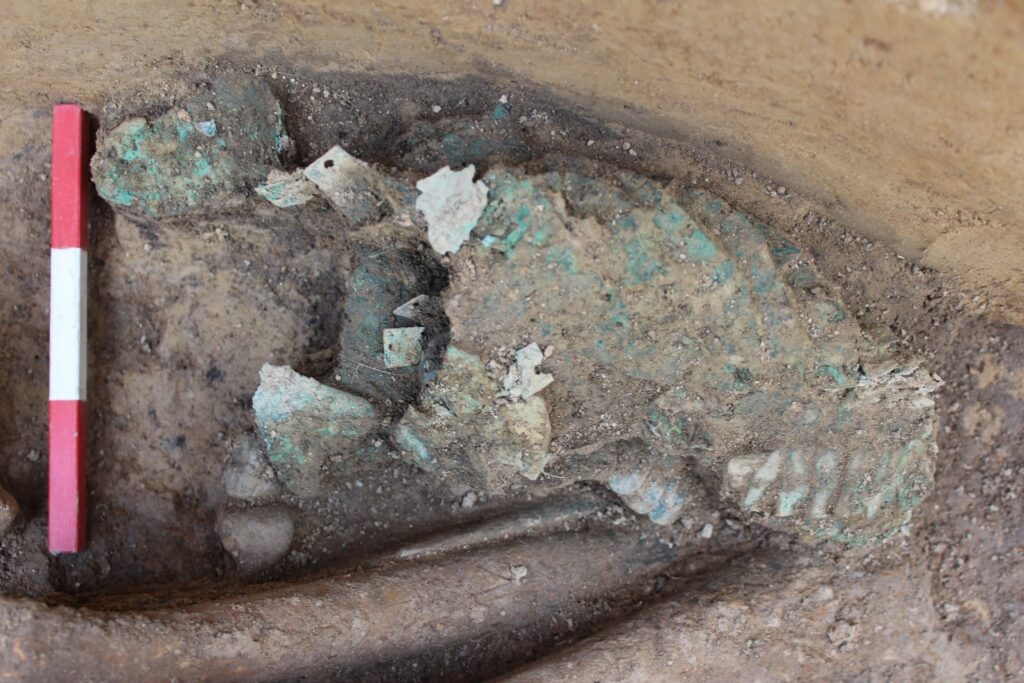
Archaeologists in southwestern Slovakia have uncovered a 7.4-hectare Roman military camp near Šurany, together with human remains, weapons, armor, coins, and traces of soldiers’ footwear. Dating to the second half of the 2nd century CE, the camp was probably used during the Marcomannic Wars, when Emperor Marcus Aurelius sent Roman armies north of the Danube.
The discovery was made in the southern section of the planned Šurany Industrial Park. More than 150 hectares have been examined since the large-scale rescue excavation began, but archaeologists describe the Roman camp as the most significant find recorded at the site so far.
What they have found is not simply another temporary military enclosure. Complete skeletons and disarticulated human remains were discovered in defensive ditches, storage pits, possible wells, and hastily dug shallow graves. The condition of the camp suggests that it ceased to function immediately after a confrontation between Roman forces and local Germanic groups.
An Unusual Roman Camp with Five Gates
Roman marching camps were temporary fortified bases constructed by troops during military campaigns. Their defensive ditches, earthen ramparts, and controlled entrances gave soldiers a protected place to rest, reorganize, and store equipment while operating far from permanent forts.
The Šurany camp differs from the familiar rectangular plan associated with many Roman military sites. Its outline is irregular, although archaeologists have identified the principal elements expected in a Roman field fortification, including ramparts and five entrance gates.
One entrance was protected by a structure known as a clavicula. This consisted of a curving ditch and rampart that restricted direct access to the opening, forcing anyone entering the camp to change direction while remaining exposed to its defenders. Although clavicula gates are known from Roman camps elsewhere in Europe, this is the first example identified in Slovakia.
Matej Ruttkay, director of the Archaeological Institute of the Slovak Academy of Sciences, said the camp is the first of its kind discovered in the Ponitrie region. Its position helps fill a major geographical gap in evidence for Roman operations north of the Danube during the final decades of the 2nd century.
The scale of the rescue project has also allowed researchers to investigate almost the entire camp. Temporary Roman camps are often detected only through aerial photography, geophysical survey or limited sections of their defensive ditches. Excavating such a large proportion of one site is comparatively rare.
Bodies Found with Roman Armor and Weapons
The human remains provide the most unsettling evidence from the camp.
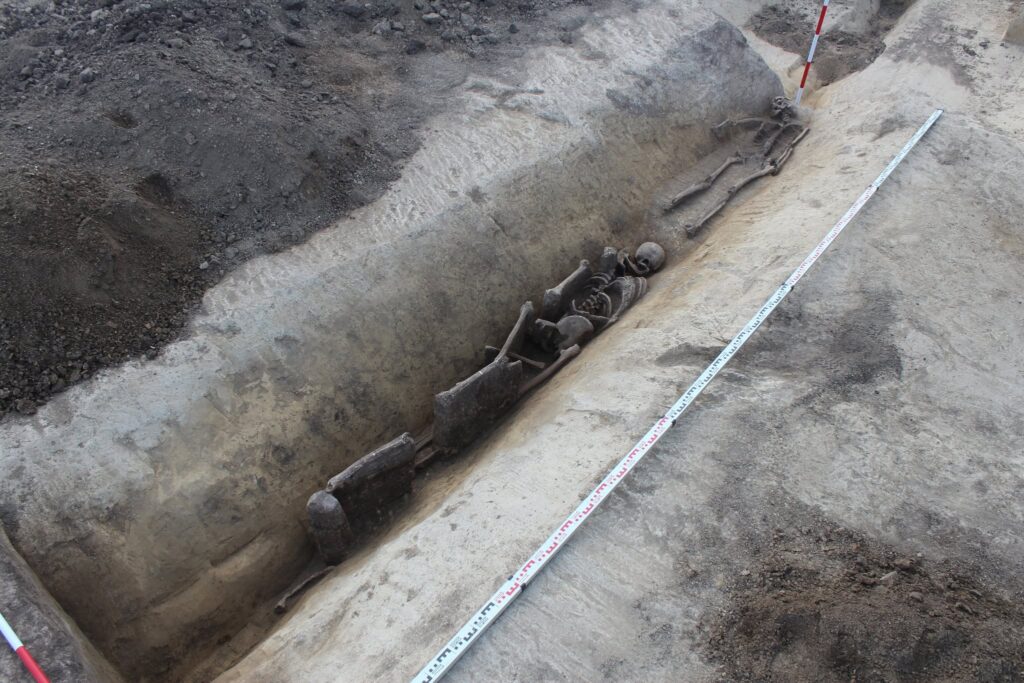
Archaeologists found complete bodies as well as separated skeletal elements deposited in several parts of the site. Some appear to have been placed in hastily prepared graves, while others were left in deep features originally used for different purposes.
The researchers’ preliminary interpretation is that many of the dead were Roman soldiers. This has not yet been confirmed through biological analysis, but numerous pieces of Roman military equipment were recovered beside or close to the remains.
The finds include spearheads, arrowheads, helmet fragments, legionary brooches and pieces of both segmented plate armor and scale armor. Coins and iron hobnails from caligae—the heavy sandals commonly associated with Roman troops—were also found. More personal objects include an axe, a cutting implement and a gaming die.
These objects raise an important question. Valuable military equipment would normally have been recovered, reused or looted after a battle. Its survival alongside the bodies may indicate that the camp was abandoned under unusual circumstances, although archaeologists have not yet established exactly what happened.
Combat injuries are one possibility, but disease may also have contributed to the deaths. Genetic, anthropological and isotopic studies will examine the origins, health, diet and biological relationships of the people buried at the site. Researchers also hope to distinguish injuries caused around the time of death from older trauma.
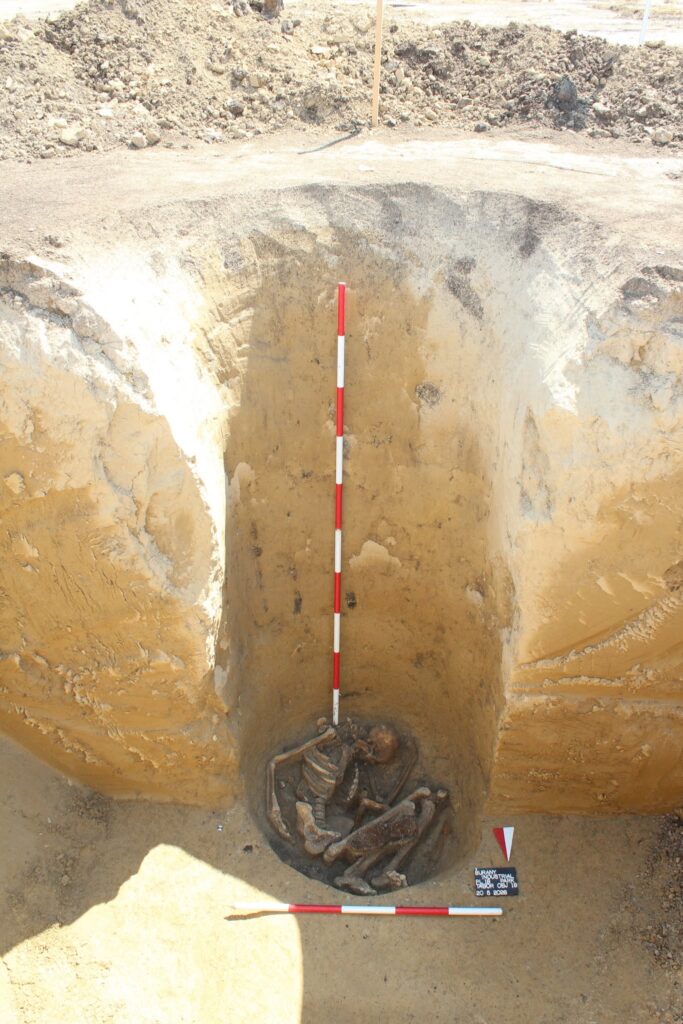
Skeletal remains believed to belong to Roman soldiers were found in pits and ditches at the Šurany site, where archaeologists uncovered a 2nd-century military camp linked to the wars of Marcus Aurelius. Credit: ArÚ SAV – M. Ruttkay, M. Vojteček, M. Cheben, MH Invest via Facebook
Marcus Aurelius and Rome’s Wars North of the Danube
The camp belongs to one of the most difficult periods of Marcus Aurelius’ reign.
The Marcomannic Wars, conventionally dated from 166 to 180 CE, involved repeated conflict between Rome and several Germanic and Sarmatian peoples along the Danube frontier. Among Rome’s principal opponents were the Marcomanni, the Quadi and the Iazyges.
Roman counteroffensives intensified from around 172, carrying imperial forces across the Danube and into territories that had never become permanent Roman provinces. Temporary camps such as the one at Šurany are therefore direct archaeological evidence of troop movements beyond the empire’s established frontier. More than 30 such installations have been documented across parts of the Middle Danube region, many associated with operations against the Marcomanni and Quadi.
Marcus Aurelius spent much of the final phase of his reign directing these campaigns. The wars form a striking contrast with his modern reputation as the “philosopher emperor.” His private reflections, later collected as the Meditations, were written partly while he was on military service along the Danube.
At the end of the work’s first book, Marcus recorded that he was writing “among the Quadi, on the Granua,” generally identified with the Hron River in present-day Slovakia. A Roman marching camp previously detected near Želiezovce has consequently been proposed as one possible location connected with the composition of the text, although this identification remains a hypothesis rather than a proven fact.
Another major trace of the same campaigns survives at Trenčín. A Latin inscription carved into the castle rock in 179 CE commemorates a Roman victory and records the presence of 855 soldiers of the Second Auxiliary Legion at Laugaricio, usually associated with ancient Trenčín. Until recent archaeological discoveries, it remained one of the clearest pieces of evidence for Roman forces operating deep inside what is now Slovakia.
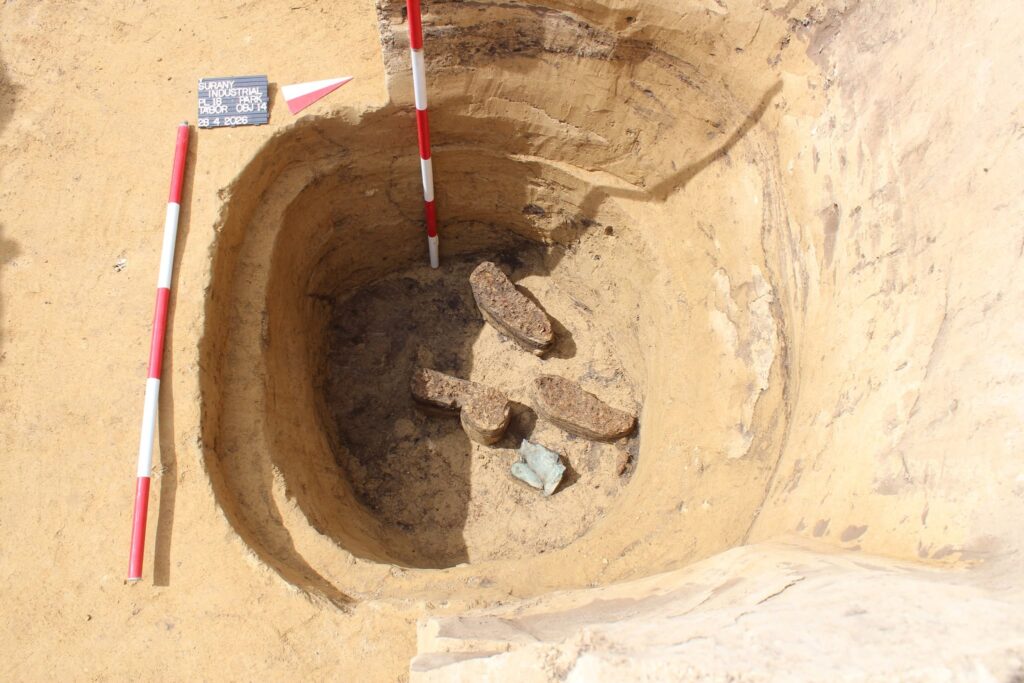
Traces of a Roman soldier’s footwear preserved at the Šurany military camp, including iron hobnails from the soles of caligae, the sandals worn by Roman troops. Credit: ArÚ SAV – M. Ruttkay, M. Vojteček, M. Cheben, MH Invest via Facebook
Years of Analysis Ahead
Some of the most fragile objects from Šurany were removed inside blocks of soil and examined with X-rays before conservation. Researchers said one block preserved enough of a Roman soldier’s original footwear to make it possible to estimate its size.
Radiocarbon dating will be conducted in Poznań, while specialists in the Czech Republic will study soil sediments. Archaeogenetic analysis is planned at the University of Vienna, with isotope research involving laboratories in several countries.
The work is expected to continue for years. Until those results are available, the camp offers a rare and unusually direct view of Marcus Aurelius’ northern wars—not through a triumphal monument or an imperial account, but through the remains of the soldiers who camped, fought and died beyond Rome’s Danube frontier.
Cover Image Credit: ArÚ SAV – M. Ruttkay, M. Vojteček, M. Cheben, MH Invest via Facebook
