

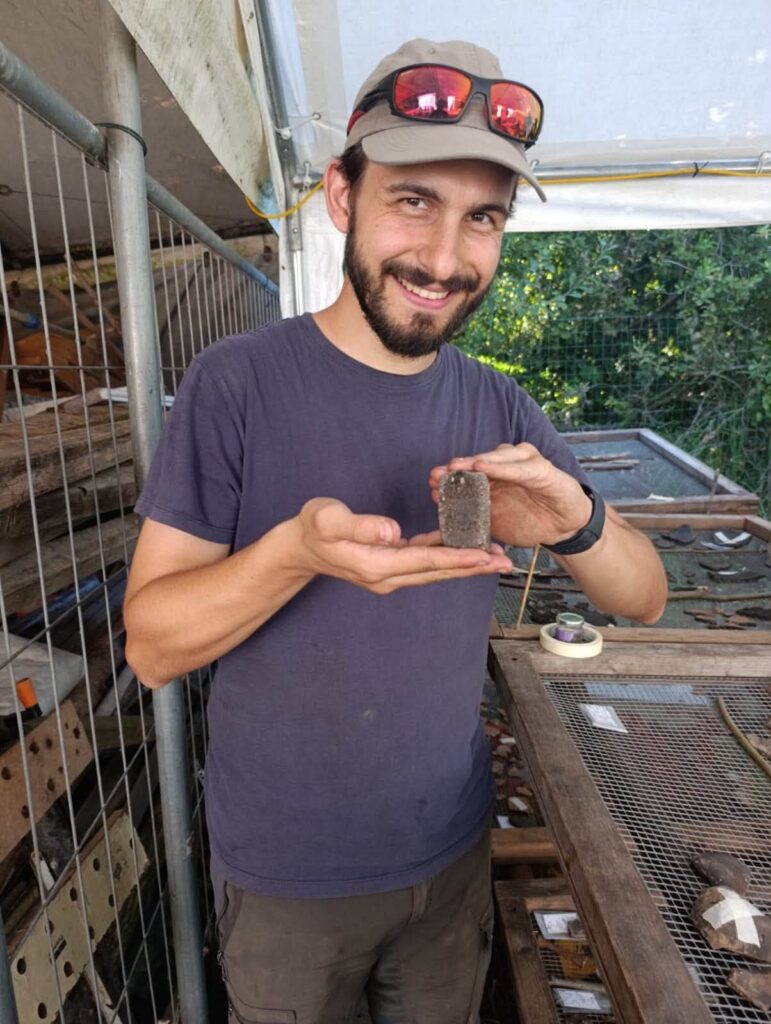
Archaeologists excavating the prehistoric settlement of Lucone di Polpenazze, near Lake Garda in northern Italy, have uncovered a rare intact clay object covered with mysterious geometric markings. The Bronze Age enigmatic tablet is the first such artifact found at Lucone since 2019 and brings the total known from the Lucone plain to 21: more than at any other archaeological site, according to the excavation team.
The tablet emerged during the third week of the 2026 excavation campaign from a charcoal-rich archaeological layer designated US 1015. It is only the third enigmatic tablet recovered from Lucone’s Site D, the area currently under investigation. Its survival intact makes the discovery particularly valuable because many examples of these puzzling objects are known only as fragments.
A 4,000-year-old object with an unknown purpose
The newly discovered artifact belongs to a distinctive group known in Italian archaeology as tavolette enigmatiche, or “enigmatic tablets.” German-language scholarship often calls them Brotlaibidole, literally “bread-loaf idols,” after the rounded or loaf-like appearance of many examples.
Despite the name “tablet,” they should not be confused with the written clay tablets of Mesopotamia. No accepted writing system has been identified on them. Instead, their surfaces carry combinations of incised lines and impressed geometric signs, including circles, dots, triangles, squares and rectangular motifs. Examples can be made from clay or, more rarely, stone. The Archaeological Museum of Valle Sabbia notes that Lucone specimens display considerable variation in shape and decoration.
Comparable objects appeared across parts of northern Italy and Central and southeastern Europe during the Early and Middle Bronze Age, broadly between the late third and second millennia BCE. A Bronze Age example from nearby Polada, for instance, is dated to approximately 2200–1700 BCE.
The geographical spread of the objects is one reason they continue to attract attention. Similar combinations of lines and impressions occur hundreds of kilometers apart, raising the possibility that the markings formed part of a shared symbolic system understood by communities participating in long-distance networks.
Were they calendars, trade documents or sacred objects?
Their function remains unresolved. Researchers have proposed interpretations ranging from calendars and ritual objects to counting devices, identification tokens and records connected with exchange. One particularly persistent hypothesis links them to Bronze Age trade, possibly including the circulation of metals.
That interpretation remains a hypothesis rather than a decipherment. There is currently no agreed method for reading the symbols, nor evidence demonstrating that they represent language in the conventional sense. Their importance may instead lie in repeated combinations of standardized signs that could have communicated information without constituting writing.
Research at Lucone has already provided evidence for connections beyond the Lake Garda region. Studies of the settlement have argued that finds including enigmatic tablets and faience beads point toward exchange networks linking northern Italy with Central Europe and the Carpathian Basin.
Modern researchers have also used 3D scanning and morphological comparison to examine whether impressions and patterns on tablets found far apart were produced according to shared conventions. Such work could eventually establish whether particular motifs correspond to regions, commodities, communities or other forms of Bronze Age interaction.
Lucone preserves an unusually detailed Bronze Age world
The discovery is particularly significant because of its archaeological setting. Lucone di Polpenazze once occupied a small wetland basin in the hills west of Lake Garda. Several prehistoric settlement areas have been identified there, while excavation of Lucone D has been underway since 2007.
Dendrochronological research indicates that trees used to construct the village were first felled at around 2034 BCE, with building and repair activity continuing into the late 20th century BCE. The settlement therefore provides an unusually precise chronological window into life around 4,000 years ago.
At one stage, part of the village was devastated by a major fire. Wooden architectural elements collapsed into the wet environment, where waterlogging and charring helped preserve materials that normally disappear, including wooden tools, plant remains, textiles, cereals and elements of houses. The combination has allowed archaeologists to reconstruct aspects of food production, construction and everyday life at an exceptional level of detail.
Lucone is also one of the Italian components of UNESCO’s Prehistoric Pile Dwellings around the Alps, a World Heritage property comprising 111 prehistoric settlements in six European countries. UNESCO lists Lucone specifically among the Italian components of the transnational site.
The new tablet therefore adds more than another unusual artifact to the Lucone collection. With 21 enigmatic tablets now recorded from the plain, the site offers archaeologists an unusually large dataset for comparing signs, manufacturing techniques and archaeological contexts. Whether the objects recorded exchanges, measured time, identified individuals or served an entirely different purpose remains unknown, but Lucone is increasingly becoming one of the key places where that Bronze Age mystery might eventually be solved.
