
8 November 2025 The Future is the Product of the Past

Rare 15th-Century Coin Hoard of the Grand Duchy of Lithuania Unearthed in Smolensk: The ‘Dollar of the Middle Ages’ Found

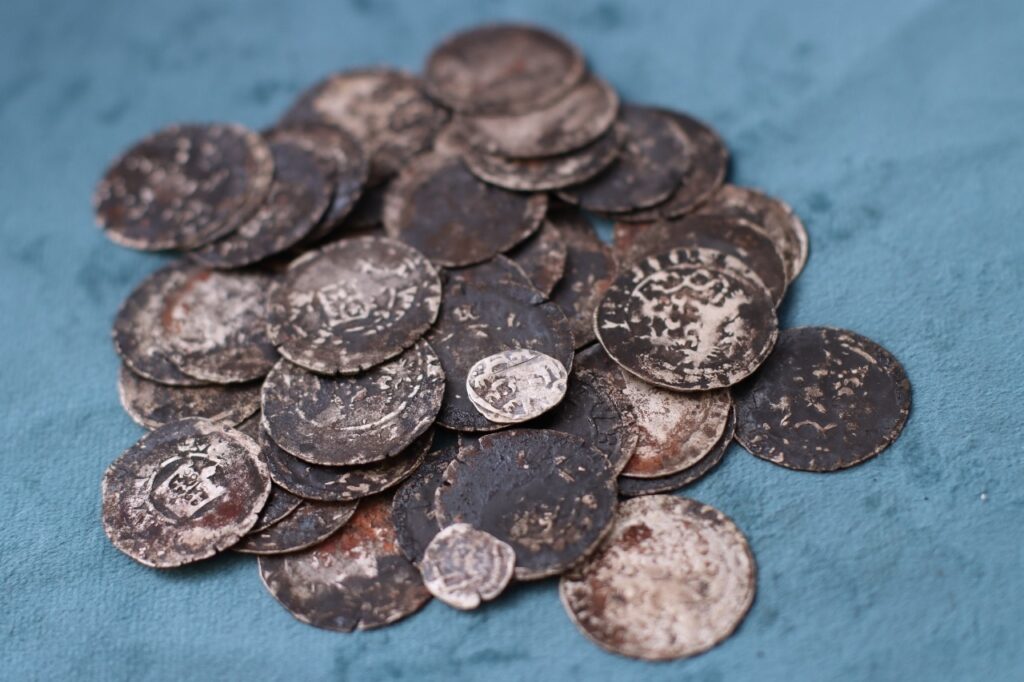
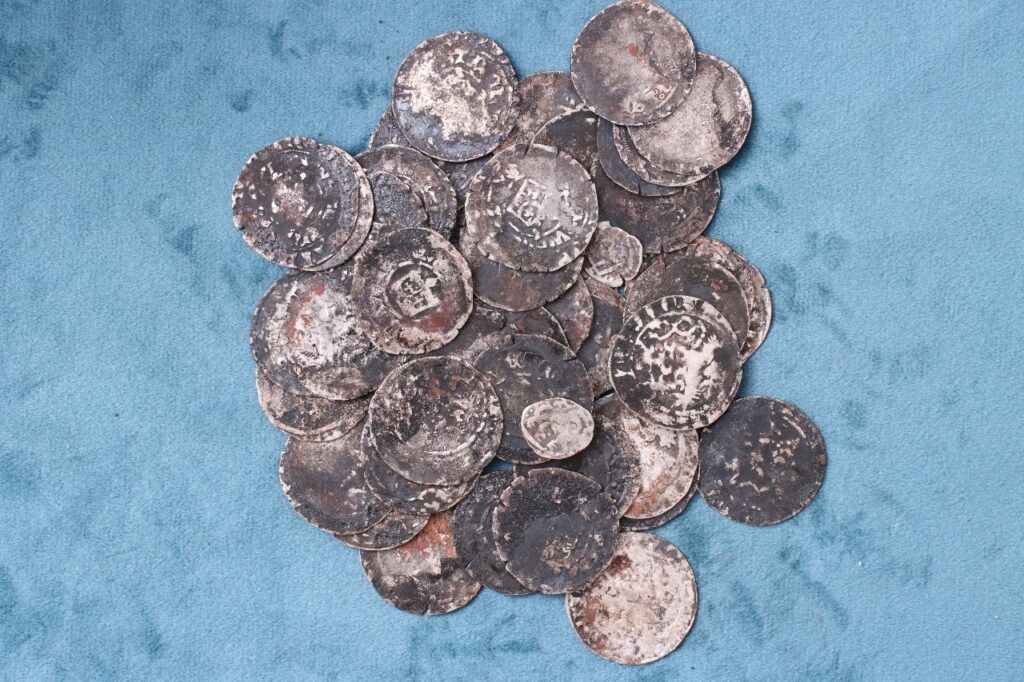
Smolensk archaeologists uncover 48 medieval silver coins, including Prague groschen — widely known as the ‘Dollar of the Middle Ages’ — a Lithuanian denarius, and a Crimean dang, shedding light on Eastern Europe’s monetary networks in the early 1400s.

Archaeologists in Russia’s Smolensk region have unearthed an exceptionally rare medieval treasure: a hoard of 48 silver coins dating back more than 600 years to the early 15th century. The discovery, made during routine construction works on Sobolev Street, marks only the second hoard from the era of the Grand Duchy of Lithuania ever documented in the city. Experts say the find is of extraordinary importance, both for Russian archaeology and the broader study of medieval Eastern European trade.

The find in Smolensk

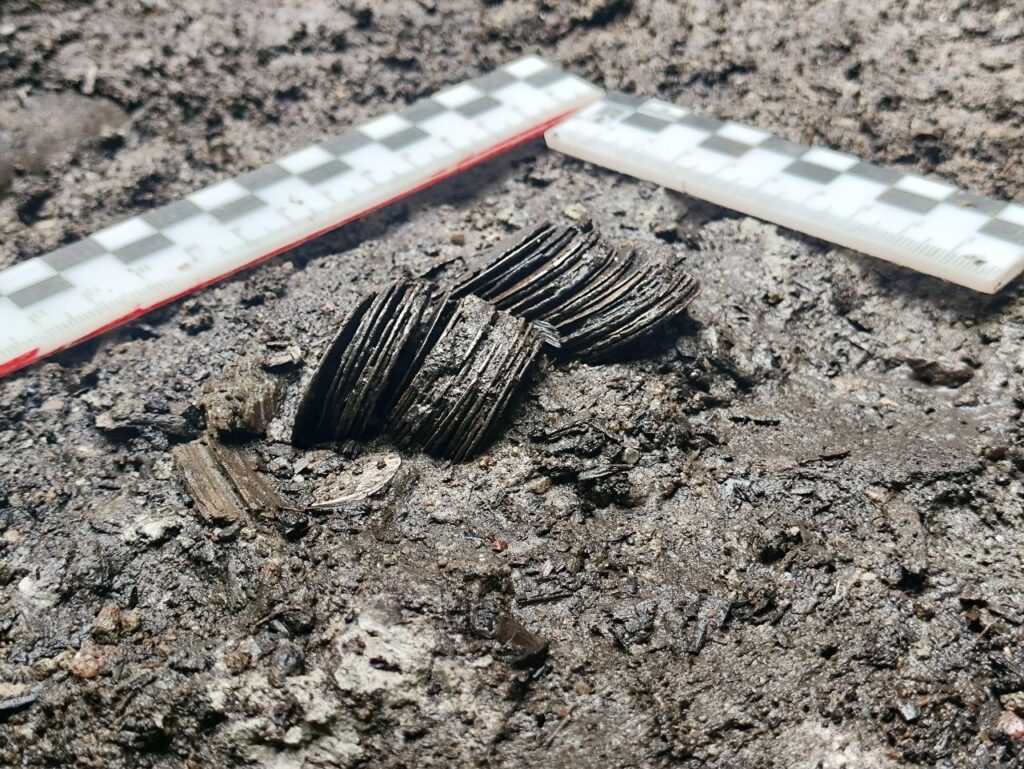
The coins were discovered inside a technological shaft during excavation work for a new water pipeline. According to the Smolensk expedition team of the Institute of Archaeology of the Russian Academy of Sciences, the hoard had been deliberately hidden in the 1420s—a turbulent period when Smolensk stood at the crossroads of competing powers: the Grand Duchy of Lithuania, the Grand Duchy of Moscow, and the Golden Horde.

Most of the 48 silver coins turned out to be Prague groschen, one of the most widely circulated currencies of medieval Europe. Minted after the monetary reform of King Wenceslas II of Bohemia in 1300, the groschen quickly became a trusted international coinage, circulating across Central and Eastern Europe well into the 15th century.

Alongside these were two particularly significant coins: a denarius of the Grand Duchy of Lithuania, struck during the reign of Vytautas the Great (1392–1430), and a Crimean dang minted around 1420 under Khan Beg-Sufi of the Golden Horde’s Crimean ulus. The presence of these three distinct monetary traditions in one small hoard highlights the intense commercial and political interactions that characterized the early 1400s.


📣 Our WhatsApp channel is now LIVE! Stay up-to-date with the latest news and updates, just click here to follow us on WhatsApp and never miss a thing!!


Members of the Institute of Archaeology of the Russian Academy of Sciences (IA RAS) expedition reported this unique find on VKontakte. Credit: IA RAS / VKontakte

Prague groschen: the Dollar of the Middle Ages

The Prague groschen was minted from nearly pure silver extracted from the Kutná Hora mines in Bohemia, one of Europe’s richest deposits at the time. Each coin weighed about 3.5 grams and was widely trusted for its consistent silver content. Historians often describe the groschen as the “dollar of the Middle Ages,” since it was accepted from the Baltic to the Balkans. Its dominance made it a key driver of regional trade, including exchanges involving Smolensk merchants, who were active on routes between the Baltic ports, Novgorod, and the Black Sea.

The Lithuanian denarius and the Column symbol

The Lithuanian denarius included in the hoard bears the heraldic emblem known as the Columns of Gediminas, one of the earliest dynastic symbols of the Grand Duchy of Lithuania. On the reverse, it displays a spear topped with a cross, emphasizing Vytautas’s authority and Christian legitimacy at a time when Lithuania was consolidating power as one of the largest states in Europe. The denarius was a small change coin, typically weighing less than a gram, but its presence in Smolensk confirms the city’s integration into the Lithuanian monetary sphere during Vytautas’s reign.
Smolensk archaeologists uncover 48 medieval silver coins, including Prague groschen — widely known as the ‘Dollar of the Middle Ages’ — a Lithuanian denarius, and a Crimean dang, shedding light on Eastern Europe’s monetary networks in the early 1400s. Credit: IA RAS / VKontakte

A Crimean link: the dang of Beg-Sufi

Perhaps the most surprising element of the hoard is the inclusion of a Crimean dang. Minted in the early 15th century, this coin carries the name of Khan Beg-Sufi, who ruled a Crimean branch of the Golden Horde from 1419 to 1421. Dangs were fractional silver coins, commonly used across the steppe and Black Sea trade hubs. Its presence in Smolensk suggests active trade contacts linking Lithuanian-controlled territories with Crimean ports such as Kaffa (modern Feodosiya), which were crucial for the export of grain, wax, and furs.

Why the hoard was hidden

Archaeologists believe the hoard was buried during political instability in the 1420s, when Smolensk’s allegiance was contested between Lithuania and Moscow. Hiding wealth in small earthen or wooden containers was common practice during times of unrest, with the hope of retrieving it once stability returned. In this case, the owner never came back.

Historical significance

The Smolensk hoard is only the second Lithuanian-era treasure ever documented in the city. The first, discovered in 1988, weighed over 12 kilograms and consisted entirely of silver coins—making it one of the largest medieval hoards ever found in Russia. By contrast, the new discovery is modest in size but remarkable for its diversity, featuring coins from three distinct political entities: Bohemia, Lithuania, and the Crimean Khanate.

Such finds provide crucial insights into medieval Smolensk as a hub of trans-regional exchange. They illustrate not only the circulation of wealth but also the overlapping spheres of influence—Lithuanian, Muscovite, and steppe—that shaped the city’s destiny in the 15th century.
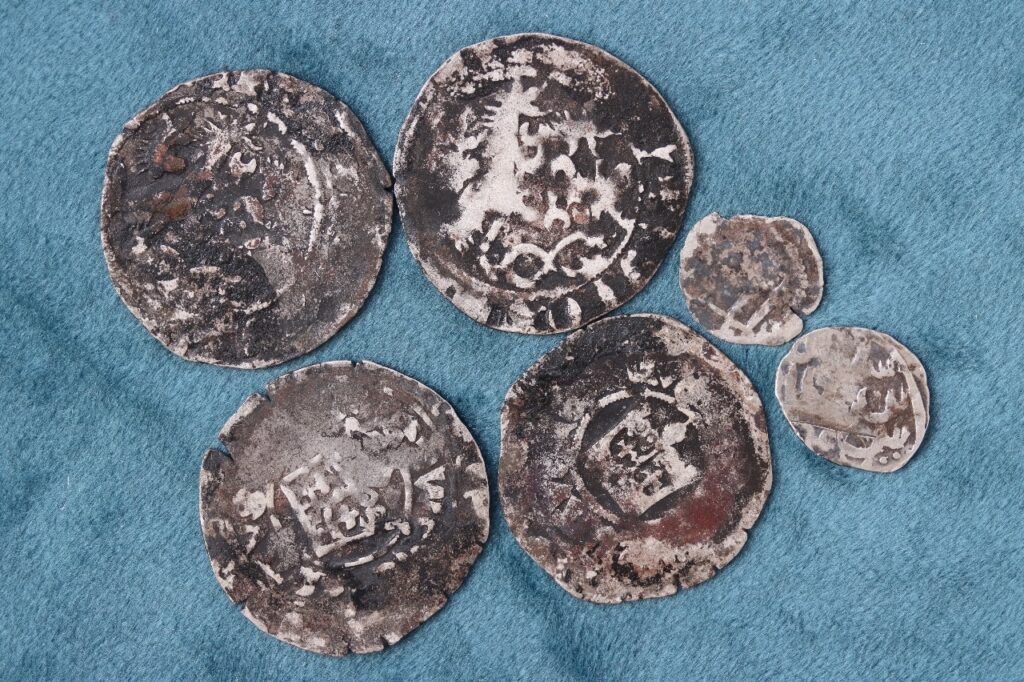
Smolensk archaeologists uncover 48 medieval silver coins, including Prague groschen — widely known as the ‘Dollar of the Middle Ages’ — a Lithuanian denarius, and a Crimean dang, shedding light on Eastern Europe’s monetary networks in the early 1400s. Credit: IA RAS / VKontakte

Looking ahead

Excavations in Smolensk are ongoing, and archaeologists believe further discoveries may follow. “Finds like this remind us how deeply interconnected medieval Eastern Europe was,” the expedition team noted. “Coins, even when small, can tell us entire stories of politics, economy, and cultural exchange.”

Institute of Archaeology of the Russian Academy of Sciences

Cover Image Credit: Members of the Institute of Archaeology of the Russian Academy of Sciences (IA RAS) expedition reported this unique find on VKontakte. Credit: IA RAS / VKontakte

Related Articles

Bronze Age women’s jewelry set discovered in Güttingen carrot field, Swiss

17 October 2023

17 October 2023

A set of Bronze Age women’s jewelry was discovered by archaeologists in Güttingen, Thurgau canton, northeastern Switzerland, in a freshly...

A cemetery belonging to 54 children was found during the excavation in the old quarry in Diyarbakır, Türkiye

4 January 2024

4 January 2024

During the archaeological excavation carried out in the area considered to be an old quarry in the Kulp district of...

INAH Archaeologists recover the coyote-man of Tacámbaro

26 January 2022

26 January 2022

Archaeologists win the coyote-man trial that lasted 30 years in Mexico. The litigation regarding the coyote-man of Tacámbaro, an important...

Salt May Have Been Used as Money in Exchanges

24 March 2021

24 March 2021

Salt has always been a precious metal. Salt was needed in many areas, from the preservation of food to the...

A beautiful Medieval key discovered in Claverham village, UK

11 October 2023

11 October 2023

Earlier this year the Kemble fieldwork team from Cotswold Archaeology undertook a small excavation for Newland Homes on the edge...

Ushabti figurines on display at Izmir Archeology Museum

18 September 2021

18 September 2021

The 2,700-year-old “Ushabti” statuettes, discovered in archaeological digs in western Turkey and used in Egyptian burial ceremonies, are being shown...

World treasure that cannot be displayed in the Local Museum in Pljevlja, Montenegro

30 July 2023

30 July 2023

Despite representing one of the most valuable portable cultural assets of Montenegro, the Pljevlja Diatreta is not accessible to visitors. The...

4,500-Year-Old Three Warrior Graves Found in Germany, One Still Wearing an Arm Guard

30 January 2025

30 January 2025

Extraordinary discovery during the construction of a New Power Line: Archaeologists unearth a cemetery from the Copper Age with Three...

Maya Farmers May Have Planned Population Growth Contrary to Thought

19 November 2021

19 November 2021

Contrary to what was thought, Maya farmers may have planned for population growth, says a new study. According to a...

The migration movement that started from Siberia 30,000 years ago may have shaped Göbeklitepe

24 June 2022

24 June 2022

Professor Semih Güneri, retired faculty member from Dokuz Eylul University (DEU) Caucasus Central Asia Archeology Research Center, stated that they...

Britain’s Oldest Prehistoric Circle Uncovered, Potential Blueprint for Stonehenge

10 March 2025

10 March 2025

Recent archaeological findings at the prehistoric funerary site of Flagstones in Dorset have unveiled that this remarkable circular enclosure, dating...

Bronze Age Settlement and Neolithic Relics Found at Skaņkalne Hillfort in Latvia

9 August 2025

9 August 2025

Archaeologists have uncovered remarkable evidence of ancient human habitation during the latest excavations at Skaņkalne Hillfort, offering fresh insights into...

Are There Stone Age Megastructures on the Baltic Sea Floor?

11 June 2025

11 June 2025

The western Baltic Sea may conceal far more prehistoric cultural heritage than previously believed — including monumental underwater structures created...

Stonehenge’s Altar Stone May Be From Scotland, Over 700 Kilometers Away

14 August 2024

14 August 2024

Recent research led by Curtin University suggests that the Altar Stone at Stonehenge may have originated in northeast Scotland, at...

Traces of Pozzolan Dust from Phlegraean Fields Found in a 1st-Century Roman Hydraulic Structure Submerged in Venetian Lagoon

29 November 2024

29 November 2024

In the San Felice Canal, in the northern Venetian Lagoon, a material used as an additive in Roman concrete was...