
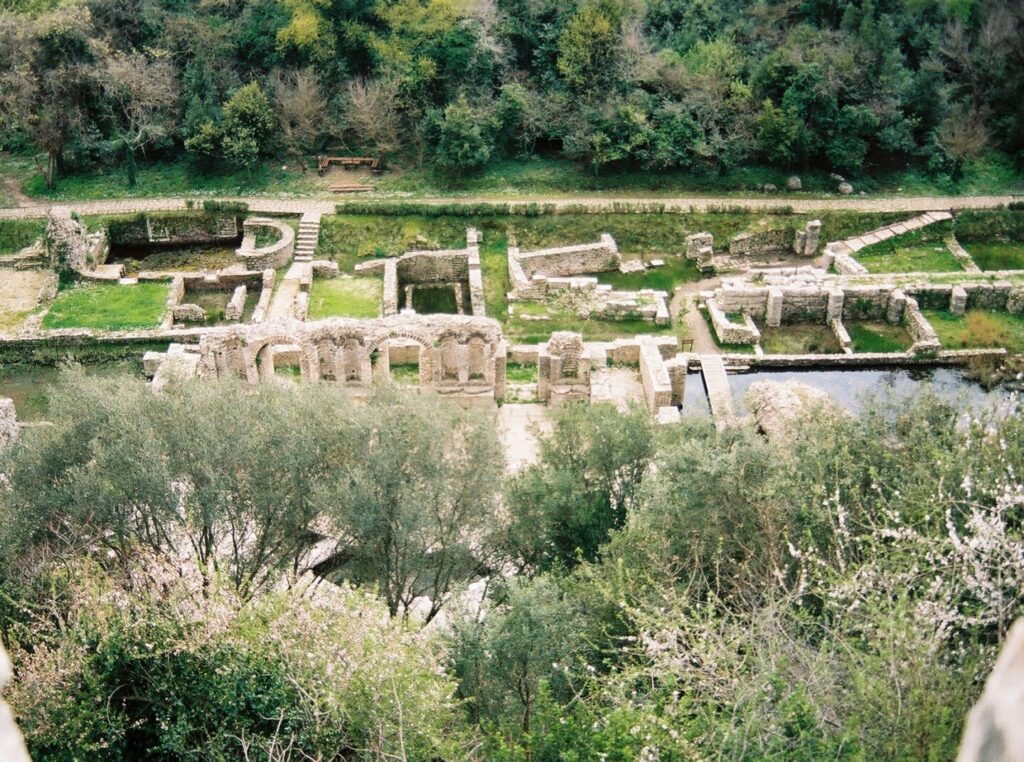
Archaeologists have identified previously unknown buildings, fortifications, tombs, and water systems at the ancient city of Butrint in southern Albania. A new laser survey has revealed structures concealed by dense vegetation, including a possible public building near the Roman Forum and a church with three apses.
One of the Mediterranean’s most extensively studied ancient cities has yielded a series of unexpected discoveries. At Butrint, a UNESCO World Heritage Site in southern Albania, archaeologists have identified monumental structures that had escaped documentation for decades, including a large building that may have stood alongside the city’s Roman Forum. The discoveries suggest that significant parts of Butrint’s ancient urban landscape remain unexplored, even a century after modern archaeological investigations began.
The findings were announced on October 26 by the University of Bologna, whose archaeological mission works in partnership with the Archaeological Institute of Tirana. Using drone-mounted laser technology and ground surveys, the team identified previously unknown buildings, defensive walls, water installations and burials both within the archaeological park and in the surrounding hills.
A forgotten building beside the Roman Forum
Among the most intriguing discoveries is a large two-room building immediately east of Butrint’s Roman Forum. The structure first appeared as a rectangular depression in the terrain, but closer examination revealed substantial architectural remains that may belong to the same construction phase as the forum.
Inside, archaeologists documented traces of plaster, flooring made from terracotta slabs, and a stone threshold with steps leading to an outdoor area furnished with benches. These features suggest that the building may have served a public function, although its precise purpose remains uncertain.
Its location makes the discovery particularly significant. The Roman Forum formed the civic center of Butrint during the city’s development under Roman rule, and an additional public building nearby could provide valuable information about how that center was organized.
The survey also identified what appears to be a previously unknown section of Hellenistic fortifications near the acropolis. Constructed from large, carefully squared stone blocks, the remains could help researchers trace changes in the city’s defensive boundaries before the Roman period.
Buildings hidden beneath centuries of vegetation
Butrint occupies a wooded peninsula overlooking a lagoon near Albania’s southern coast. Its landscape has helped preserve archaeological remains, but the dense vegetation covering much of the site has also made systematic exploration difficult.
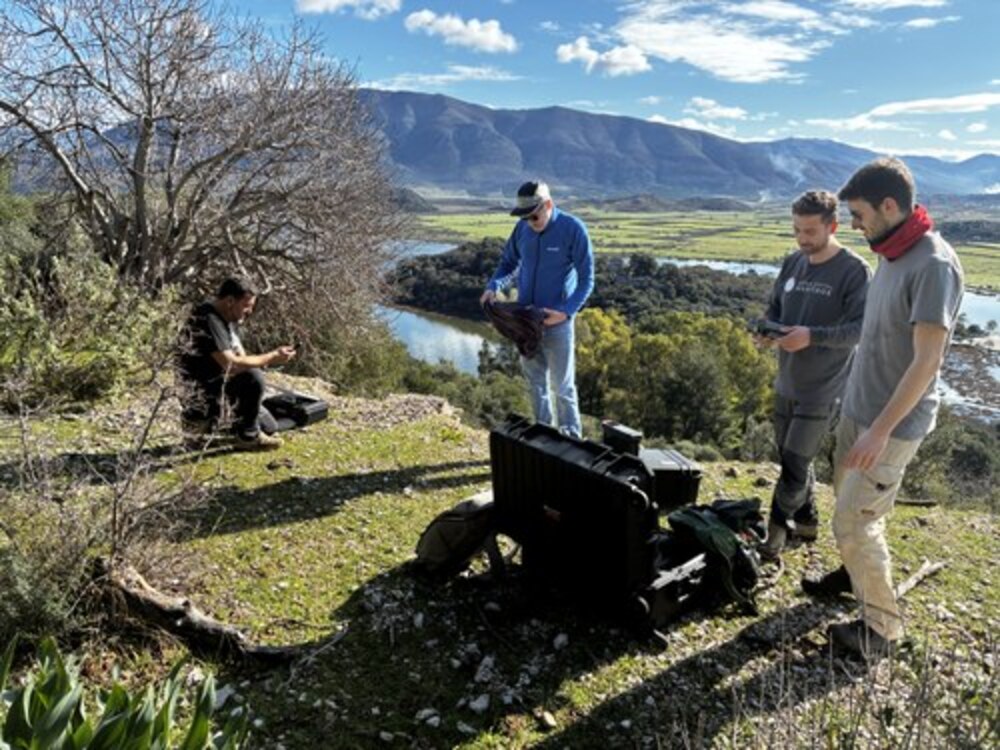
To overcome this obstacle, researchers collaborated with the University of Siena’s Laboratory of Landscape Archaeology and Remote Sensing, directed by Stefano Campana. The project produced the first comprehensive LiDAR survey of the archaeological park and the nearby Ksamil Peninsula.
LiDAR uses laser pulses to measure the terrain from above, allowing specialists to create detailed digital models of the ground surface beneath tree cover. Unusual alignments, depressions, and geometric forms can indicate archaeological structures that are difficult to recognize on foot.
The technology does not identify ancient buildings automatically. Archaeologists must examine suspicious features on the ground, sometimes cutting through thick vegetation to determine whether they are natural formations or human constructions.
That combination of technology and fieldwork proved particularly productive during the latest campaign, revealing several structures that had not previously been recorded.
One is a building with two apses whose surviving walls reach almost two meters in height. Its construction technique resembles that of Butrint’s Great Basilica, raising the possibility that it belongs to the city’s Late Antique period. Further investigation will be necessary to establish its date and original function.
Elsewhere, the team identified a well with a limestone-block opening and a circular cistern lined with waterproof mortar on the park’s northwestern slopes. These features provide additional evidence of the infrastructure that supplied water to the ancient settlement.
A three-apsed church and ancient tombs beyond the city
The discoveries extend beyond Butrint’s familiar archaeological monuments. Surveys in the surrounding hills revealed additional buildings and burials, some carved directly into the rock.
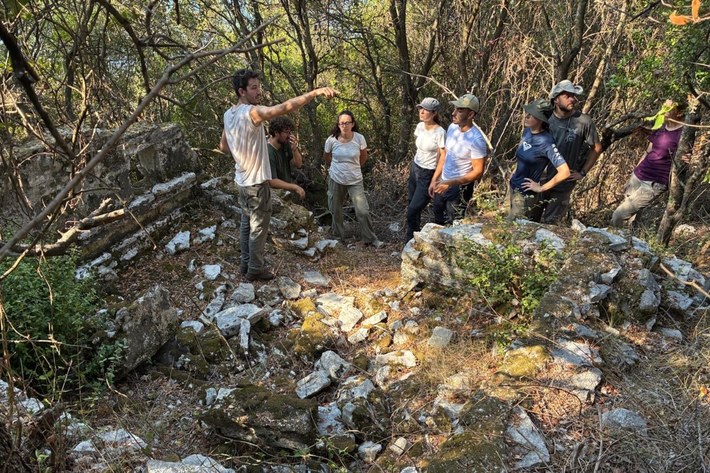
Of particular interest is a church with three apses, with sections of its walls surviving to more than two meters in height. Nearby stands another building that may have originated during the Roman period, suggesting that the area experienced multiple phases of occupation and construction.
Researchers also documented more recent remains, including military bunkers and trenches from twentieth-century Albania. Their presence reflects the long and varied history of a landscape that continued to serve different purposes long after the ancient city declined.
Occupied since prehistoric times, the settlement developed through Greek, Roman, Early Christian, Byzantine, and medieval phases. Under Roman rule, it expanded into a substantial urban center, while Christianity later brought churches and other religious buildings to the site.
Its surviving monuments, including a Greek theater, Roman Forum, baptistery, and Great Basilica, have made Butrint one of the most important archaeological destinations in the Balkans. The city was inscribed on the UNESCO World Heritage List in 1992.
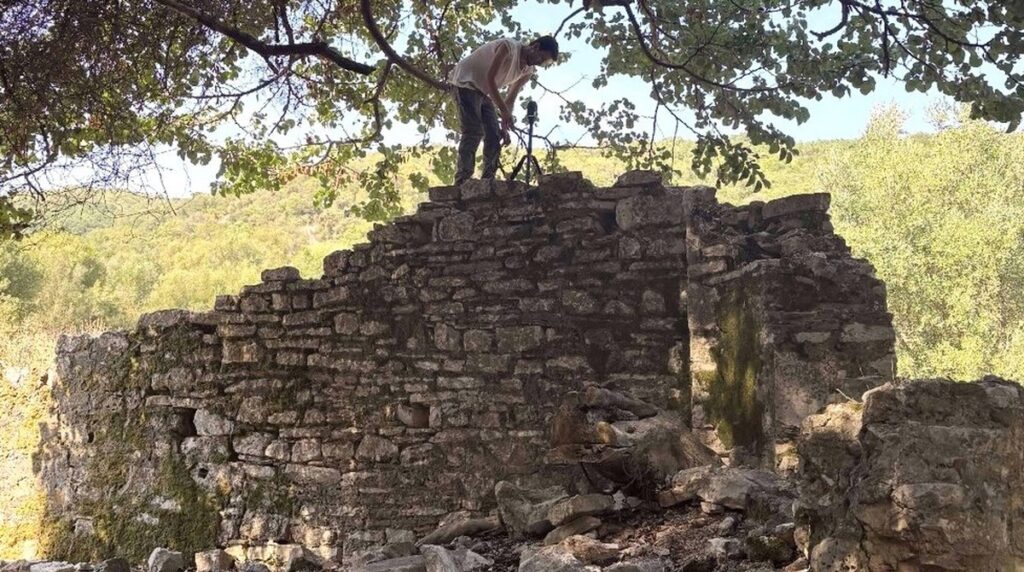
An archaeologist documents the remains of an ancient stone building during field investigations at Butrint. Credit: University of Bologna
A century of research, with more still to discover
Modern investigations at Butrint are closely associated with Italian archaeologist Luigi Maria Ugolini, who began exploring the site in the 1920s. A century later, the latest research demonstrates how much of the ancient settlement remains concealed within its surrounding landscape.
The Italian-Albanian archaeological mission is coordinated by Enrico Giorgi of the University of Bologna and Belisa Muka of the Archaeological Institute of Tirana. Their work has combined excavations, topographical research and archaeological documentation to investigate the city’s development across successive historical periods.
Giorgi emphasized that monuments of this scale had not been newly documented at Butrint for some time. The latest results are especially important because they extend the known archaeological landscape beyond the monuments already visible to visitors.
The newly identified buildings have not all been excavated or securely dated. Nevertheless, their locations and surviving architectural details provide researchers with new targets for investigation, particularly around the Roman Forum, the acropolis and the hills beyond the archaeological park.
