
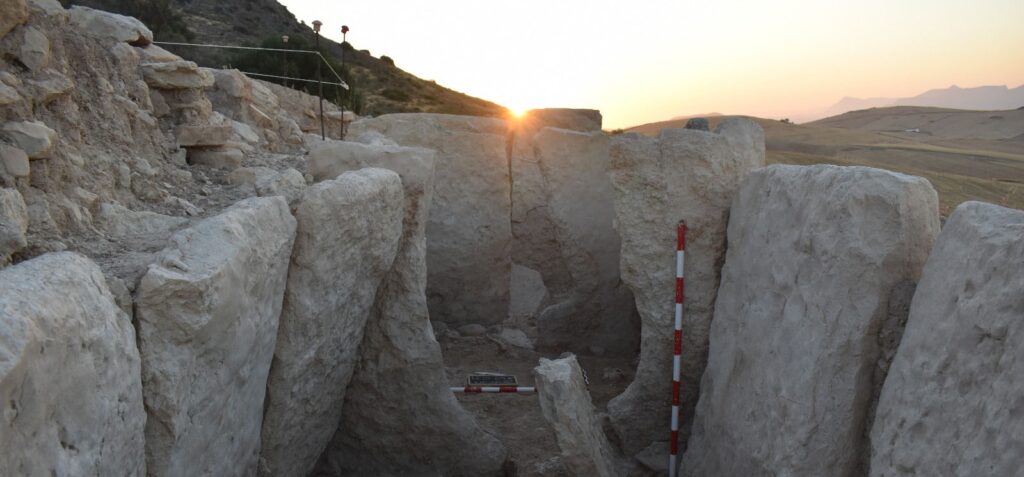
A team of archaeologists from the University of Cádiz has uncovered one of Andalusia’s most monumental and best-preserved prehistoric tombs: Dolmen I of the La Lentejuela necropolis in Teba (Málaga, Spain). Measuring 13 meters in length and dating back more than 5,000 years, this extraordinary discovery sheds light on the funerary practices, long-distance trade, and social structures of the Iberian Peninsula during the 3rd millennium BC.
The excavation, carried out over four archaeological campaigns, was led by Dr. Eduardo Vijande and Dr. Serafín Becerra of the University of Cádiz’s Thalassa Research Group. The project, titled Monumentality, Time and Society. The Megalithic Phenomenon in the La Lentejuela Necropolis was authorized by the Andalusian Ministry of Culture and Historical Heritage and funded by the Municipality of Teba.
A Monument of Exceptional Preservation
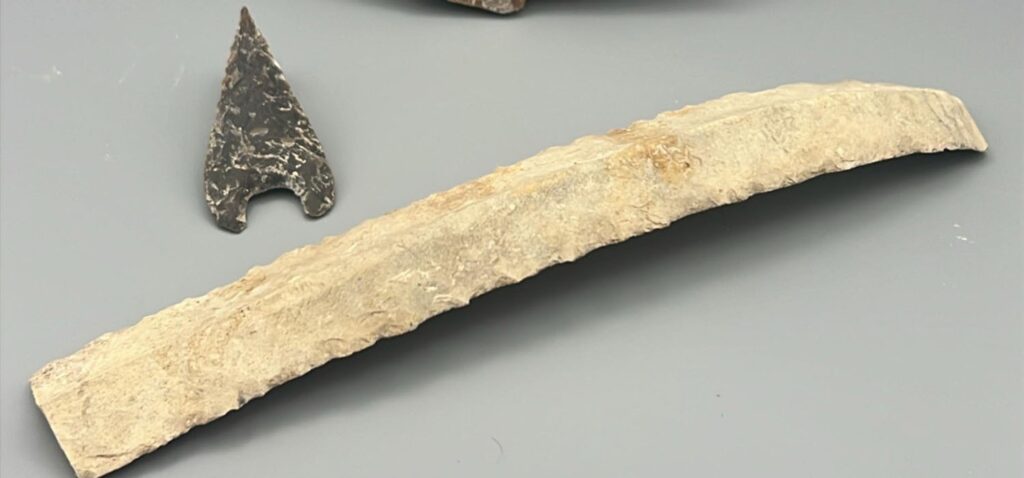
What makes this dolmen remarkable is not only its sheer scale but also its extraordinary state of preservation. Inside, archaeologists documented several ossuaries, along with an impressive collection of prestige grave goods crafted from exotic and locally rare materials. These include ivory, amber, marine shells, and intricately worked flint artifacts such as arrowheads, large-format blades, and an exceptional halberd.
According to Dr. Becerra, “we may be looking at one of the most monumental and complete dolmens in all of Andalusia.” His co-director, Dr. Vijande, emphasized that the tomb’s integrity will allow researchers to reconstruct with unprecedented clarity the beliefs, lifestyles, and rituals of the prehistoric communities that inhabited southern Spain.
Symbols of Power and Long-Distance Trade
The recovered objects not only reflect the wealth and status of those interred but also highlight the existence of long-distance exchange networks. The presence of ivory and amber—materials not native to the region—suggests connections that extended far beyond Andalusia. The inclusion of marine shells, despite the necropolis being located inland, reinforces the symbolic prestige of the sea in prehistoric societies.
As Professor Juan Jesús Cantillo of the University of Cádiz explained, “these finds show that Late Prehistoric communities in the Iberian interior were far from isolated. They participated in extensive trade routes that linked coastal and inland areas, circulating goods, ideas, and cultural values.”
What Is a Dolmen?
For readers unfamiliar with the term, a dolmen is a type of megalithic tomb built from large upright stones supporting a horizontal capstone. These structures, dating mainly to the Neolithic and Bronze Ages, served as collective burial sites and often carried deep ritual or symbolic significance. Found across Europe, Asia, and parts of Africa, dolmens are among the earliest forms of monumental architecture created by human societies.
The discovery at Teba’s La Lentejuela necropolis not only enriches Andalusia’s archaeological record but also contributes to the broader understanding of the European megalithic phenomenon—a cultural movement characterized by the construction of large stone monuments for burial and ceremonial purposes.
A Collaborative and Educational Project
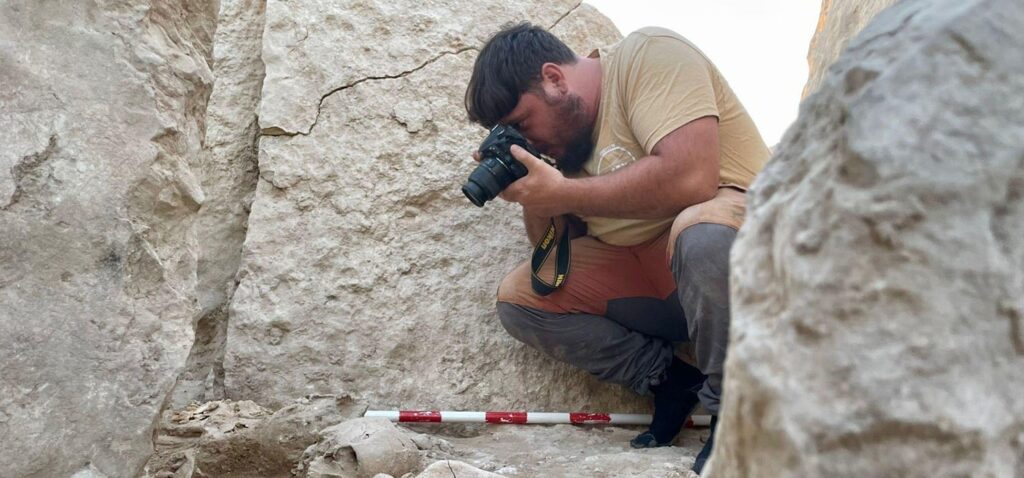
The excavation has been a collaborative effort involving faculty, doctoral researchers, and students. Alongside the lead archaeologists, team members included Dr. Leticia Gómez, doctoral candidates Alejandro Muñoz and Jesús Corrales, and Dr. Adolfo Moreno from the University of Almería. Importantly, the project also served as a training ground for University of Cádiz history students, who gained hands-on experience in field archaeology.
The initiative was further supported by the Palarq Foundation, which assisted with archaeometric analyses, and by the logistical and equipment resources of the University of Cádiz.
Unlocking the Stone Archive
Scholars emphasize that Dolmen I of La Lentejuela is much more than a prehistoric grave—it is a stone archive, preserving crucial information about social organization, ritual life, and intercultural connections during the dawn of the Metal Ages. The exceptional preservation of the monument promises to reveal invaluable insights into how communities in southern Iberia lived, believed, and interacted with the wider world over 5,000 years ago.
With this discovery, the University of Cádiz consolidates its position at the forefront of European megalithic research and highlights the enduring importance of Andalusia’s archaeological heritage.
