
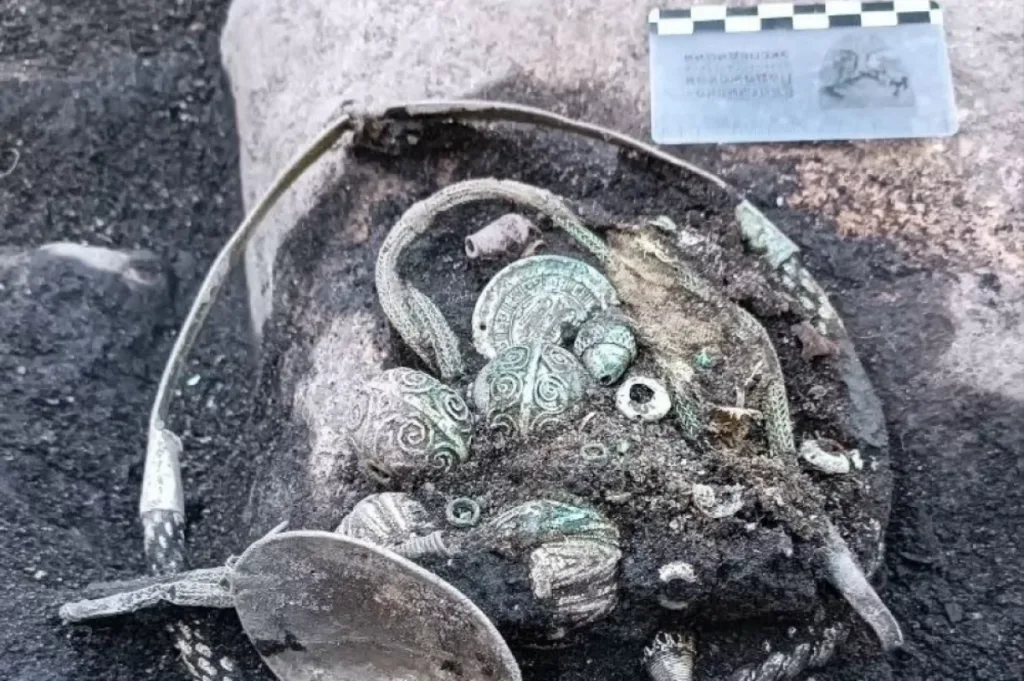
Archaeologists excavating a medieval fortified settlement in northwestern Russia have uncovered more than two kilograms of silver, including two exceptionally rare Swedish coins that have doubled the number of known examples in the world.
The hoard was discovered at Tiversky Gorodok, an archaeological site in the Leningrad region connected with medieval Karelians, Novgorod and the wider Baltic world. Alongside coins, the deposit contained elaborate silver jewelry, chains, medallions and personal ornaments, some of which appear to have arrived from Scandinavia or the lands of medieval Rus.
Two coins double the known number
Three coins immediately drew the attention of researchers. The oldest is an Arab dirham that numismatists have provisionally dated to between AD 907 and 912, although researchers have so far examined it only through photographs, meaning the identification remains preliminary.
The other two are far more unusual. Both are large Uppsala-type bracteates, thin coins struck on only one side and produced in Sweden between the late 11th century and the first half of the 12th century.
Before the Tiversky discovery, only two examples of this particular type were known, both preserved in Uppsala, Sweden. The two newly discovered coins therefore bring the known total to four.
Belsky, a senior researcher at the Museum of Anthropology and Ethnography of the Russian Academy of Sciences, described the bracteates as exceptionally rare and emphasized that the Tiversky examples effectively doubled the known corpus.
More than two kilograms of medieval silver
The coins formed only a small part of the discovery. The hoard weighs more than two kilograms and includes several circular medallions decorated with granulation and filigree, a large ornamented silver neck ring, coin pendants, fine wire chains, a ring and a horseshoe-shaped fibula.
Archaeologists also recovered a Karelian-type head ornament and a leather headband. Researchers describe the craftsmanship as exceptionally high, and their preliminary assessment suggests that many of the objects did not originate at Tiversky Gorodok itself but were produced elsewhere in medieval Rus or Scandinavia before eventually reaching the settlement.
The expedition provisionally places the deposition of the hoard in the second half of the 12th or the 13th century. Individual objects are considerably older, showing that some pieces may have circulated, remained in families or accumulated over generations before someone finally concealed them.
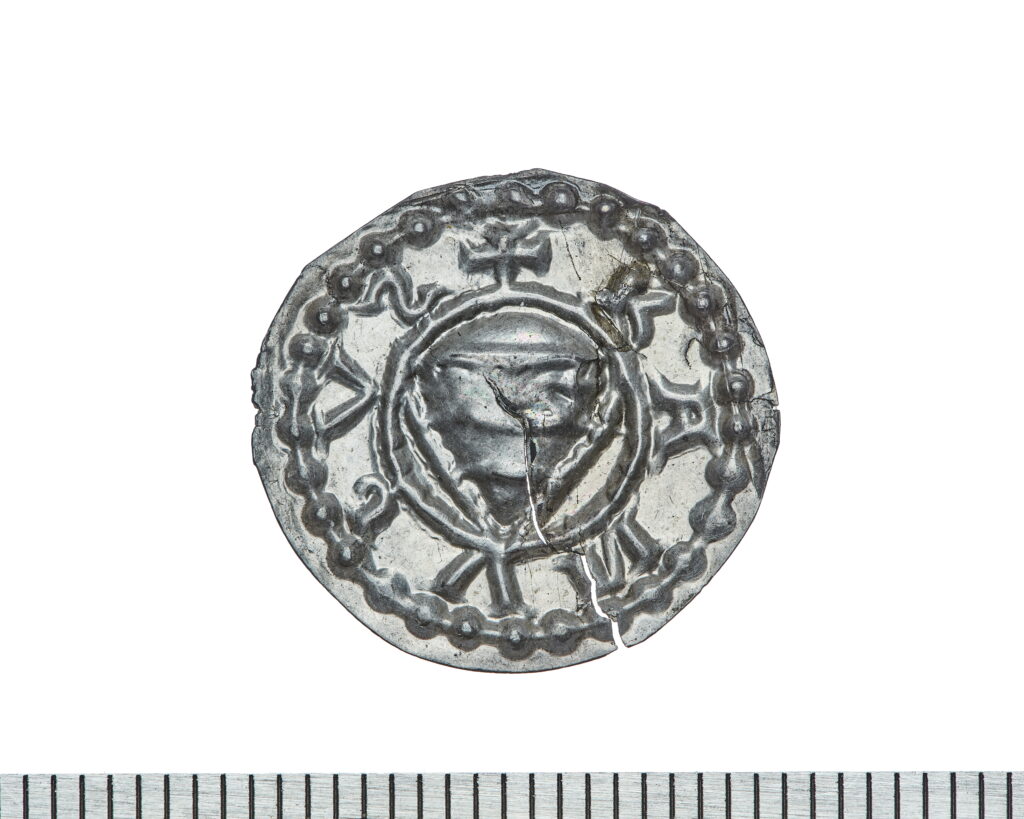
Representative image of a medieval Swedish silver bracteate. The Tiversky hoard contained two exceptionally rare Swedish bracteates of a different type. Credit: Photo: Helena Bonnevier / Ekonomiska museet – Kungliga myntkabinettet / SHM (CC BY 4.0).
Did one medallion depict Odin’s ravens?
One silver medallion has created another puzzle. It carries an image of two birds positioned around a central element, and researchers are considering whether the birds could represent Huginn and Muninn, the two ravens associated with the Norse god Odin, while the object between them may depict Odin’s spear, Gungnir.
For now, that interpretation remains a hypothesis rather than a firm identification. What makes the medallion particularly intriguing is its context, because objects bearing apparently Christian symbolism also occur in the same hoard, placing possible imagery from Norse pagan mythology beside material connected with Christianity.
Belsky said researchers still cannot explain the combination. Rather than representing a contradiction, however, the assemblage may eventually help archaeologists understand a society in which objects, beliefs and artistic traditions circulated across cultural boundaries.
A settlement between Karelia, Rus and Scandinavia
Tiversky Gorodok lies in the Priozersky district of the Leningrad region, close to the Vuoksa water system. During the Middle Ages, waterways through this landscape connected communities around Lake Ladoga with the Baltic and with territories farther east, helping to explain the mixture of objects found in the newly discovered hoard.
The settlement occupied a zone where Karelian communities interacted with Novgorod and Scandinavian networks rather than an isolated frontier. Archaeologists have investigated Tiversky Gorodok for more than a century, and in 1890 another silver hoard discovered at the site contained ornaments, a chain, silver ingots and eastern coins.
The latest find, however, surpasses previous comparable discoveries from northwestern Russia in its richness and composition, according to the researchers.
The latest excavation began as work on sections of the archaeological monument that had suffered damage. Belsky described the moment when the hoard emerged as the kind of event archaeologists rarely expect to witness during an excavation.
The work is being carried out by specialists from the Museum of Anthropology and Ethnography of the Russian Academy of Sciences, better known as the Kunstkamera, together with the St. Petersburg research center Actual Archaeology.
A hoard that still has questions to answer
The discovery does not yet reveal who assembled the silver or why it was hidden. Its contents nevertheless show that valuable objects reaching Tiversky Gorodok could travel considerable distances, with an early 10th-century Arab dirham, exceptionally rare Swedish bracteates, Scandinavian-style imagery and locally significant Karelian ornaments all ending up in the same deposit.
Further conservation and study may establish where individual objects were produced and refine the date when the hoard entered the ground. The two Swedish coins already give the find significance far beyond the settlement itself: a single excavation in northwestern Russia has doubled the number of known examples of their type.
