
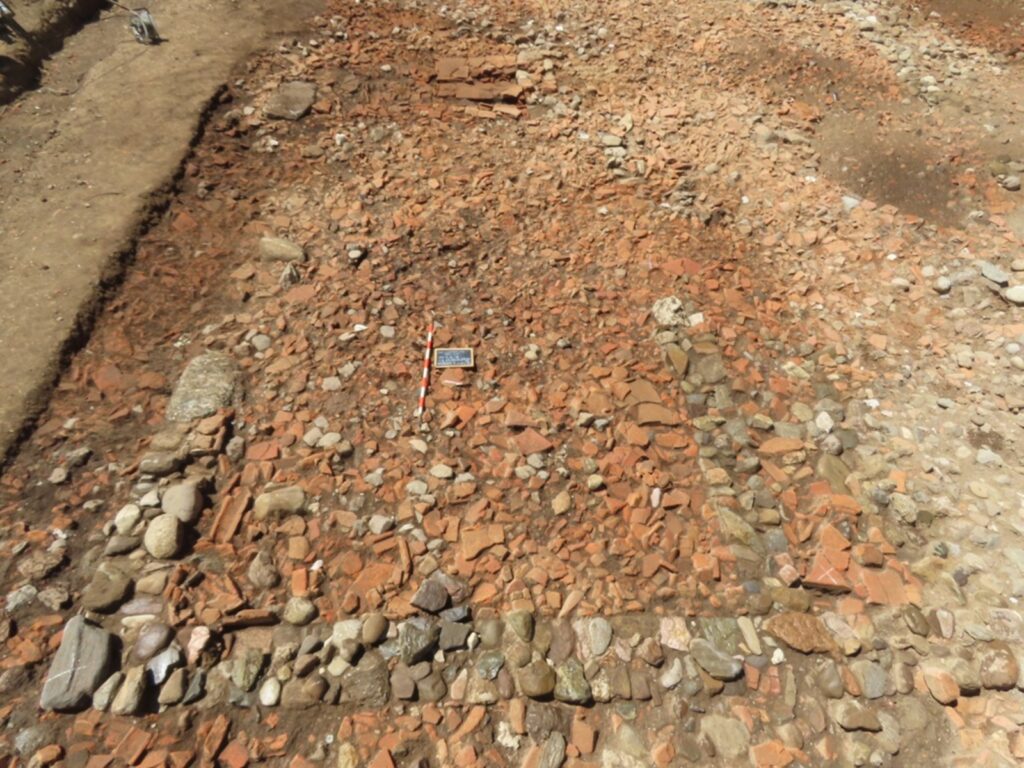
A newly uncovered Roman settlement in southern Switzerland is revealing an unexpected picture of everyday life nearly 2,000 years ago. Archaeologists have exposed a roadside building, working areas filled with metalworking waste, and a small bronze peacock brooch that carries an intriguing connection to the Roman goddess Juno.
The excavation is taking place at Stramonte in Ligornetto, in the Italian-speaking canton of Ticino, where archaeological investigations began in June ahead of the construction of a new residential building. What has emerged across roughly 500 square meters is not an isolated structure but part of a broader Roman landscape combining craft production, agriculture and movement along a local road.
Most of the masonry building dates to the second and third centuries AD, although the history beneath it reaches considerably further back. Archaeologists examining deeper layers are now encountering material from the Augustan period and the final decades BC, suggesting that people were using the area before the substantial Roman building appeared.
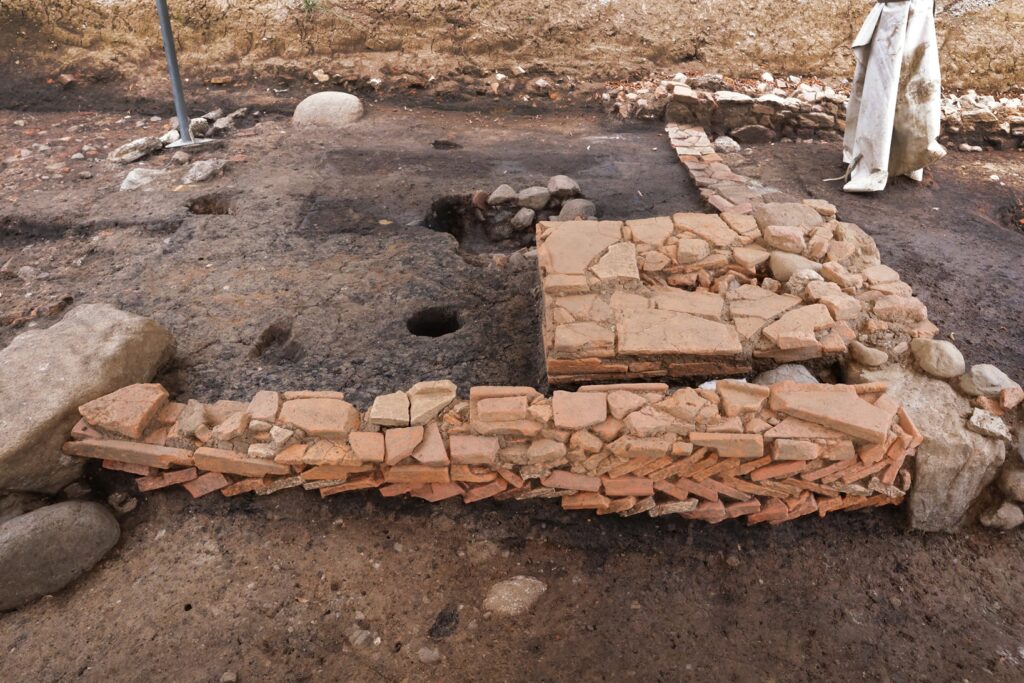
Platform made from reused Roman bricks in the portico. Credit: UBC Archaeology Service Archive, photo by D. Rogantini-Temperli.
A Roman building beside the road
The excavated building measures about eight meters across and extends for at least 11 meters, continuing beyond the western limit of the construction site. Six rooms have been identified so far, together with a portico roughly three meters wide along the southern side.
That portico faced a small road, immediately placing the building within a wider organized settlement rather than an isolated rural structure. Behind it, archaeologists have explored rooms of around 16 and 20 square meters, while the surrounding open ground produced postholes and a small path made with reused tiles.
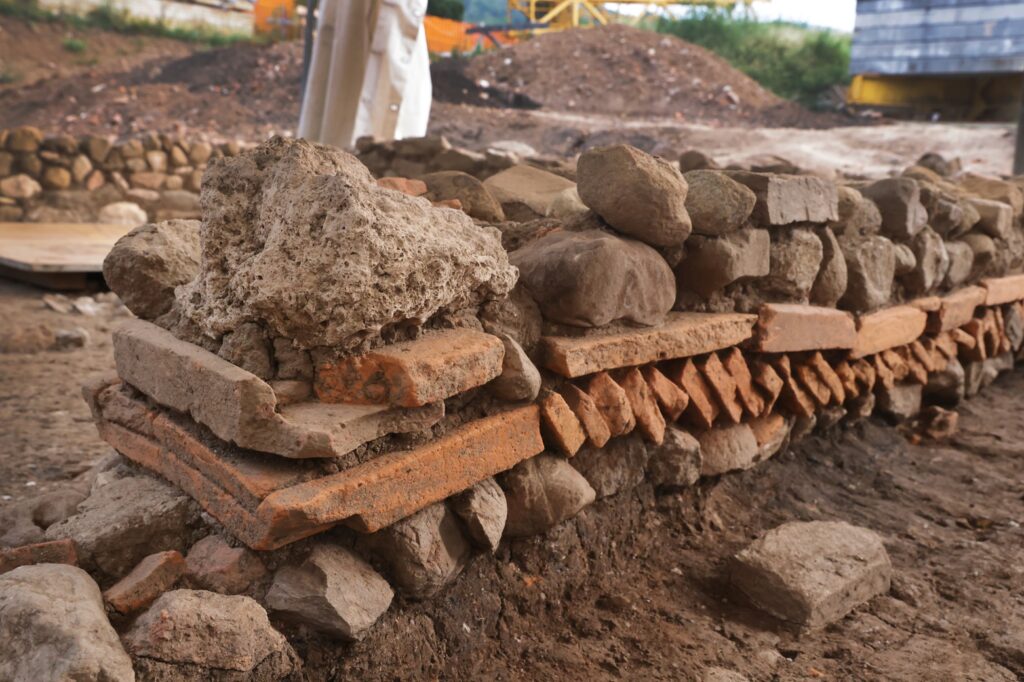
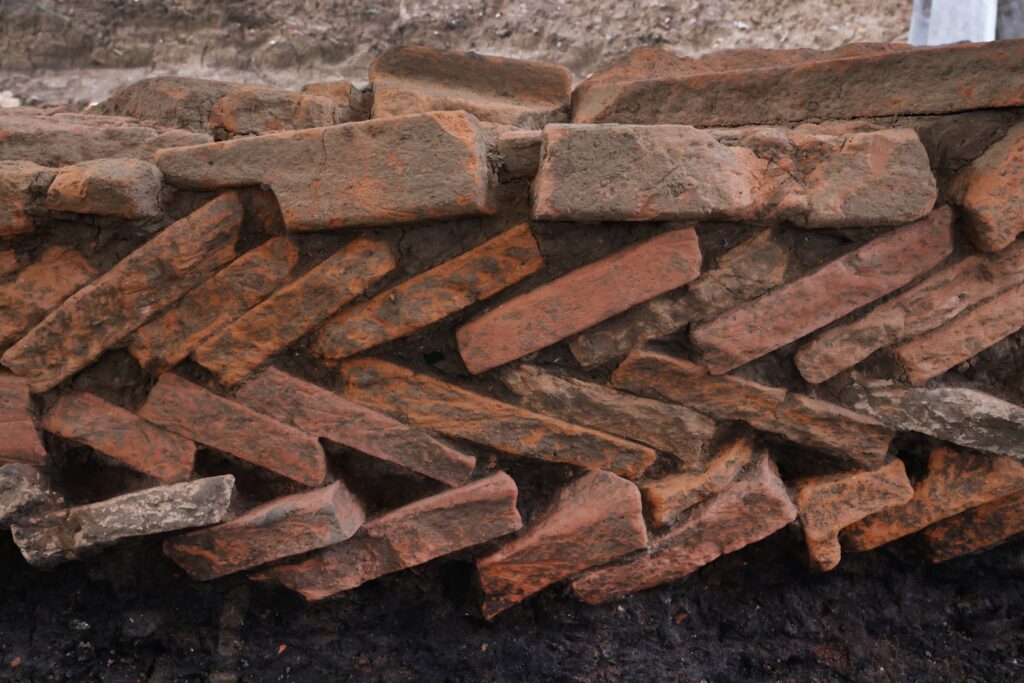
The building did not remain unchanged. During the second and third centuries, new internal divisions were added, and older building materials were reused. Luisa Mosetti, an archaeologist with Ticino’s cultural heritage office, pointed to particularly striking partition walls in which reused roof tiles had been arranged in a herringbone pattern.
Yet one feature expected in an ordinary Roman house is conspicuously absent: hearths.
According to Mosetti, the lack of fireplaces or comparable installations suggests that the excavated structure was probably not a conventional residence where people cooked and heated their living spaces. Its precise function is still being investigated, but the evidence from the ground immediately around it is beginning to provide a much stronger clue.
Metalworking on a significant scale
Behind and around the building stretched an area apparently devoted to agricultural and artisanal activity. Here archaeologists encountered one of the most important elements of the discovery: unusually large quantities of iron slag, accompanied by waste from bronze working.
“This is something we have here in large quantities,” archaeologist Rosanna Janke told Swiss broadcaster RSI while showing a piece of iron-working slag recovered at the excavation. The concentration indicates that iron was being worked somewhere nearby, even though the exact location and organization of the workshop have not yet been established.
The distinction matters. Archaeologists have evidence for metalworking in the immediate area, but that does not yet mean every room of the excavated building formed part of a forge or workshop. Instead, the combination of industrial debris, light structures represented by postholes, open working ground and a building apparently lacking normal domestic installations points to a wider working complex.
Such spaces can add a different dimension to the archaeology of Roman Switzerland. Monumental buildings, villas, inscriptions and cemeteries often provide the most visible remains of Roman occupation, while the places where people produced, repaired and processed everyday materials can be harder to identify.
At Stramonte, that working landscape is beginning to emerge unusually clearly.
A tiny peacock among the industrial remains
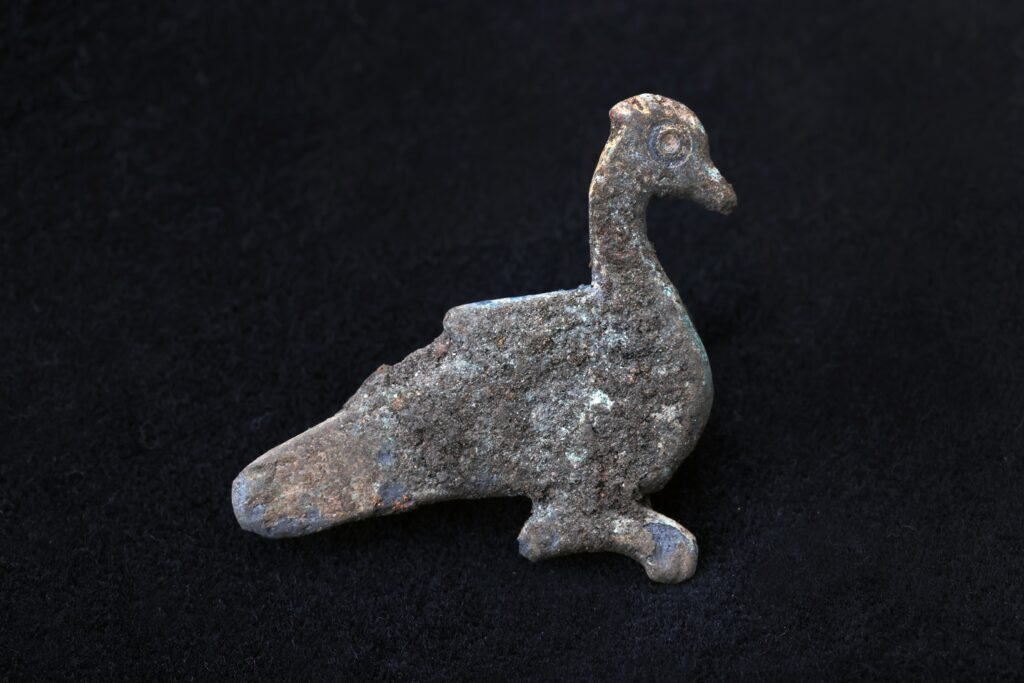
One of the excavation’s most distinctive objects is far smaller than its walls and piles of metalworking debris. Archaeologists recovered a bronze zoomorphic fibula, or brooch, dating to the second or third century AD and probably representing a peacock.
Animal-shaped brooches were not unusual in the Roman world. The Metropolitan Museum of Art holds a strikingly comparable Roman peacock brooch of the same broad date, noting that such small animal-form fittings were worn by both Roman soldiers in the provinces and local populations. Archaeological evidence suggests important production centers for these brooches existed in Britain and Gaul.
But the choice of a peacock adds another layer of interest.
In Roman imagery, the bird was closely associated with Juno, wife of Jupiter, queen of the gods and goddess of marriage. The British Museum identifies the peacock as Juno’s emblem, and Roman representations survive in which the goddess appears directly beside the bird.
That does not establish that the Ligornetto fibula was a religious object or that its owner had a particular devotion to Juno. The connection is iconographic rather than archaeological at this stage. But whoever wore the small bronze brooch selected an image that belonged to a recognizable symbolic vocabulary across the Roman world.
Against the larger evidence for furnaces, metalworkers and agricultural activity, the fibula also brings an individual presence back into the site. Walls can reveal how a building was organized, and slag can show what people produced; a piece of jewelry is something a person actually fastened to clothing and carried with them.
From Augustus to a destructive fire
The story of Stramonte did not begin with the second-century masonry building. Beneath it, archaeologists have found earlier traces including wooden structures from the final decades BC, while work in deeper deposits is now reaching material belonging to the transition between the late Iron Age and the Augustan period.
Nor was Ligornetto isolated from the larger Roman world. The Mendrisiotto stood within the sphere of influence of Como and Milan, while inscriptions previously discovered at Ligornetto and nearby Stabio document families connected with individuals who held important positions in those urban centers. Less than a kilometer from Stramonte lies the substantial Roman villa of San Pietro di Stabio, further evidence for the density and prosperity of ancient occupation in the area.
The Stramonte building eventually came to a dramatic end. During the third century AD, a violent fire caused its tiled roof to collapse, leaving extensive charcoal and building debris behind. Those destructive remains now form part of the archaeological record that is allowing the final phase of the complex to be reconstructed.
Excavations are expected to continue through autumn 2026 as archaeologists work alongside the residential construction project. Its complete function remains unresolved, and part of the Roman building still extends beyond the excavated area.
Even at this stage, however, Stramonte is offering more than another Roman building on the map. The road, work areas, metalworking debris, and earlier occupation are beginning to reveal how this corner of Roman Switzerland functioned, while a tiny bronze peacock provides a rare glimpse of the people who moved through that working landscape nearly two millennia ago.
