
4 June 2026 The Future is the Product of the Past

1,700-Year-Old Roman Bridge Discovered Beneath the Aare River in Solothurn, Switzerland

A Roman bridge in Solothurn, Switzerland, long suspected by archaeologists but never proven through physical remains, has finally been confirmed beneath the waters of the Aare River.

During an underwater archaeological survey ahead of the renewal of the SBB railway bridge, divers working for the Cantonal Archaeology Office of Solothurn identified wooden piles embedded in the riverbed near the Wengi Bridge. Samples from the timbers have now been dated to the fourth century AD, placing them in the late Roman period, when ancient Solothurn, known as Salodurum, was being reshaped into a fortified settlement.

The find gives archaeologists the first material proof of a Roman-era river crossing at a location that had long seemed almost inevitable. For years, scholars suspected that a bridge must have stood here. Now, after roughly 1,700 years underwater, part of its structure has been found.

Wooden piles reveal a lost Roman crossing

The remains lie a few meters upstream from the modern Wengi Bridge, around ten meters from the southern bank of the Aare. Divers documented a short line of piles, nearly two meters long, running in the direction of the current. The timbers probably belonged to a bridge pier, or pile bent, which once supported the upper structure and roadway.

The surviving posts are modest in size today, but their significance is far larger than their appearance suggests. Some are preserved to a height of about one meter and have a diameter of roughly 20 centimeters. Their dating confirms that they were part of a late Roman construction phase, not a later crossing.


📣 Our WhatsApp channel is now LIVE! Stay up-to-date with the latest news and updates, just click here to follow us on WhatsApp and never miss a thing!!


Older reports had mentioned piles in this part of the river, but the current investigation allowed archaeologists to examine them closely and obtain datable wood samples.
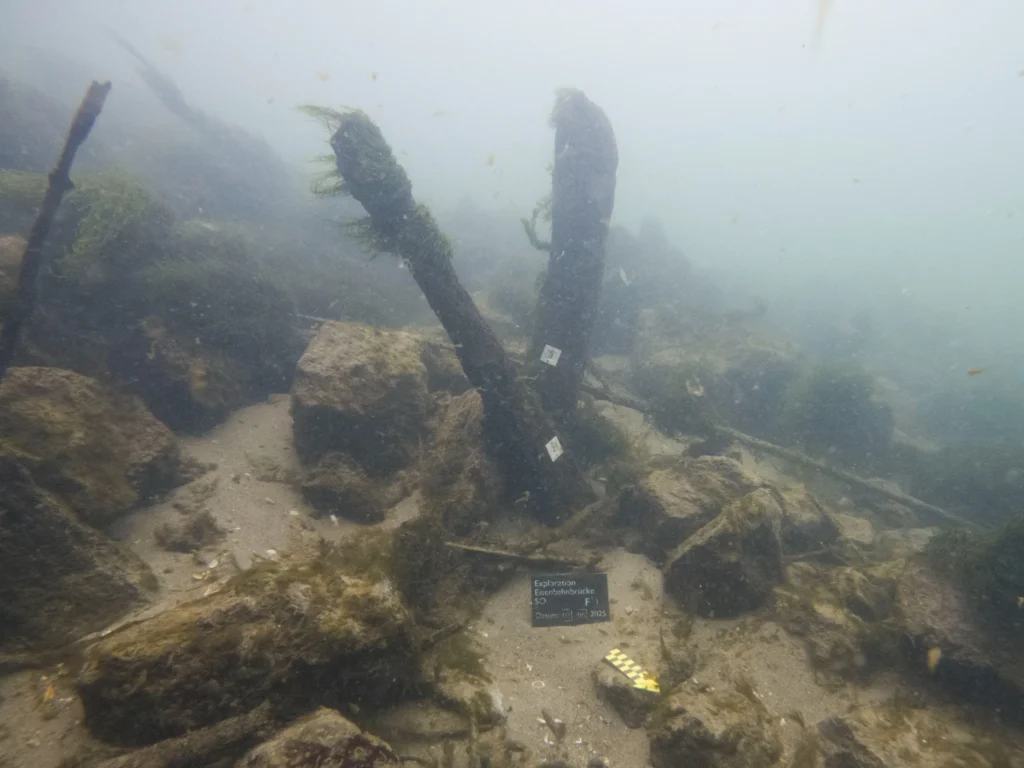
The largest surviving remains of the bridge. The two wooden piles rise about one meter from the riverbed and measure roughly 20 centimeters in diameter. Credit: Kantonsarchäologie Solothurn / Carlos Pinto

Salodurum stood at a strategic bend in the Aare

The bridge makes sense within the geography of Roman Solothurn. The Aare winds strongly upstream of the city, but at Solothurn it narrows into a more constrained channel. For Roman engineers, soldiers, traders, and travelers, this was a practical place to cross.

That topography is reflected in the ancient name Salodurum, usually understood as the Latinized form of a Celtic place-name referring to a river narrows or “water gate.” The Romans founded the settlement around the early first century AD, probably around AD 20, as part of a transport system linking important centers of Roman Switzerland.

The newly confirmed bridge belonged to a long-distance Roman road that ran from Italy over the Great St Bernard Pass, crossed the western Swiss Plateau, and continued through the Jura toward the Rhine. Remains of this road had already been identified near Solothurn.

A bridge from the age of the late Roman castrum

The fourth-century date is important because it places the bridge in the same period when Salodurum was transformed from an earlier Roman settlement into a fortified castrum. Across parts of Roman Switzerland, the later empire responded to military pressure and political instability by reducing and fortifying urban sites.

A castrum was not simply a town wall. It was a defensive system. At Solothurn, the fortification protected a key crossing point on the Aare and helped secure movement through a region connected to wider imperial routes. The newly dated bridge piles do more than confirm an old hypothesis. They help explain why late Roman authorities strengthened Salodurum.

Beneath Solothurn’s later urban layers lies a Roman settlement whose position was chosen for movement, control, and access to the river.
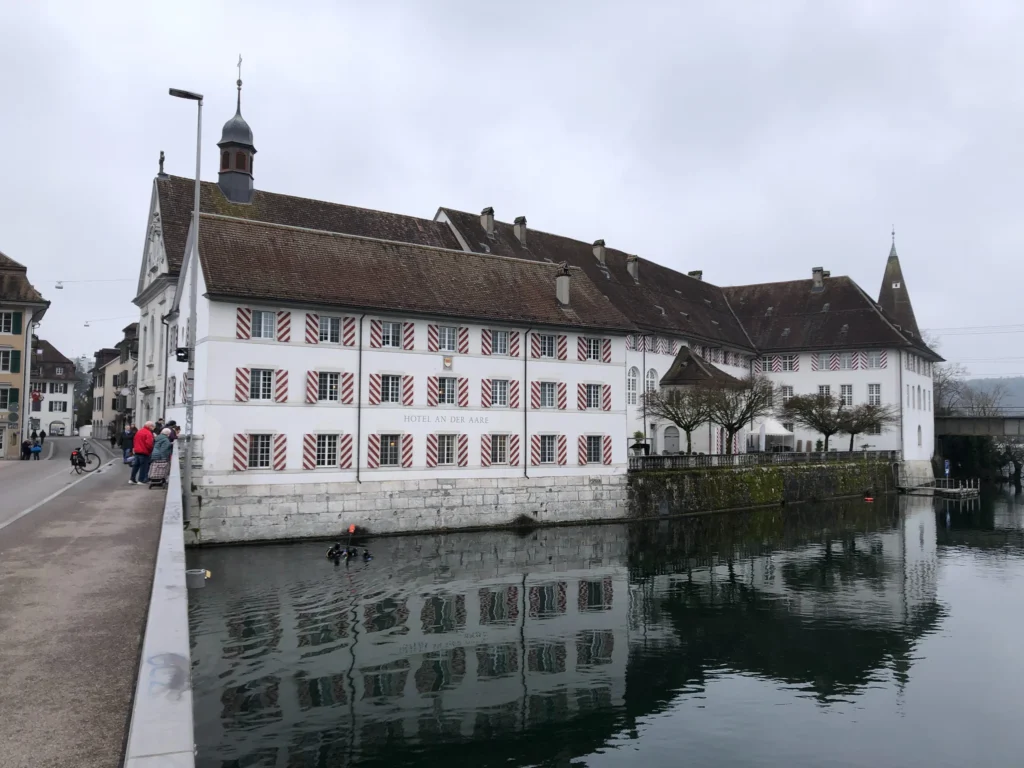
The Roman bridge piles lie about ten meters from the riverbank, near the Wengi Bridge on the left. The railway bridge can be seen at the right edge. Credit: Kantonsarchäologie Solothurn / Pierre Harb

Preserved by water, spared by chance

The survival of the wooden piles is a fortunate accident. During the Jura water correction works in 1969, the riverbed near Solothurn was dredged extensively. Many ancient remains could have disappeared. The late Roman piles survived because they stood in the protected area near the Wengi Bridge.

They will remain where they are. For ancient waterlogged wood, the riverbed can be the safest place, because constant moisture slows decay. Since the new railway bridge works do not threaten the timbers, archaeologists have no reason to recover them.

Further dives are planned. The known piles may represent only a small part of the original bridge structure. If additional rows are found in the Aare, archaeologists could reconstruct more precisely how the bridge connected to the road system of Salodurum.

For now, the discovery turns a long-standing assumption into archaeological fact. Solothurn was a guarded crossing point tied into the military and transport geography of the late Roman world.

Cantonal Archaeology Office of Solothurn

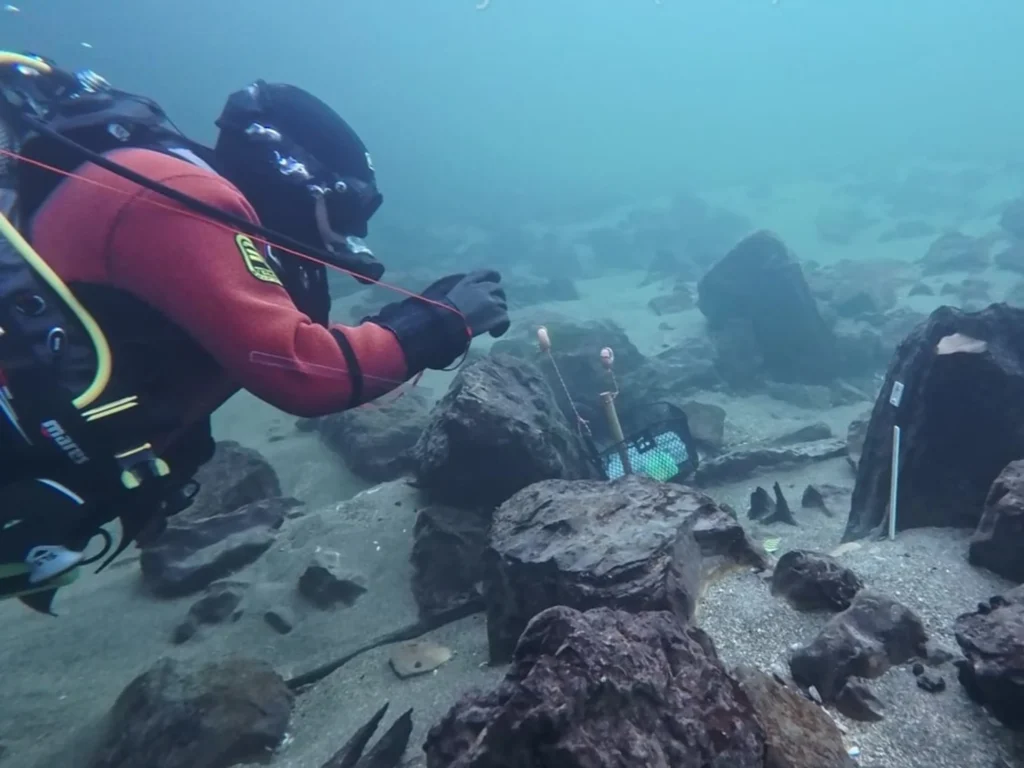
Cover Image Credit: A diver photographs the 1,700-year-old remains of the Roman bridge in the Aare River. Kantonsarchäologie Solothurn / Roman Sollberger

Related Articles

Study Reveals Mysterious Avars Origin

1 April 2022

1 April 2022

Ruled much of Central and Eastern Europe for 250 years, the Avars were less well known than Attila’s Huns, but...

2,700-year-old bronze figurine found in Germany’s Tollence River: goddess or weight?

9 April 2022

9 April 2022

A Bronze Age female figurine discovered in the Tollense River in northern Germany may have been a goddess, part of...

The best-preserved Roman ruins outside of Italy can be seen in Jerash the ancient city of Jordan’s

2 December 2021

2 December 2021

Jerash is a magnificent old Roman city located around 50 kilometers from Amman, Jordan. Jerash is considered the most well-preserved...

A 2,000-Year-Old Roman Head in a Sealed Mexican Tomb Raises Questions History Can’t Answer

18 March 2026

18 March 2026

In the heart of central Mexico, beneath layers of earth untouched for centuries, archaeologists uncovered a discovery that still unsettles...

Slavic settlement and burial ground with two unusual graves discovered in Saxony-Anhalt

7 August 2024

7 August 2024

Archaeologists from the State Office for Monument Preservation and Archaeology (LDA) of Saxony-Anhalt have uncovered a wealth of medieval treasures,...

The first ivory work of art recovered from the World Heritage cave Hohle Fels was believed to be a horse – until archaeologists made a new discovery-

30 July 2023

30 July 2023

For more than 20 years, the first ivory work of art recovered from the World Heritage cave Hohle Fels was...

Ancient Three Fortresses: Layered Defense on Egypt’s Eastern Border at Tell Abu Saifi

11 May 2025

11 May 2025

Archaeological excavations at the strategically significant Tell Abu Saifi site in North Sinai have unearthed compelling evidence of Egypt’s long-standing...

Archaeologists uncovered a ‘golden tomb’ during excavations in Armenia

26 March 2023

26 March 2023

A team of archaeologists made up of Polish and Armenian scientists has discovered a “golden tomb” containing two skeletons in...

A Celtiberian city more than 2000 years old found in Spain

16 July 2023

16 July 2023

The Polytechnic University of Madrid announced the discovery of a Roman camp and the Celtiberian city of Titiakos in the...

Who will solve the puzzle of Bronze Age tin? Origin of tin ingots from Uluburun shipwreck disputed – the metal may have come from Cornwall

3 October 2023

3 October 2023

The exact origin of tin in the Bronze Age is the Holy Grail of archaeometallurgists: For 150 years, experts have...

The New Study, Reveals Invisible Stews

25 November 2022

25 November 2022

New Results of Organic Residue Analyzes of Beveled Rim Bowls in Mesopotamia Reveal Invisible Stews. The world’s first urban state...

Ancient Bone Flute Discovered in Iran Offers Rare Glimpse into 8,000-Year-Old Musical Traditions

29 June 2025

29 June 2025

The National Museum of Iran has launched an exciting initiative in collaboration with the Public Relations Department of the Ministry...

Climate Change Negatively Impacts 45 000-year-old Cave Paintings in Indonesia

13 May 2021

13 May 2021

Cave paintings from 20,000 to 50,000 years ago in Indonesia are in danger of extinction due to climate change. Indonesia...

Contemporaneous with ancient Egypt and Mesopotamia the Indus Valley Civilization city of ‘Mohenjo Daro’: Skilled urban planners with a reverence for the control of water

10 September 2022

10 September 2022

The Indus River Valley (or Harappan) civilization (3300-1300 BCE) lasted 2,000 years and spanned northeast Afghanistan to Pakistan and northwest...

Małopolskie Region Reveals Oldest Evidence of Metal Mining in Poland, Dating Back 1,000 Years Earlier Than Previously Thought

16 February 2025

16 February 2025

Researchers have uncovered the oldest confirmed evidence of metal ore mining and metallurgy in Poland through the study of lead...

Comments
Leave a Reply

Your email address will not be published. Required fields are marked *