
A rare Roman mosaic discovered in Soissons is offering a striking new glimpse into the wealth, taste, and cultural identity of the city’s ancient elite.
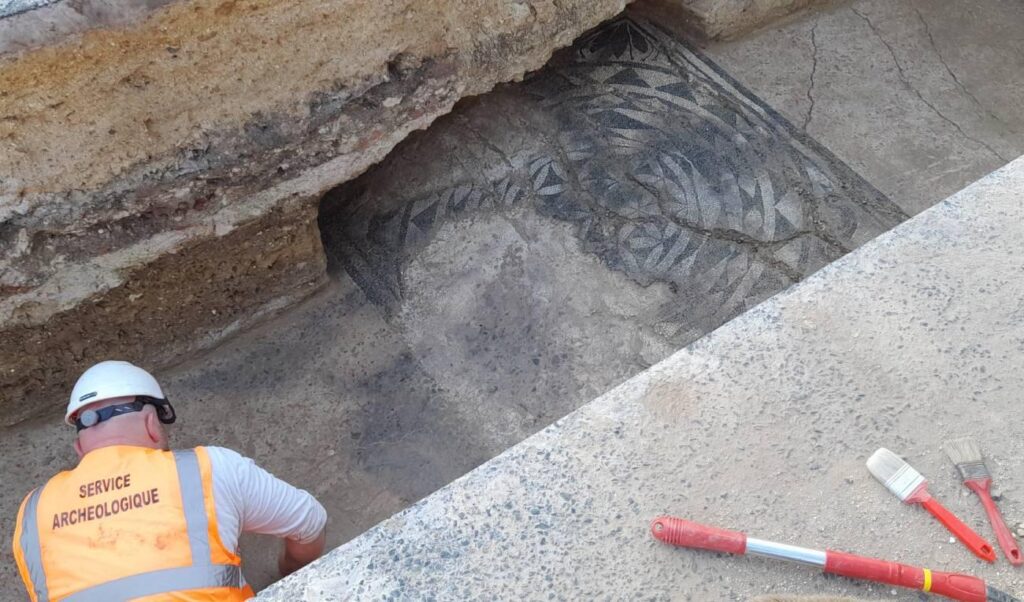
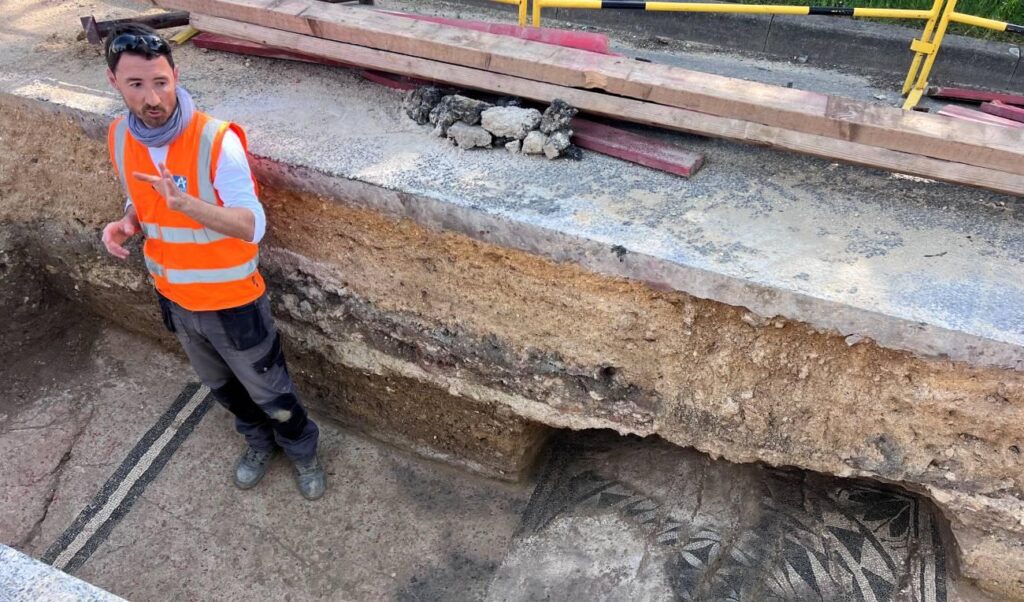
According to the Conseil Départemental de l’Aisne, archaeologists from the department’s Archaeological Service uncovered the exceptionally preserved Gallo-Roman pavement in the Saint-Crépin district during preventive archaeology work linked to the installation of a district heating network. The discovery, dated to the late 1st century AD, is believed to have decorated the floor of a Roman villa, probably in a reception room measuring nearly 50 square meters.
The find is considered especially important because of its scale, preservation, and unusual construction. Rather than being made entirely of tesserae, the small cubes of stone or glass paste used in Roman mosaics, the pavement combines two techniques: a concrete section and a decorated tessellated section. Archaeologists describe it as a “mixed” pavement, a form rarely documented at this size and quality in the region.
A refined floor from a Roman villa
The most elaborate part of the mosaic is a square central panel measuring 1.56 meters on each side. Its design is organized around a black-and-white tessellated medallion, framed by concentric lines and interlocking rhombuses. The result is a carefully planned geometric composition, the kind of decorative language often associated with domestic spaces used for display, hospitality, and social status.
One detail has drawn particular attention. In one corner of the panel, archaeologists identified a dolphin with red fins, rendered with notable care. The motif is more than a decorative flourish. For specialists, such details can preserve traces of the mosaicist’s working method, from the selection of colored materials to the physical gesture used to set individual tesserae into the floor.
Dolphins appeared widely in Roman visual culture, often linked to water, movement, prosperity, and the Mediterranean world. In an inland city such as Soissons, the image may also reflect the adoption of broader Roman tastes by local patrons who wished to decorate their homes according to fashionable imperial-era models.
Soissons before the medieval city
Modern Soissons is better known for its medieval and later history, but the new discovery underlines the depth of its Roman past. In antiquity, the city developed in the territory of the Suessiones, a Gallic people of northern Gaul, and became part of the Roman urban and cultural landscape after the conquest of the region.
The Saint-Crépin district, where the mosaic was found, now appears to have been an ancient neighborhood occupied between the 1st and 3rd centuries AD. The presence of a villa with a decorated reception room suggests that this part of Soissons was not a marginal zone, but an area where members of the local elite lived and displayed their status.
For the archaeologists, the mosaic is therefore evidence of Romanization at a local level. It shows how wealthy inhabitants of Soissons adopted architectural habits, decorative programs, and social customs associated with Roman domestic life. A reception room of this size and quality would have been a space where visitors were received, alliances were maintained, and status was made visible through the very floor beneath their feet.
Preventive archaeology without delaying the works
The mosaic was discovered during a construction project, but officials say the archaeological operation has not delayed the progress of the district heating works. The Conseil Départemental de l’Aisne emphasized that the find reflects the value of preventive archaeology when field knowledge and construction planning are closely coordinated.
The department’s archaeological teams had a strong understanding of the local terrain, allowing them to work efficiently with those responsible for the heating network. This coordination made it possible to document and protect the remains while keeping the broader infrastructure project on schedule.
Such cases are increasingly important in European urban archaeology. Ancient cities often lie beneath modern streets, utilities, and public works. Preventive excavations can reveal major discoveries without requiring large, open-ended research campaigns, especially when archaeologists are involved before or during construction.
Study, conservation, and possible public display
Many questions remain open. Researchers now need to study the pavement’s construction sequence, the materials used, and the relationship between the concrete and tessellated sections. The organization of the design, still only partly understood, will be examined with the help of specialists in Roman mosaics.
The dolphin motif may also prove significant. Its colors, placement, and execution could help identify workshop traditions or technical habits shared with other mosaics in northern Gaul. Even small details may provide information about how the artisan planned the design and how the floor was assembled.
At the same time, the technical services of the Aisne Department are evaluating whether the mosaic can be lifted from its original location. Removing a Roman mosaic is a delicate operation, but it may be necessary to ensure long-term preservation. If approved, the next stages would include extraction, detailed study, restoration, and possibly public presentation.
For now, the Soissons mosaic stands as one of the most remarkable recent archaeological discoveries in the Aisne department. Its craftsmanship, preservation, and setting in an elite Roman domestic space make it a key piece for understanding how ancient Soissons developed during the early centuries of Roman rule.
Conseil Départemental de l’Aisne
Cover Image Credit: Conseil Départemental de l’Aisne
