
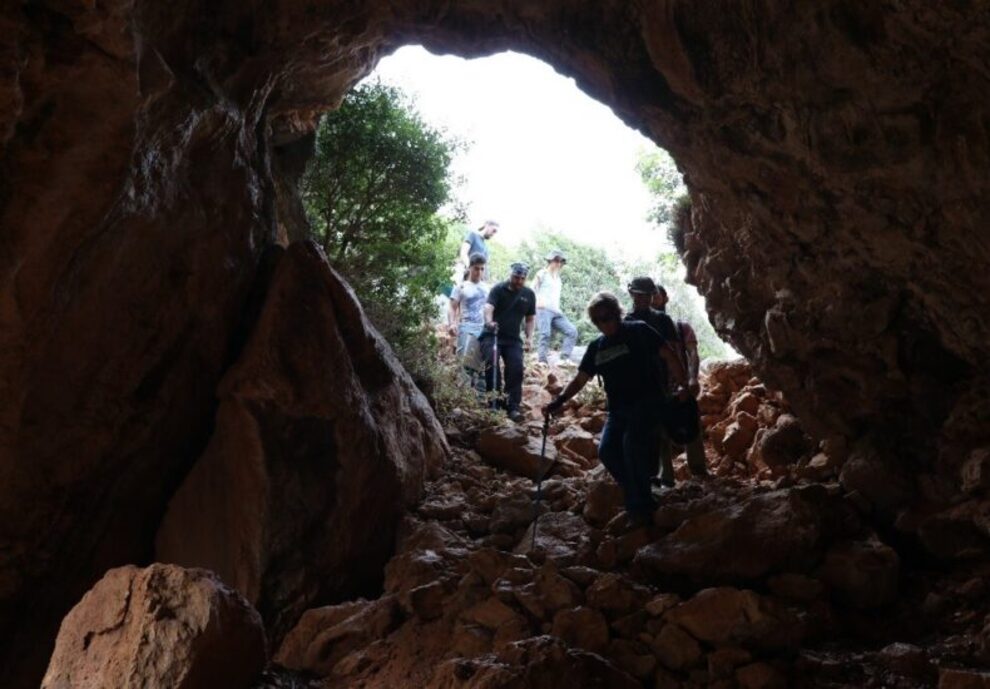
A cave on Türkiye’s eastern Mediterranean coast has preserved a rare sequence of human history: Neanderthals lived there first, Homo sapiens arrived later, and yet many of the daily habits recorded in the ground appear to have remained strikingly similar.
The evidence comes from Üçağızlı II Cave in Hatay, near the northern edge of the Levant, a region long seen as one of the main corridors between Africa and Eurasia. In a new study published in Proceedings of the National Academy of Sciences, researchers report that the cave was occupied by Neanderthals between about 77,000 and 59,000 years ago, and later by modern humans between about 59,000 and 47,000 years ago.
The surprise is not simply that both human groups used the same cave. It is that the shift from one species to another did not produce an obvious cultural break in the archaeological record.
Across the layers, researchers found similar stone-tool traditions, similar hunting patterns, and even the repeated selection of the same small marine shells—objects that were probably not gathered for food. The findings suggest that in this corner of the Levant, biological turnover and cultural change did not necessarily move together.
A cave at the edge of a human crossroads
Üçağızlı II Cave lies close to the Mediterranean shoreline and near the Orontes River, in a landscape that connects Anatolia, the Levant, and routes farther south toward Africa. That geography gives the site unusual importance.
For decades, the Levant has been central to debates about when and how Homo sapiens expanded beyond Africa. Fossils and genetic evidence suggest several movements of modern humans into Eurasia, including a major dispersal around 60,000 years ago. But direct archaeological sequences that combine human fossils, tools, animal remains, and other behavioral evidence from this period are scarce.
Üçağızlı II helps fill that gap. Unlike many Paleolithic sites where tools are found without diagnostic human fossils, this cave preserves both artifacts and human remains in a clear stratigraphic sequence.
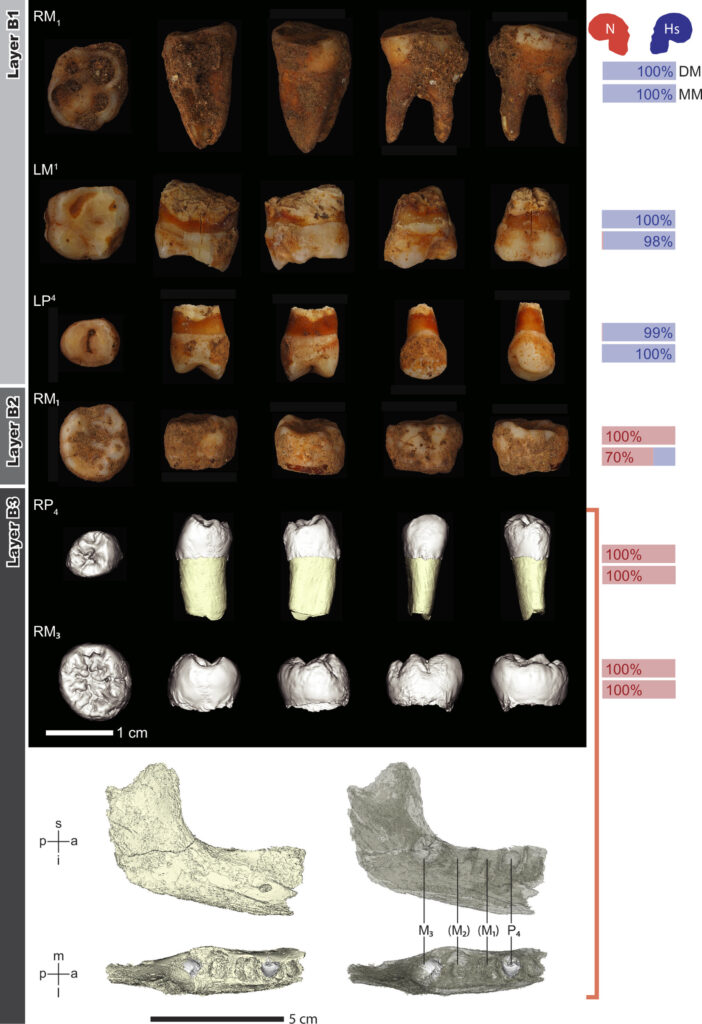
The deposits were divided into three main layers. The oldest, B3, dates to roughly 77,000–70,000 years ago. The middle layer, B2, dates to about 70,000–59,000 years ago. Both contained Neanderthal remains. The youngest layer, B1, dates to about 59,000–47,000 years ago and contained Homo sapiens fossils.
That makes the site especially valuable: it records a local sequence from Neanderthal occupation to modern human occupation at roughly the time when Homo sapiens populations were expanding across western Asia.
Teeth and a jaw fragment identify the cave’s occupants
The human fossil evidence is small but important. Researchers recovered four isolated teeth and a partially preserved lower jaw containing two unerupted teeth. Using dental morphology and enamel-dentine junction analyses, they attributed the remains from the upper layer to Homo sapiens and those from the lower layers to Neanderthals.
The Neanderthal remains include teeth and a partial juvenile mandible. The Homo sapiens remains come from the younger layer, placing modern humans in the cave during a period that overlaps with the broader timing proposed for major dispersals out of Africa.
The study does not claim that Neanderthals and Homo sapiens lived together in the cave at the same time. That distinction matters. The evidence points instead to successive occupations: Neanderthals first, then Homo sapiens. What follows in the archaeological record, however, is not a clean cultural break, but a pattern of continuity in tools, hunting, and the choice of certain shells.
The tools did not change dramatically
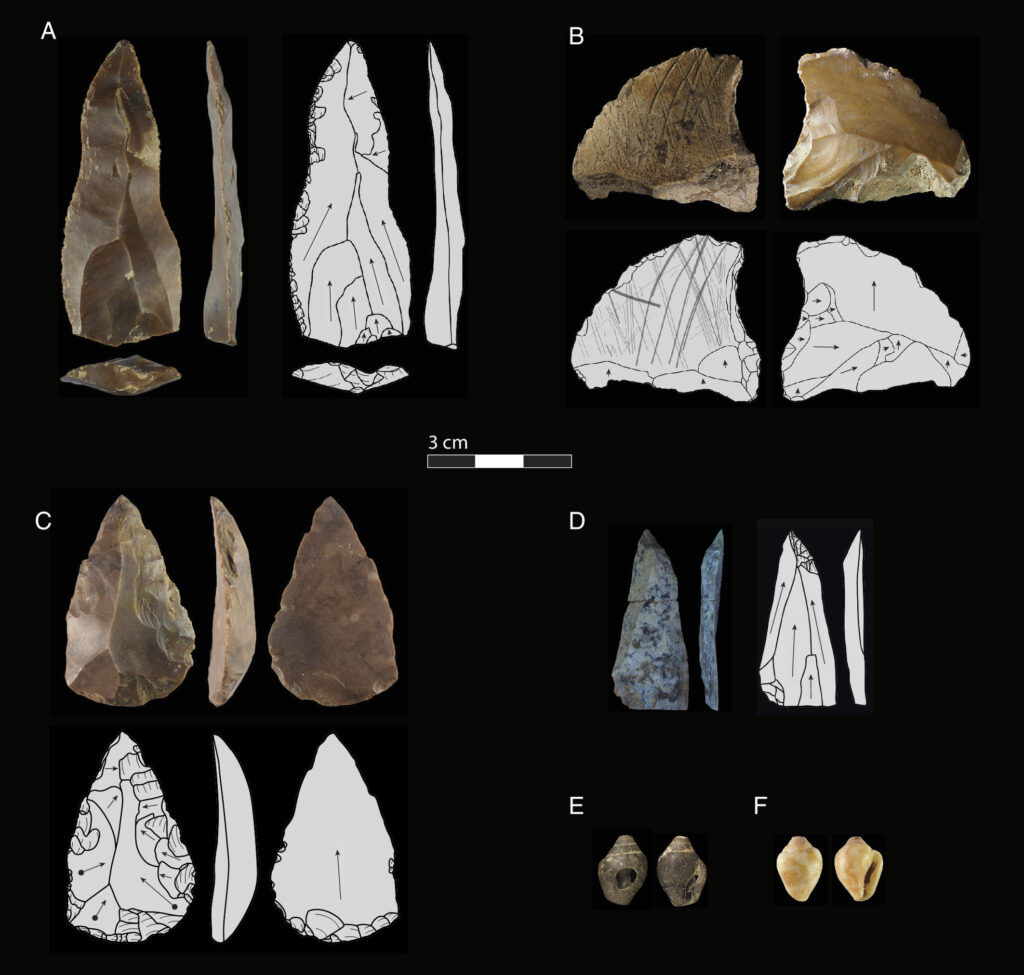
Archaeologists recovered 19,252 stone artifacts from Üçağızlı II Cave. More than 7,000 larger pieces were analyzed in detail. The assemblages from all three layers are dominated by flint and largely fit within late Middle Paleolithic traditions, including Mousterian-style technologies commonly associated with Neanderthals.
The tools include scrapers, points, Levallois flakes, Mousterian points, modified Mousterian points, and a small number of other point types. Blade production is present but does not dominate the assemblage. The technological pattern remains broadly consistent across the Neanderthal and Homo sapiens layers.
That consistency is one of the study’s strongest points. If modern humans had arrived with a completely different tool tradition, the upper layer might show a sharp technological break. Instead, the cave suggests a more complicated picture: Homo sapiens in this part of the northern Levant continued to use a toolkit closely aligned with the older local tradition.
The raw material also points to a shared understanding of the surrounding landscape. Most of the flint appears to have come from sources within about 35 kilometers of the cave. Both Neanderthals and modern humans were using lusing local stone resources in similar ways.
The same prey, the same landscape
The animal remains reinforce the pattern. Researchers identified more than 24,000 animal remains and consumed mollusk shells. Large game dominates the assemblage, especially wild goats, fallow deer, roe deer, and wild boar.
The composition of the faunal remains is broadly similar across the layers. This suggests that both Neanderthals and Homo sapiens hunted and gathered within the same ecological setting and used the cave in comparable ways.
The cave was not merely a place where isolated objects accumulated. The sediment patterns point to repeated use of the cave floor over time. In other words, Üçağızlı II seems to record recurring visits or occupations across tens of thousands of years, rather than a single dramatic episode.
Shells that may carry a deeper story
Among the most intriguing finds are small marine shells, especially Columbella rustica, a Mediterranean gastropod not usually considered a food resource. These shells are often discussed in Paleolithic archaeology as ornaments or objects with nonutilitarian value.
At Üçağızlı II, Columbella rustica shells were found in all main occupation layers, including both Neanderthal and Homo sapiens contexts. Some were unperforated; others, especially in the middle Neanderthal layer, were perforated. One shell showed signs of heat exposure that altered its color, and another may have had a smoothed or polished surface.
The study does not overstate the case. The shells do not prove a fully developed symbolic system, nor do they show exactly how the objects were worn or used. But their repeated selection and transport are difficult to dismiss as accidental, especially because Columbella rustica was consistently favored even though other mollusk species were available.
This is where Üçağızlı II becomes more than a story about tools. The cave suggests that Neanderthals and Homo sapiens may have shared not only subsistence habits, but also local preferences for particular nonfood objects.
That matters because personal ornaments and selected shells have often been treated as markers of modern human behavior. The Üçağızlı II evidence complicates that older divide. In this cave, at least, a shell tradition appears to cross the boundary between two human species.
Not a simple story of replacement
The findings challenge a familiar narrative in which Homo sapiens arrives and quickly replaces Neanderthals along with their technologies and behaviors. Üçağızlı II suggests something less theatrical but more interesting: local continuity.
The researchers argue that the cave records a “cultural continuum” across a taxonomic sequence. In plain terms, the people changed, but many practices did not. The same broad stone-tool tradition, similar hunting strategies, and repeated interest in selected shells continued across the transition.
That does not mean Neanderthals and Homo sapiens were identical in behavior. Nor does it prove direct teaching, imitation, or interbreeding at the site. The mechanism remains unresolved. The similarities could reflect contact between groups, shared adaptation to the same landscape, or longer regional traditions that both populations participated in.
The authors are cautious on this point. They suggest that the two human species may have been in contact and may have shared aspects of culture, but further evidence is needed to test that hypothesis.
A rare window into the Late Pleistocene Levant
Üçağızlı II Cave now joins a small group of sites that are reshaping how archaeologists think about the relationship between Neanderthals and Homo sapiens in western Asia.
The Levant was not just a route out of Africa. It was a meeting zone, a refuge, a corridor, and possibly a region where different human populations overlapped repeatedly over long periods. Fossils from sites such as Skhul, Qafzeh, Manot, Tabun, Amud, Kebara, and others have already shown that both Neanderthals and Homo sapiens used parts of this broad region at different times.
What Üçağızlı II adds is a tightly connected sequence: diagnostic fossils, stone tools, animal remains, plant remains, shells, dating evidence, and repeated occupation layers from the same cave.
Its importance lies in that combination. The site does not rely only on tools to infer who was there. Nor does it offer fossils without behavioral context. It brings both together.
What the cave does—and does not—prove
The strongest conclusion from Üçağızlı II is that cultural change at the Neanderthal–Homo sapiens boundary was not always abrupt. At this site, the archaeological record shows continuity across a period when the fossil record changes from Neanderthal to modern human.
The more speculative question is why.
Were incoming Homo sapiens groups adopting local Neanderthal traditions? Were both groups drawing from a shared regional behavioral repertoire? Did contact between them help maintain similar practices? Could interbreeding have played a role? The study raises these questions but does not settle them.
That restraint is important. The cave does not prove peaceful coexistence. It does not prove direct cultural transmission. It does not show that Neanderthals and Homo sapiens sat in the same chamber at the same time making the same tools.
But it does show that the old model of a clean cultural break is too simple.
At Üçağızlı II, the deep past looks less like replacement and more like continuity: a coastal cave used again and again, by different human groups, within a landscape whose resources, traditions, and habits endured across thousands of generations.
İ. Baykara,D. Turan, E. Eren Kural, D. Silibolatlaz, M.K. Agras, E. Şahiner, S. Kavak, C. Zanolli, Y. Ishihara,W. Morita, & N. Morimoto, Long-term cultural continuity across the Neanderthal–modern human sequence at Üçağızlı II Cave, northern Levant, Proc. Natl. Acad. Sci. U.S.A. 123 (29) e2609061123, https://doi.org/10.1073/pnas.2609061123 (2026).
