
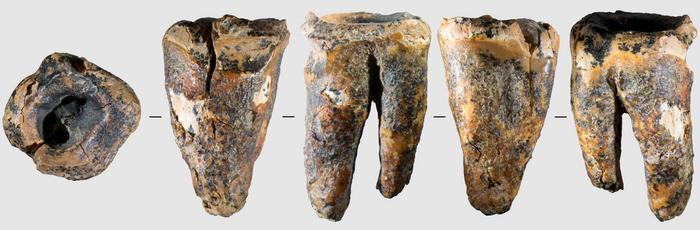
A worn molar from a Siberian cave has opened an unexpectedly intimate window into Neanderthal life: the pain of a diseased tooth, the attempt to treat it, and the steady hand required to drill into it with a stone tool nearly 59,000 years ago.
A new study published in PLOS One argues that Neanderthals living in Chagyrskaya Cave in the Altai Mountains of southern Siberia may have performed the earliest known invasive dental treatment in human evolutionary history. The tooth, known as Chagyrskaya 64, belonged to an adult Neanderthal and bears a deep, human-made cavity on its chewing surface. According to the researchers, the marks are not the result of ordinary tooth wear, trauma, or natural decay alone. They point instead to a deliberate attempt to remove diseased dental tissue and reach the pulp chamber, where nerves and blood vessels are located.
For anyone who has suffered a severe toothache, the logic is immediately understandable. Dental pain can stop daily life cold. For a small Neanderthal group moving through the Ice Age landscapes of Siberia, such pain could have carried real consequences, limiting eating, movement, concentration, and survival. What makes the Chagyrskaya tooth remarkable is not simply that it was diseased, but that someone appears to have tried to do something about it.
A tooth from one of Asia’s richest Neanderthal sites
Chagyrskaya Cave lies on the left bank of the Charysh River, in the northwestern Altai Mountains. The site is already known as one of the most important Neanderthal locations in northern Asia, preserving more than 70 hominin fossils, including 26 dental specimens. These Neanderthals were part of a late eastern population with genetic and cultural links to groups from Central and Eastern Europe.
The molar at the center of the new study was found in an undisturbed archaeological layer associated with the earliest phase of Neanderthal occupation at the cave, around 59,000 years ago. This secure context matters. It helps rule out the possibility that the tooth was altered by later sediment movement, erosion, or post-depositional damage.
When researchers examined the tooth, they found a large, irregular depression in the center of its chewing surface. It extended deep into the pulp chamber. The tooth also showed signs of heavy wear, toothpick use, and severe caries. But the shape of the central cavity was unusual. It was too structured, too deep, and too marked by microscopic traces to be explained as natural decay alone.
Stone tools, rotating motions, and a painful procedure
The research team, led by Alisa V. Zubova of the Russian Academy of Sciences, used a combination of traceological analysis, scanning electron microscopy, micro-CT imaging, Raman spectroscopy, and experimental replication. The goal was straightforward: could the marks on Chagyrskaya 64 have been made intentionally, and could Neanderthal stone tools have produced them?
The answer, according to the study, is yes.
Microscopic traces inside the cavity showed fine linear striations and small grooves consistent with a rotating or drilling motion. The researchers then tested the idea experimentally, using modern human molars and small stone perforators made from local jasper-like raw material. The experiments showed that a pointed lithic tool could penetrate dental tissue through manual rotation and create marks comparable to those seen on the Neanderthal tooth.
This was not a quick scrape at the surface. The procedure appears to have involved the removal of dentin and access to the pulp chamber. In modern terms, it was not a full root canal, but it resembled an early and very crude attempt to relieve the source of severe dental pain by opening and clearing the affected area.
The researchers identified three partially overlapping depressions on the tooth, suggesting that the work may have been done in stages. Whether these were separate attempts or part of one imperfect procedure remains uncertain. What is clear is that the person who performed the intervention used a technique requiring precision, pressure, and controlled finger movement.
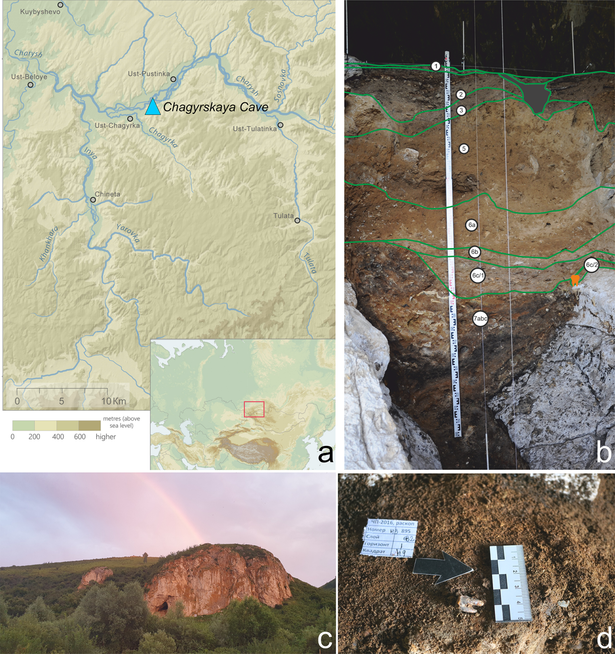
The treated Neanderthal tooth was found in Siberia’s Chagyrskaya Cave. Credit: Zubova et al., 2026, PLOS One
More than toothpicks
Evidence of Neanderthal toothpick use has been known for years. Such grooves, often found between teeth, may reflect attempts to remove trapped food or relieve gum pain. But toothpick use alone is not necessarily proof of complex medical behavior; similar actions have been observed in other primates.
Chagyrskaya 64 appears to go further. The tooth shows both toothpick grooves and a drilled cavity. That combination suggests different forms of dental manipulation, possibly using different tools and techniques. The intervention was invasive, targeted, and likely painful.
The researchers also found evidence of deep caries through micro-CT analysis. Demineralized dentin showed that the tooth was genuinely diseased, giving a plausible reason for treatment. The absence of secondary dentin and the widened shape of the cavity also support the idea that tissue had been intentionally removed rather than simply exposed through wear.
A rare glimpse of Neanderthal medical thinking
The discovery adds to a growing body of evidence that Neanderthals were not the brutish caricatures once imagined. They cared for injured individuals, used complex tools, adapted to harsh environments, and may have understood some medicinal properties of plants. The Chagyrskaya tooth now adds a more specific possibility: they could identify a source of pain and attempt a practical intervention.
That does not mean Neanderthals practiced dentistry in any formal sense. There is no evidence of specialized healers, repeated dental procedures across many individuals, or standardized medical knowledge. But the tooth points to something more subtle and perhaps more important: problem-solving under pain.
The person performing the treatment had to recognize that the tooth was the problem, select a tool, apply it to a tiny target inside the mouth, and continue despite the discomfort such a procedure would have caused. If the patient performed the act on themselves, the degree of endurance is striking. If another group member did it, the find may also reflect trust and care within the group.
The oldest known invasive dental intervention
Before this study, the earliest widely cited evidence for dental caries treatment came from Upper Paleolithic Homo sapiens remains, including a roughly 14,000-year-old case from Italy. The Chagyrskaya molar pushes the timeline far deeper into the past and attributes such behavior not to modern humans, but to Neanderthals.
The treatment may even have worked, at least partly. The smoothed and polished edges of the cavity indicate that the tooth continued to be used while the individual was alive. That means the person survived long enough after the intervention for wear to develop on the modified surface. Pain relief may have followed if the damaged nerve tissue died after exposure, although the study cannot determine whether infection later spread into the jaw.
In the end, the tooth is small evidence with large implications. It suggests that 59,000 years ago, somewhere inside a Siberian cave, a Neanderthal faced a familiar human problem: unbearable dental pain. The solution was not elegant. It was stone, pressure, rotation, and endurance. But it was deliberate. And in that rough intervention, archaeologists may have found the oldest known trace of dental treatment in the human story.
Zubova, A. V., Zotkina, L. V., Olsen, J. W., Kulkov, A. M., Moiseyev, V. G., Malyutina, A. A., Davydov, R. V., Markin, S. V., Maksimovskiy, E. A., Chistyakov, P. V., Krivoshapkin, A. I., & Kolobova, K. A. (2026). Earliest evidence for invasive mitigation of dental caries by Neanderthals. PLOS One, 21(5), e0347662. https://doi.org/10.1371/journal.pone.0347662
Cover Image Credit: Chagyrskaya 64 molar tooth and its macro-features: General view of the tooth in five projections. Zubova et al., 2026, PLOS One
