
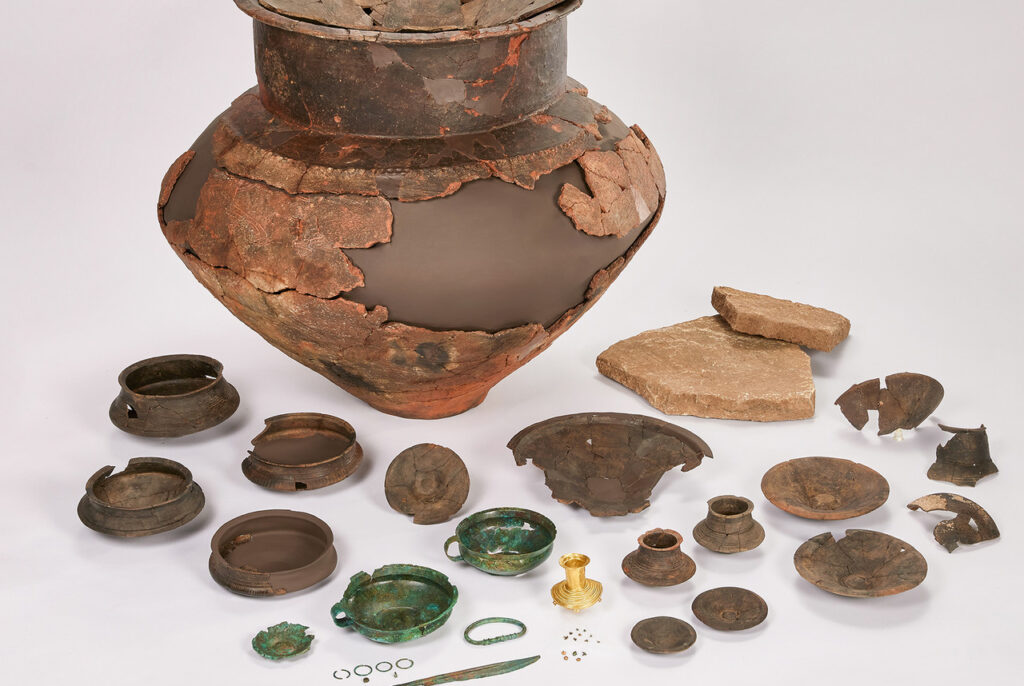
New research into a richly furnished 3,000-year-old grave in Germany has overturned an early interpretation of a mysterious gold artifact. Conservators found tiny nails, adhesive residues, and traces of a lost material, revealing that the object was more complex than its surviving appearance suggests.
For more than 3,000 years, a mysterious gold object lay beneath a bronze bowl in a burial in southwestern Germany. Its unusual shape initially led researchers to consider whether someone had cut it from a larger gold vessel. Now, microscopic traces and detailed restoration work suggest an entirely different origin.
The object came from an exceptionally rich burial at Albisheim, in Germany’s Rhineland-Palatinate state. On September 29, the General Directorate for Cultural Heritage of Rhineland-Palatinate (GDKE) announced the first research results, revealing previously unnoticed details of its construction.
Tiny Clues Change the Story of the Gold Artifact
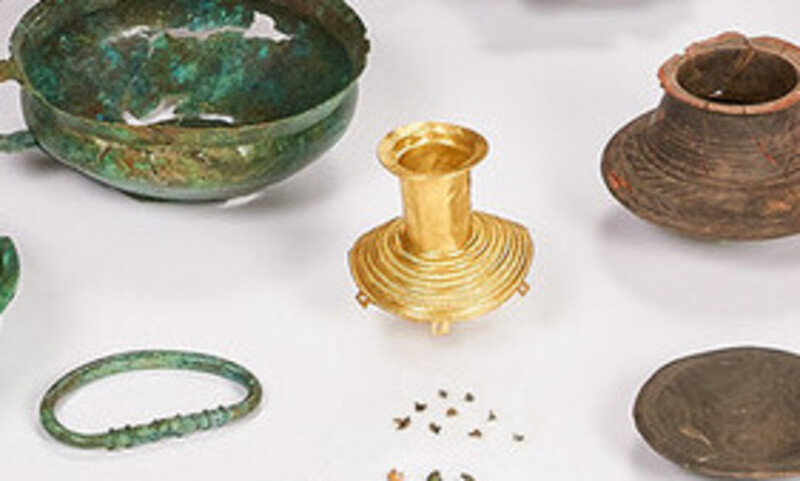
The most revealing evidence emerged when conservators examined the gold’s surface and construction. They identified traces of adhesive, tiny nails, and cord-like structures, suggesting that the metal originally connected to an organic material that has not survived.
These details indicate that the gold may have formed part of a more complex object. Its decoration offers another clue: researchers believe a craftsperson worked the pattern into the thin metal sheet from the inside, demonstrating the care involved in its manufacture.
The discovery illustrates how restoration can change the interpretation of an archaeological artifact. The gold survived more than three millennia underground, but much of the object to which it belonged may have disappeared, leaving only small traces of its construction.
Dr. Ulrich Himmelmann, acting head of the GDKE’s State Archaeology Directorate, emphasized the importance of examining minute tool marks and material residues. Such evidence allows specialists to reconstruct manufacturing techniques even when substantial parts of an artifact are missing.
An Extraordinary Burial from the Late Bronze Age
Archaeologists discovered the grave during excavations conducted ahead of a residential development in the Alzey hill country. Between 2023 and 2025, the GDKE’s Speyer archaeological team documented more than 850 archaeological features representing different periods.
Among them was an unusually elaborate urn burial dating to the 12th or 11th century BCE. It contained at least 24 ceramic vessels, along with exceptional grave goods made from bronze and precious metals.
The quantity and variety of these objects distinguish the burial from more modest funerary assemblages. They also raise questions about the individual whose cremated remains received such elaborate treatment. Although the grave goods suggest considerable resources were devoted to the burial, researchers have not established the person’s identity or precise social standing.
The gold artifact’s position beneath a bronze bowl adds another intriguing detail to the burial arrangement. Whether this placement reflected a practical connection between the objects or a deliberate funerary choice remains unknown.
The Next Stage of the Investigation
The GDKE team now plans scientific analyses of the surviving organic residues, adhesive and cord-like structures. Researchers will also compare the artifact with similar archaeological finds to establish whether its construction matches a known object type.
These investigations could help determine what material once accompanied the gold and how its components fitted together. The central question, however, concerns what the complete object was intended to do.
For archaeologists, the Albisheim find demonstrates the value of studying objects beyond their visible appearance. What initially looked like a possible fragment of a gold vessel now provides evidence of a more elaborate manufacturing process, one that further research may help reconstruct.
General Directorate for Cultural Heritage of Rhineland-Palatinate (GDKE)
