
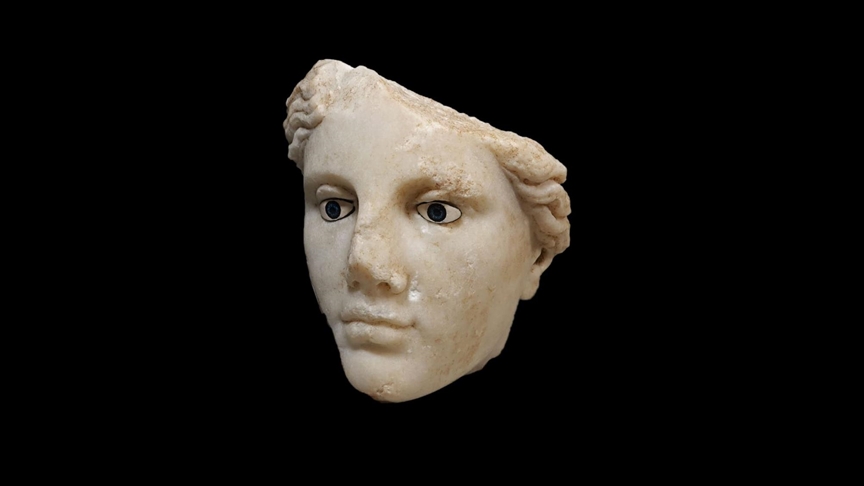
A remarkable marble head believed to belong to a monumental goddess statue from the Hellenistic period has been unearthed at the ancient city of Metropolis in western Türkiye, offering new insights into the city’s artistic production and religious life more than two millennia ago. Archaeologists suggest the sculpture may represent Hestia, the Greek goddess of the hearth, domestic harmony, and civic unity.
The discovery was made during ongoing excavations at Metropolis, located in İzmir’s Torbalı district, a site often referred to as the “City of the Mother Goddess.” Archaeological research at Metropolis began in 1989 and has been led since 2007 by Prof. Dr. Serdar Aybek of Dokuz Eylül University’s Department of Archaeology. Today, the excavations continue under Türkiye’s “Heritage for the Future” initiative of the Ministry of Culture and Tourism, with additional support from the Sabancı Foundation.
The newly uncovered artifact emerged from an area identified as a commercial structure, an unexpected but significant context that underscores the interconnectedness of economic, civic, and religious life in ancient cities.
A Masterpiece of Hellenistic Sculpture
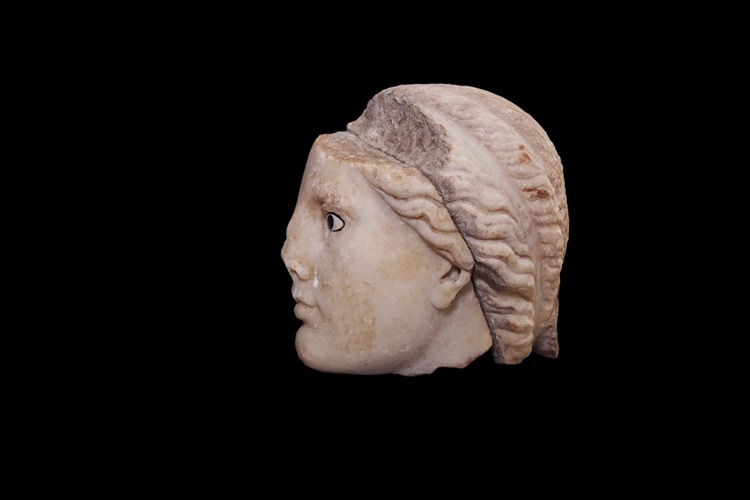
According to Prof. Aybek, the head’s hairstyle, facial proportions, and portrait-like realism, along with its advanced construction technique, point decisively to the Hellenistic period (circa 323–31 BCE). The sculpture was carved in two separate marble pieces that were then meticulously joined using metal clamps—a hallmark of large-scale, high-quality statuary of the era.
Following careful cleaning by conservator Didem Taner, archaeologists observed that the pupils were intentionally hollowed during the initial carving process. Similar examples from ancient Greece indicate that such cavities were often designed to hold colored stones or glass inlays, giving statues a strikingly lifelike gaze.
“The dimensions suggest that this head belonged to a monumental statue,” Aybek noted. “It provides valuable evidence for the level of sculptural expertise and artistic ambition present in Metropolis during the Hellenistic period.”
Could This Be Hestia?
Researchers believe the head may belong to Goddess Hestia, one of the most revered yet understated figures in Greek mythology. Unlike Olympian gods associated with dramatic myths or heroic feats, Hestia symbolized the sacred hearth, representing home, family, and social stability. In civic life, she was the spiritual center of the bouleuterion, or council house, where the eternal flame embodied the continuity and unity of the city-state.
Previous excavations at Metropolis uncovered a torso fragment within the city’s Council House, thought to depict Hestia as the protector of the assembly. Aybek explains that the newly discovered head appears proportionally compatible with that earlier find, raising the possibility that the two fragments once formed a single statue.
An experimental visualization conducted by conservator Taner Özgür has further helped scholars imagine the statue’s original appearance, revealing how light, color, and polished marble would have combined to create an imposing and serene presence.
Hestia: Goddess of the Sacred Flame
In Greek belief, Hestia was the eldest of the Olympian gods, daughter of Kronos and Rhea. She rarely appeared in mythological narratives, yet her importance was profound. Every household hearth was dedicated to her, and every public sacrifice began and ended in her name. Cities maintained an eternal flame in her honor—extinguishing it symbolized the death of the community itself.
If confirmed as Hestia, the Metropolis statue would underscore the city’s emphasis on civic order, tradition, and collective identity, values that were especially significant during the politically complex Hellenistic age.
Metropolis: A City Across Millennia
Metropolis boasts a history stretching back to the Neolithic period, evolving into a prominent urban center in Ionia. Known for its theaters, council buildings, bath complexes, and sanctuaries, the city reflects centuries of cultural exchange between Anatolian traditions and Greek influence.
Each new discovery adds depth to Metropolis’s story, and the goddess head stands as a powerful reminder of how art, belief, and daily life were woven together in the ancient world.
As conservation and comparative studies continue, archaeologists hope the sculpture will soon take its place among the most significant finds from Hellenistic Anatolia—its calm gaze once again illuminating the hearth of a long-silent city.
Cover Image Credit: AA
