
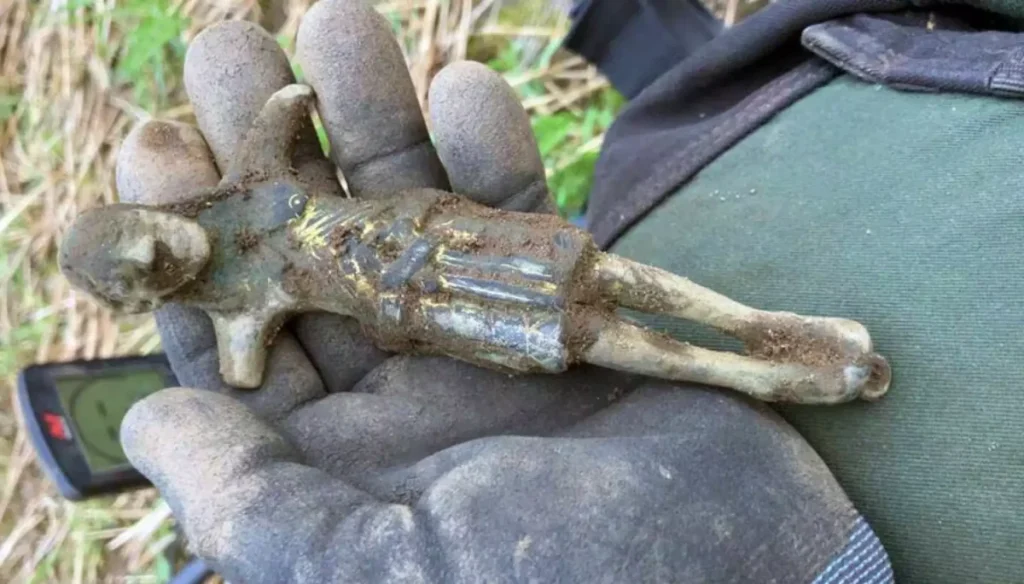
A metal detectorist in Åndalsnes has uncovered an 800-year-old gilded bronze Christ figure just beneath the surface of a ploughed field. The medieval artifact, now headed to NTNU for analysis, may point to the remains of a lost church.
The autumn light was already fading over Åndalsnes when detectorist Kim Erik Fylling Dybvik decided to make one final sweep across the ploughed field. He and his search partner, Warren Schmidt, had spent the entire day crossing the terrain with little to show for it. Then the detector rang out with unexpected force — a signal so strong that Dybvik immediately knew this would not be another discarded button or fragment of tin. Just beneath the surface, almost resting in the topsoil, lay a small medieval Christ figure of bronze, still bearing patches of its original gold.
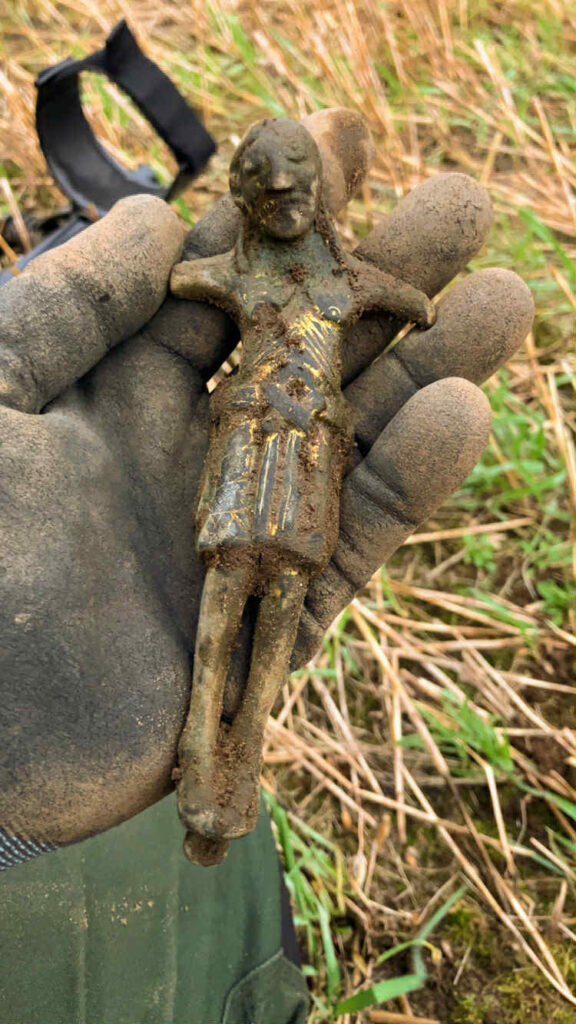
“That moment was one of the greatest of my life,” Dybvik recalled. After more than eleven years travelling across Norway with a metal detector, he instantly recognised that the object was medieval. It was small enough to fit into the palm of his hand, yet crafted with fine detail: outstretched arms, defined facial features, and unmistakable traces of gilding that glimmered once the soil was brushed away. “I almost had to rub my eyes. My pulse shot up. These are the moments we live for — saving cultural history that would otherwise disappear.”
A rare medieval artifact emerges from the soil
Experts believe the figure dates to the late 1100s or early 1200s — the High Middle Ages. Bjørn Ringstad, former county conservator in Møre og Romsdal, examined the images soon after the discovery and placed it confidently in that period. He described the find as “highly unusual” and publicly congratulated Dybvik on what he called a “magnificent discovery.”
Its survival is nearly miraculous. The figure was retrieved from a newly ploughed field, sitting just centimeters below the surface. Each cycle of ploughing might have crushed or bent it, yet it remained intact. Dybvik noted that the same field had produced a Viking-period ring brooch only a week earlier — still with its pin preserved, an extremely rare occurrence. Earlier that afternoon, the pair had also recovered silver coins and roughly seventy tin and copper buttons from later centuries, showing the site’s long-term activity.
Such a concentration of finds is not random. The field lies close to where a medieval church once stood, and earlier discoveries have hinted that the surrounding landscape still hides forgotten layers of ecclesiastical and domestic life.
A race against sunset — and a careful rescue
As soon as the figure emerged from the soil, Dybvik contacted a field archaeologist from Møre og Romsdal County. Aaron Johnston, who lives nearby, didn’t hesitate: “I was just about to eat dinner, but I jumped into the car,” he said. Within fifteen minutes he arrived at the darkening field, using car headlights as makeshift work lamps.
He immediately realised the significance of the object — not only because of its age, but because of the gilding and the style of the cast. Johnston documented the exact coordinates, took measurements and photographs, and ensured the piece was handled correctly. He placed it in a box lined with acid-free paper and kept it cool to prevent any deterioration. “It’s important not to let the metal dry out or get handled too much,” he explained. For the moment, the Christ figure is being stored in the archaeologist’s refrigerator — an unusual temporary resting place, but the safest one available.
From Åndalsnes to Trondheim — a new investigation begins
The Christ figure is now on its way to the county’s cultural department in Molde and will soon be transferred to NTNU in Trondheim for advanced analysis. Specialists there will examine the alloy composition, gilding technique, and surface wear patterns to determine how the figure was made and where it may have originally been placed. Given the proximity to a medieval church site, it may once have formed part of a liturgical object, a processional cross, or a devotional figure belonging to a cleric.
The discovery has also revived archaeological interest in the area. A georadar survey is being prepared to search for buried structural remains — possibly foundations of the lost church or associated buildings. If evidence emerges, the field could become the focus of a larger excavation.
A detectorist driven by preservation, not reward
For Dybvik, the discovery is not about profit. “It’s about preserving cultural treasures — honestly and cleanly,” he told local reporters. Any potential financial reward is irrelevant to him. What matters, he insists, is saving objects before agricultural activity destroys them.
The medieval Christ figure — delicate, gilded, and improbably intact — serves as a reminder of how easily pieces of the past can vanish, and how much chance still plays a role in uncovering them. Had Dybvik walked only a few metres to the side, or ended his search five minutes earlier, one of Norway’s most remarkable recent finds might have been lost forever.
Credit: Kim Erik Fylling Dybvik / NTNU Trondheim
