
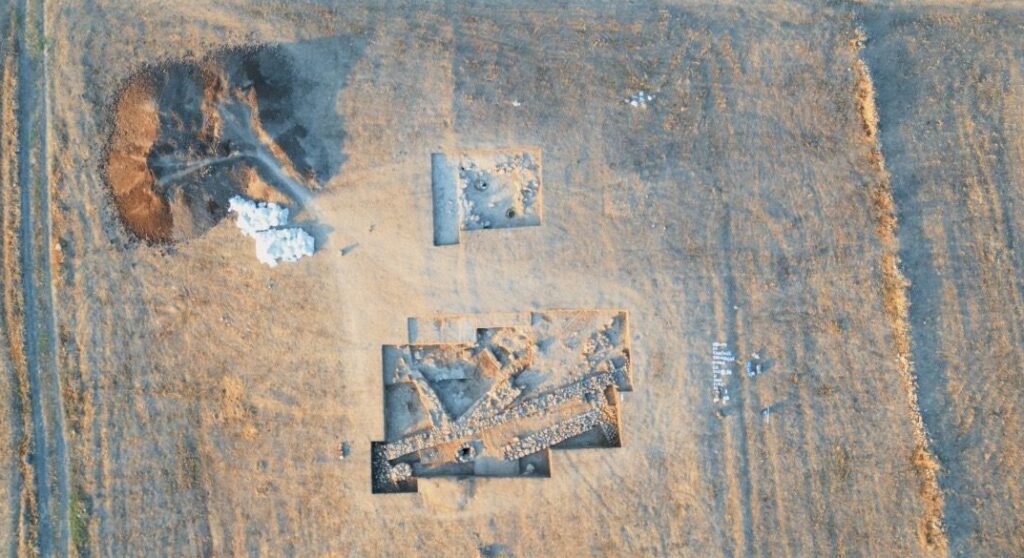
Archaeologists working in the mountains of southeastern Azerbaijan have uncovered the remains of a large settlement dating back approximately 2,200 years.
The site, located near Urakaran village in the Yardimli district, contains substantial stone buildings, defensive structures, and evidence of production activity. Researchers believe it may be the first large urban-type settlement associated with the Atropatene period to be systematically investigated in this mountainous part of Azerbaijan.
The discovery was made by a joint Azerbaijani-American expedition on the left bank of the Vilash River. The archaeological complex is locally known as Seyyidin Yeri.
Although initial reports have described the site as an ancient city, excavations have not yet revealed its full boundaries or internal plan. Current evidence nevertheless points to a permanent and unusually substantial highland settlement rather than a small rural community.
Large Buildings and Evidence of Destruction
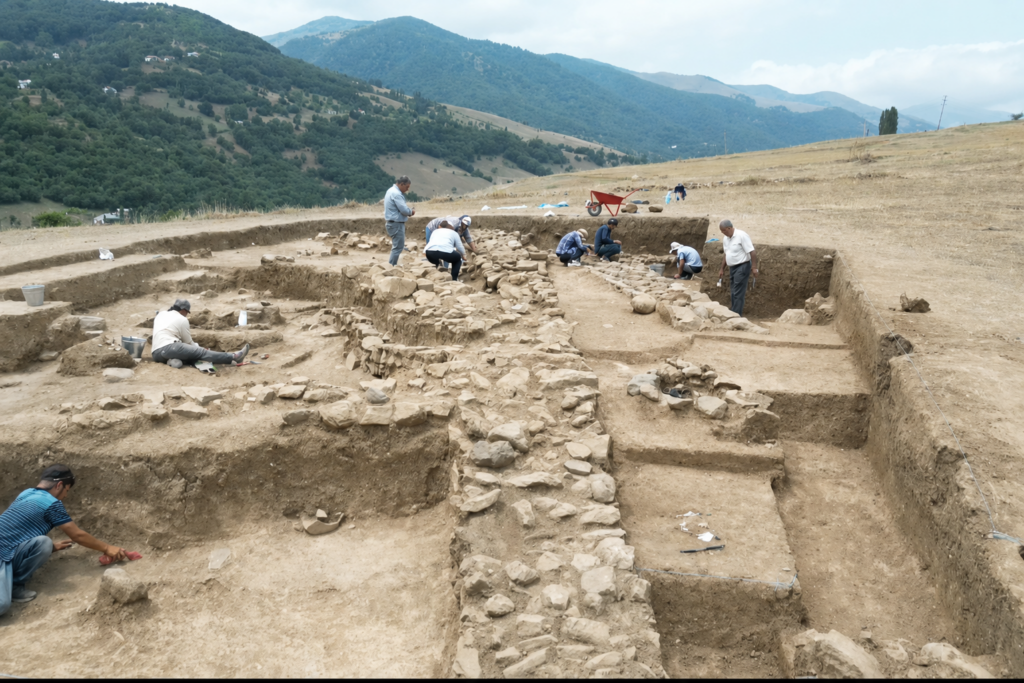
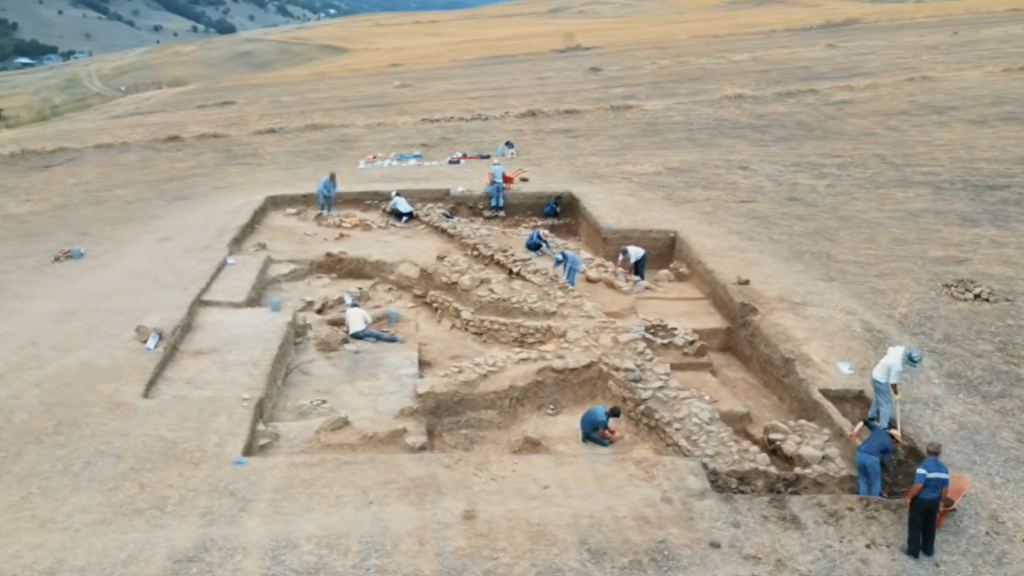
Excavations have exposed rooms belonging to several large stone structures constructed during different phases of occupation.
Jeyhun Eminli, a leading researcher at the Institute of Archaeology and Anthropology of the Azerbaijan National Academy of Sciences and head of the expedition, said some sections appear to have served a defensive purpose.
The archaeologists also found evidence that at least part of the complex was destroyed by fire. Burned roofing material apparently collapsed into the rooms, helping preserve traces of the buildings beneath it.
Researchers have collected numerous organic samples from the burned deposits and other archaeological layers. Laboratory analysis at Hamilton College in the United States is expected to provide more precise dates and information about the settlement’s economy and environment.
According to a report by the Azerbaijani news agency APA, the excavators also identified traces of production and other economic activity at the site. Finds from later occupation levels reportedly indicate that glass was being produced locally from at least the early first century CE.
If confirmed through specialist analysis, the glassworking evidence would indicate that Seyyidin Yeri was not simply a defensive outpost. It may have functioned as a regional production and exchange centre serving communities in the surrounding highlands.
Earlier Research Challenged Assumptions About the Highlands
Seyyidin Yeri was first identified during archaeological work conducted near Urakaran in 2024.
A study published in 2025 described multi-phase stone architecture, plaster floors and deposits containing substantial quantities of archaeological material. The researchers argued that these remains provided rare evidence for a durable Late Iron Age community investing in large-scale construction.
The findings challenged the long-standing assumption that the southeastern highlands were only sparsely occupied during the late first millennium BCE and early first millennium CE. Instead, the emerging evidence points to settled communities connected to wider political and commercial networks.
A nearby cemetery at Bilga has produced jar burials, megalithic tombs, ground graves and possible horse burials. Radiocarbon dates and artefacts suggest that the cemetery remained in use from the Achaemenid period into the Parthian era.
Together, the settlement and cemetery provide archaeologists with an opportunity to study both the daily lives and burial traditions of communities living in the region more than two millennia ago.
What Was Atropatene?
Atropatene, also known in ancient sources as Media Atropatene, emerged following the collapse of the Achaemenid Persian Empire in the late fourth century BCE.
The kingdom took its name from Atropates, an Achaemenid governor and military commander who retained control of the northwestern part of Media during the political struggles that followed Alexander the Great’s death. By around 323 BCE, the region had developed into a largely autonomous kingdom ruled by local Iranian dynasts.
Its core territory was centred on the mountainous lands around the Lake Urmia basin, although its political and cultural influence reached into neighbouring parts of the South Caucasus. The difficult terrain helped local rulers preserve a degree of independence while larger powers competed for control of the region.
Atropatene existed between the Seleucid, Armenian, Parthian and later Roman spheres of influence. Rather than being isolated, its mountain valleys and passes connected communities moving between the Iranian plateau, the Caspian region and the South Caucasus.
The Yardimli expedition places Seyyidin Yeri within this wider Atropatene-period landscape. The settlement could therefore help explain how political authority, trade and urban development operated outside the kingdom’s better-known lowland centres.
A Highland Community Between Larger Empires
Previous archaeological work in the mountains of southeastern Azerbaijan has uncovered imported-style pottery, jewellery and weapons associated with several surrounding political traditions.
However, researchers have also found evidence of local building techniques and domestic practices that do not simply reproduce imperial models. This combination suggests that highland communities selectively adopted outside objects and ideas while maintaining distinct regional traditions.
The location of Seyyidin Yeri may have been particularly important. Positioned near a river and mountain routes, the settlement could have controlled movement through the surrounding landscape or supported trade between valleys.
The fortification-like sections identified during excavation add weight to this interpretation, although researchers will need to expose more of the complex before its function can be determined.
Further Excavations Planned
Lara Fabian, an archaeologist at the University of California, Los Angeles, said the settlement also contains material predating the main 2,200-year-old occupation.
The research team plans to continue analysing the finds and publish detailed scientific studies. Larger excavations using remote sensing and other modern archaeological methods are expected in future seasons to determine the settlement’s full size, chronology and organisation.
Local authorities have also proposed preserving the complex as an open-air museum and adding it to a regional tourism route. Any such project will depend on continued excavation, conservation and protection of the exposed structures.
For now, Seyyidin Yeri offers rare evidence that the highlands associated with Atropatene supported substantial, economically active communities. Continued research may establish whether the settlement was a fortified regional centre, a production hub or part of a broader network of towns connecting the South Caucasus with the Iranian world.
Eminli, J., Lau, H., Fabian, L., & Huseynova, S. (2025). Research on Late Iron Age occupation in the Yardimli region: Preliminary results from the 2024 season. Tempus Pontem: Azerbaijan Journal of Archaeology and Anthropology, 1(2), 34–49. https://doi.org/10.30546/679523.2.2025.034
Institute of Archaeology and Anthropology of the Azerbaijan National Academy of Sciences
Cover Image Credit: Institute of Archaeology and Anthropology of the Azerbaijan National Academy of Sciences
