12 February 2026 The Future is the Product of the Past

In western Turkey, inscriptions and 2,500-year-old sculptures were found

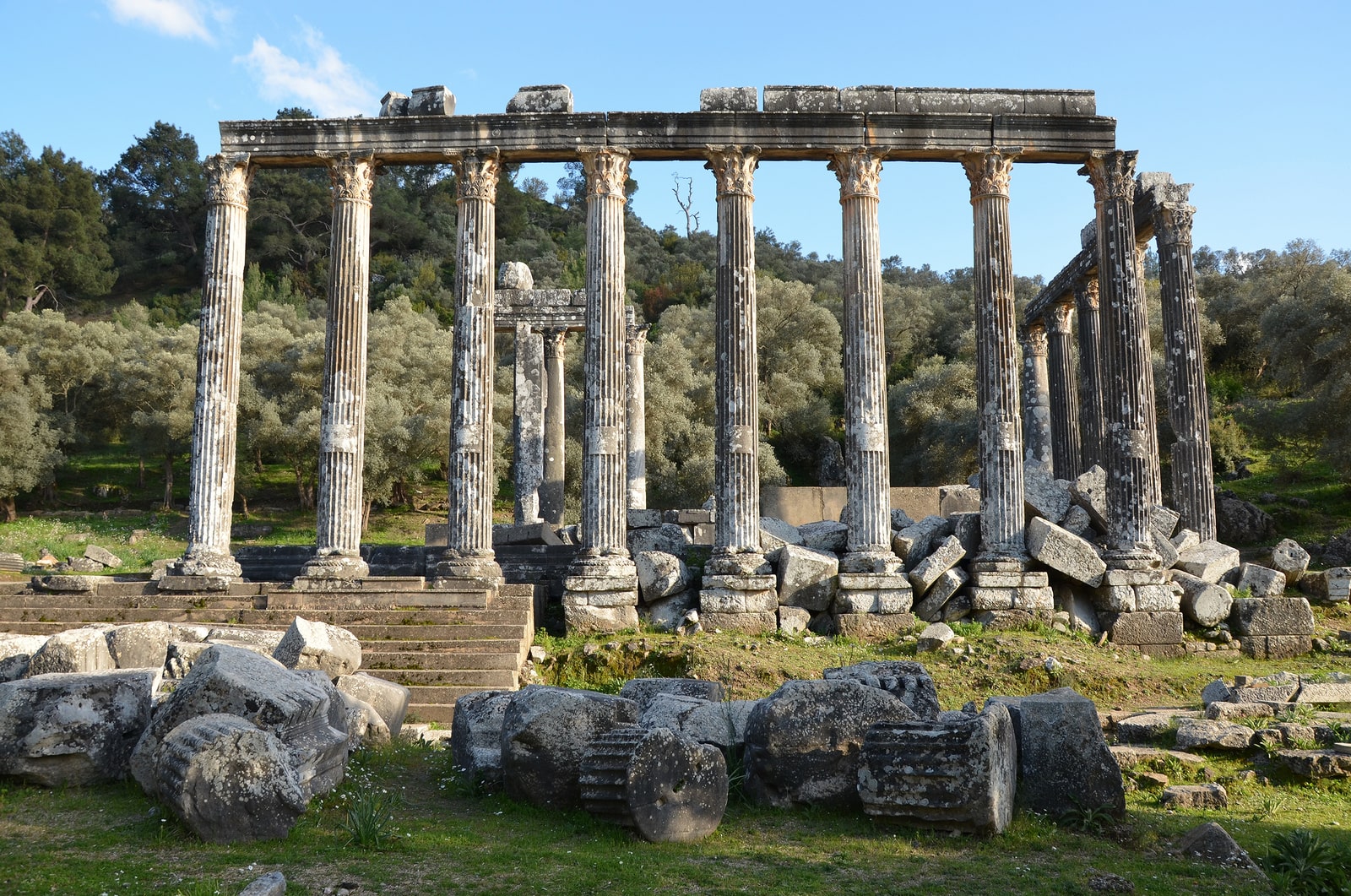
Two 2,500-year-old marble statues and an inscription have been found during excavations at the ancient city of Euromos, in Turkey’s western Mugla province.

The artifacts unearthed during the excavations in the Temple of Zeus Lepsynos, one of the best-preserved Roman temples in Anatolia, came as surprise to the world of archeology.

Abuzer Kizil, head of the excavation committee and faculty member at Mugla Sitki Kocman University’s Department of Archeology, told Anadolu Agency (AA) on Sunday that the artifacts were found during the restoration efforts unexpectedly, and came as a surprise to the world of archeology.

“We have unearthed two very important links of the missing archaic sculpture of the Caria region, and an inscription dating to the Hellenistic period,” he said.
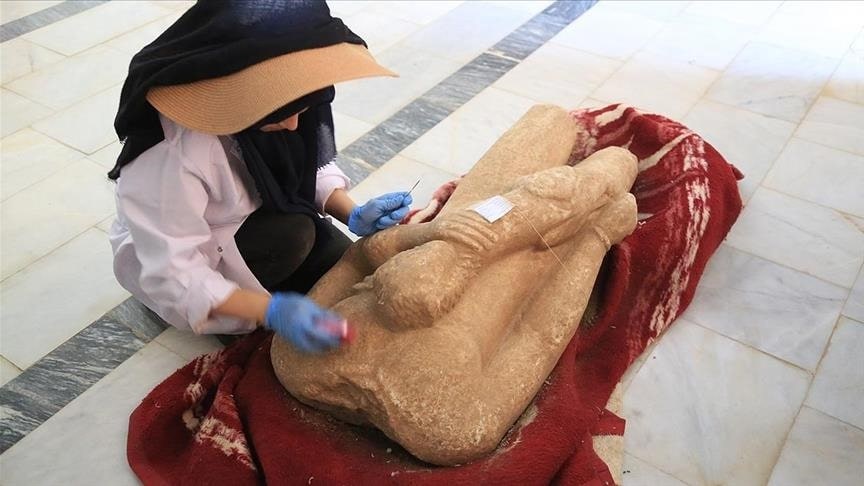
The statues were classified as kouros, a modern term given to ancient Greek statues.

Kizil added that the sculptures were categorized as kouros, a modern term given to free-standing ancient Greek sculptures.


📣 Our WhatsApp channel is now LIVE! Stay up-to-date with the latest news and updates, just click here to follow us on WhatsApp and never miss a thing!!


“One of the two kouros unearthed at Euromos is naked, the other is wearing armor and a short skirt. The armor is made of leather and it is remarkable that both statues have a lion in their hands. Iconographically, the lion holds great significance … we have not been able to find exact copies of either of the statues so far,” Kizil said.

He said the naked statue has a lion in his hand indicating it is most likely Apollo.

Kizil said the inscription from the Hellenistic period is expected to reveal important insights on the Carian history, and efforts to decipher it are continuing.

We have shared with you the moment of the discovery of the statues. For details…

Related Articles

Korea’s 900-Year-Old Celadon Bowls Raised from the West Sea Look Strikingly New — Here’s Why

2 December 2025

2 December 2025

On South Korea’s western shoreline, where vast UNESCO-listed tidal flats stretch toward the horizon, an unusual archaeological mystery has captured...

This Month in the “You Will See What You Don’t See” Project

11 February 2021

11 February 2021

Izmir Archeology Museum started to exhibit the unseen artifacts in its warehouses last month in the project that started under...

New Study reveals how England’s ‘White Queen’ worshipped a disembowelled saint at the Chapel of St Erasmus

5 December 2022

5 December 2022

A new study reveals the story of how England’s “White Queen”, Elizabeth Woodville, wife of Edward IV, once worshipped at...

Archaeologists have unearthed part of Hadrian’s Aqueduct, one of the Largest Hydraulic Works of the 2nd century AD, and Extremely Rare Greek Coins

11 January 2024

11 January 2024

Archaeologists have unearthed part of Hadrian’s aqueduct, one of the largest hydraulic works of the 2nd century AD, and a...

Earliest Known Stone Mold for Coin Production in Roman Hispania Unearthed

27 March 2025

27 March 2025

Researchers from the University of Jaén have made a groundbreaking discovery at the archaeological site of Obulco, modern-day Porcuna, revealing...

1,800-Year-Old Staircase Leading to One of Western Anatolia’s Best-Preserved Libraries Discovered in Ancient Nysa

23 December 2025

23 December 2025

Nysa, one of the most intellectually vibrant cities of Roman Asia Minor, has yielded a new architectural discovery that deepens...

Not From Denmark After All: Legendary Hjortspring Boat Linked to Baltic Raiders

11 December 2025

11 December 2025

One of Northern Europe’s most enigmatic archaeological finds—the 2,400-year-old Hjortspring Boat—may finally be giving up its secrets. New scientific analyses,...

The Artificial Intelligence Revolution: The Dark Age of Ancient Scrolls Ends

2 May 2025

2 May 2025

Artificial intelligence, often envisioned for future applications, is now playing a pivotal role in unraveling the mysteries of the past....

Young Maya Maize God’s Severed Head found in Palenque

4 June 2022

4 June 2022

Archaeologists from the Instituto Nacional de Antropología e Historia (INAH), an approximately 1,300-year-old sculpture of the head of the Young...

A One-of-a-Kind Roman Tomb with Bilingual Inscription: The First Monumental Discovery in Dibra, Albania

4 September 2025

4 September 2025

Archaeologists have uncovered a monumental Roman-era tomb in Strikçan, near Bulqiza, in northern Albania’s historic Dibra region, approximately 90 kilometers...

New Study Reveals That the First English Settlers in North America Ate Dogs to Survive

28 May 2024

28 May 2024

The first English settlers to arrive in North America ate indigenous dogs to survive an extreme period of starvation, according...

A Rare Bilingual Inscription Discovered in Saudi Arabia’s Tabuk Province

28 June 2024

28 June 2024

Saudi Arabia’s Heritage Commission announced the discovery of a rare bilingual inscription in the village of Alqan in the Tabuk...

2900-Year-Old Erzin Stele: A Key to Understanding the Hittite to Greek Mythological Transition

5 April 2025

5 April 2025

In a significant archaeological discovery, a basalt stele was unearthed in 1987 by O. Günay while plowing his field at...

Scientists unlock the ‘Cosmos’ on the Antikythera Mechanism

13 March 2021

13 March 2021

Scientists may have finally made a complete digital model of the 2000-year-old Cosmos panel of a mechanical device called the...

A rare 2500-year-old saw, the first of its kind, discovered in Anatolia

28 November 2023

28 November 2023

Archaeologists conducting excavations in Çorum, the capital of the Ancient Hittite Empire in northern Turkey, discovered a 2,250-year-old saw. Recent...