
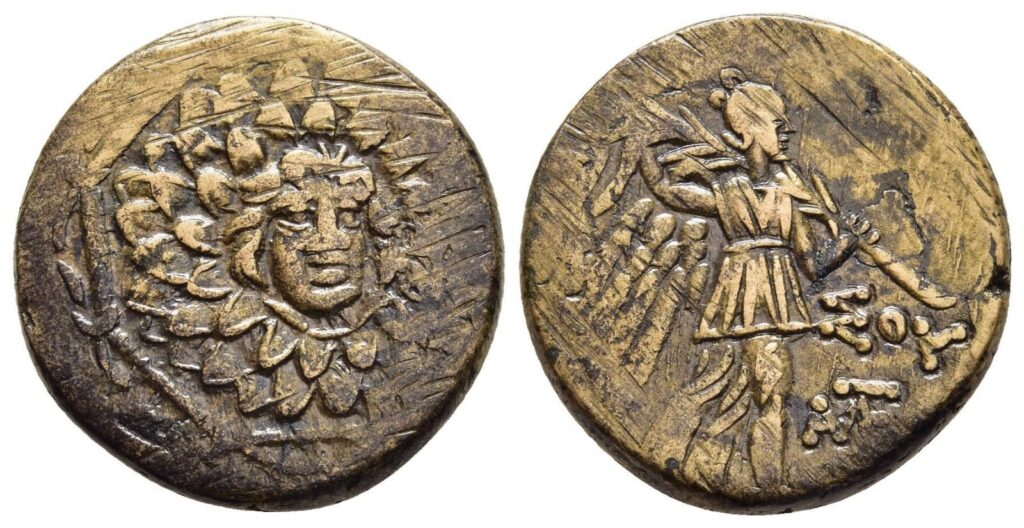
A new study of ancient coins and archaeological artifacts from northern Türkiye reveals how the Greek myth of Medusa became part of the political imagery of King Mithradates VI, one of Rome’s most formidable enemies. The research also traces how the monster’s terrifying face remained a symbol of protection long after the kingdom that used her image in its struggle against Rome had disappeared.
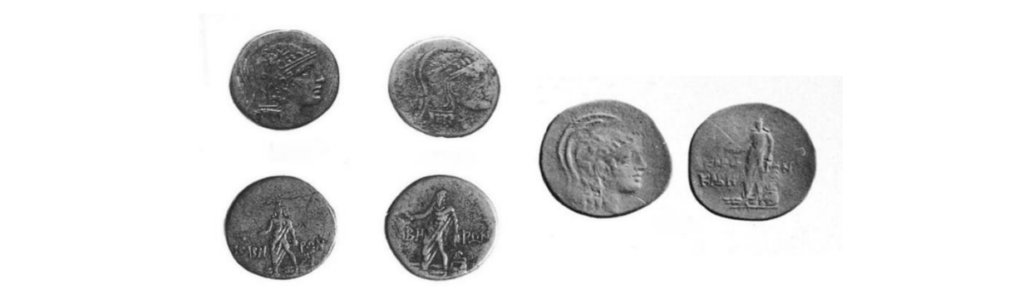
On a bronze coin struck nearly 2,100 years ago in ancient Anatolia, the Greek hero Perseus stands triumphantly with the severed head of Medusa in one hand and a curved sword in the other. The monster’s lifeless body lies at his feet. On the opposite side appears Athena, the goddess who helped him accomplish the seemingly impossible task.
For anyone familiar with Greek mythology, the scene tells a recognizable story. But in the Kingdom of Pontus, ruled by Mithradates VI, it may also have carried a political warning. The king was challenging the growing power of Rome, and images of a hero defeating a seemingly invincible enemy offered a powerful way to express victory, resistance, and royal authority.
A study by Şengül Dilek Ful of Tokat Gaziosmanpaşa University examines how Medusa appeared on coins issued in the ancient cities of Kabeira, Komana, and Taulara, all located within present-day Tokat Province. By comparing these coins with sculptures, funerary monuments, and smaller objects preserved in the Tokat Museum, Ful traces the changing roles of one of mythology’s most feared figures over several centuries.
The King Who Challenged Rome with a Greek Myth
Mithradates VI ruled Pontus from approximately 120 to 63 BC, transforming his Black Sea kingdom into one of the greatest challenges to Roman expansion in the eastern Mediterranean. His armies fought three major wars against Rome, drawing Roman commanders into a prolonged struggle for control of Anatolia.
Mithradates sought to present himself as a champion of communities threatened by Roman domination. His political message reached beyond speeches and military campaigns, appearing on coins circulated throughout cities and fortresses under his authority.
The study identifies two particularly revealing coin types. One depicts Athena on the front and Perseus holding Medusa’s severed head on the reverse. Another places Medusa’s head on a shield or aegis, while the opposite side shows Nike, the winged goddess of victory, carrying a palm branch.
These were not obscure mythological figures. In the story, Medusa was the only mortal among three monstrous Gorgon sisters, and anyone who looked directly into her eyes could be turned to stone. Perseus survived by relying on divine assistance, eventually killing her and gaining possession of a weapon whose supernatural power continued even after her death.
For a ruler confronting Rome, the symbolism was compelling. Perseus represented the hero capable of overcoming an almost unbeatable opponent, while Medusa’s head embodied a fearsome power that could be turned against enemies.
Ful interprets the imagery as part of Mithradates’ broader political propaganda, drawing on earlier studies of Pontic coinage. The coins may have helped communicate the king’s ambitions to Greek and other Anatolian populations while associating his military campaigns with heroic victory.
Three Ancient Cities, One Powerful Message
The repetition of these scenes across different mints is particularly revealing. At Kabeira and Komana, coins featured both the Perseus-and-Medusa composition and the pairing of Medusa’s head with Nike. Taulara, a fortress associated with the royal treasury of Mithradates, also issued coins showing Perseus displaying the monster’s severed head.
The imagery was therefore not confined to a single city. Related types circulated across communities loyal to the Pontic king, creating a recognizable visual language of divine protection, heroic achievement, and victory.
Komana was an important religious center, while Kabeira held a prominent place within the kingdom. Taulara’s connection to royal wealth adds another dimension to the distribution of these images. Although their audiences and local circumstances differed, the cities shared coin designs that linked familiar Greek mythology with the authority of the Pontic monarchy.
Rather than introducing an unfamiliar symbol, Mithradates’ coinage drew on stories that Greek-speaking populations already knew. The political force of the imagery lay in that familiarity: a mythical triumph could be understood without a lengthy explanation.
The Face That Frightened Enemies Also Guarded the Dead
Medusa’s story did not end with continued to appear on funerary monuments and buildings in the Tokat region, serving purposes far removed from the political ambitions of the Pontic monarchy.
One of the most striking examples is a marble sarcophagus fragment preserved in the Tokat Museum. Decorated with garlands, two Medusa heads, and a nude Eros figure, the piece was originally classified in the museum inventory as Hellenistic. Ful argues that its stylistic features instead place it in the second century AD.
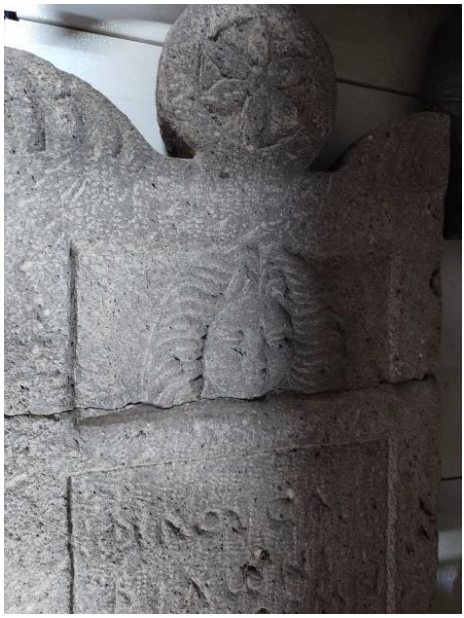
Another monument comes from the Niksar Leylekli Bridge necropolis, where rescue excavations in 1982 recovered a basalt funerary stele. Dating to the third or fourth century AD, the stone bears a six-line Greek inscription beneath a carved Medusa head.
To ancient viewers, such an image could offer reassurance rather than terror. Medusa’s supernatural gaze, deadly to anyone who encountered it in mythology, also made her a suitable guardian of tombs. Her face could warn away intruders and symbolically protect the deceased from harmful forces.
Archaeologists describe this protective use as apotropaic, a term for images or objects believed to ward off evil. The same terrifying quality that made Medusa useful as a symbol of military intimidation could therefore also explain her presence above the resting places of the dead.
When a Monster Became a Beautiful Woman
The archaeological objects from Tokat reveal another intriguing development. Although Medusa is often imagined with snakes for hair and a grotesque appearance, Roman artists frequently gave her the features of a beautiful young woman.
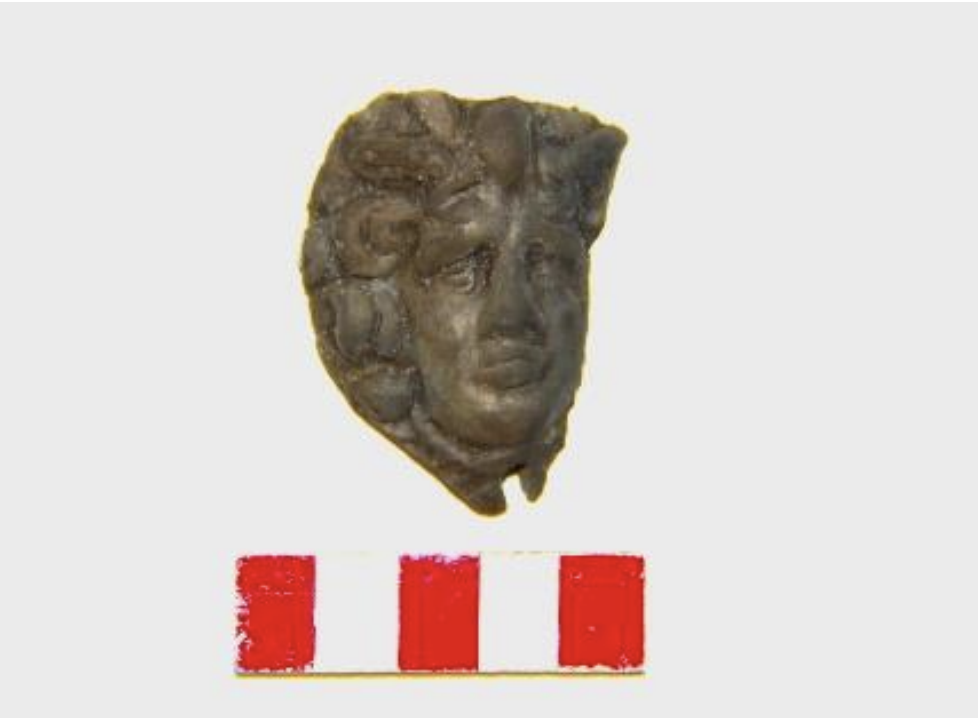
Her face became rounder and calmer, framed by thick, flowing hair. Small wings on her forehead often remained as a clue to her mythological identity. The change did not necessarily remove her protective meaning; instead, the image could become an elegant ornament while retaining its association with supernatural power.
A terracotta plaque discovered in 2017 during excavations of a Roman bath at Sebastopolis illustrates this artistic tradition. Medusa appears with abundant wavy hair and small wings, while a channel on the reverse indicates that the plaque was designed to be attached to another surface.
Other examples in the Tokat Museum include circular terracotta plaques and bronze appliques decorated with similar faces. Objects of these types could adorn military equipment, horse harnesses, furniture, and architectural fittings, although the precise original uses of the individual Tokat pieces remain uncertain.
The variety of materials is significant. Medusa was no longer encountered only on monumental buildings or coins issued by rulers. Her image appeared on smaller objects that could belong to a much wider range of social and domestic settings.
A Symbol That Outlived the Kingdom of Pontus
The research also examines Medusa reliefs on architectural blocks from Niksar and Sebastopolis. One architrave-frieze from Sebastopolis dates stylistically to the Antonine period of the second century AD, while a decorated orthostat block in the Tokat Museum is attributed to the middle of the fourth or beginning of the fifth century AD.
These objects show how long the imagery remained familiar in the region. By Late Antiquity, the kingdom of Mithradates had been gone for centuries, yet the Gorgon’s face continued to appear in local artistic traditions.
Ful’s study does not claim that the objects represent one uninterrupted cult or a single meaning preserved unchanged through time. Instead, the coins, tombstones, marble carvings, and portable decorations reveal how different generations found new uses for a familiar mythological image.
In the hands of a king challenging Rome, Medusa helped express the promise of victory over powerful enemies. On a grave, her frightening face could protect the dead. On a building or a small decorative object, she could combine artistic beauty with the ancient belief that threatening images might keep danger away.
Cover Image Credit: SILVER Numismatic Database
Ful, Ş. D. (2026). The Place and Significance of Medusa in Tokat in the Light of Numismatic and Archaeological Finds. Edebiyat ve Beşeri Bilimler Dergisi, 78, 230-239. https://doi.org/10.55590/literatureandhumanities.1949971
