
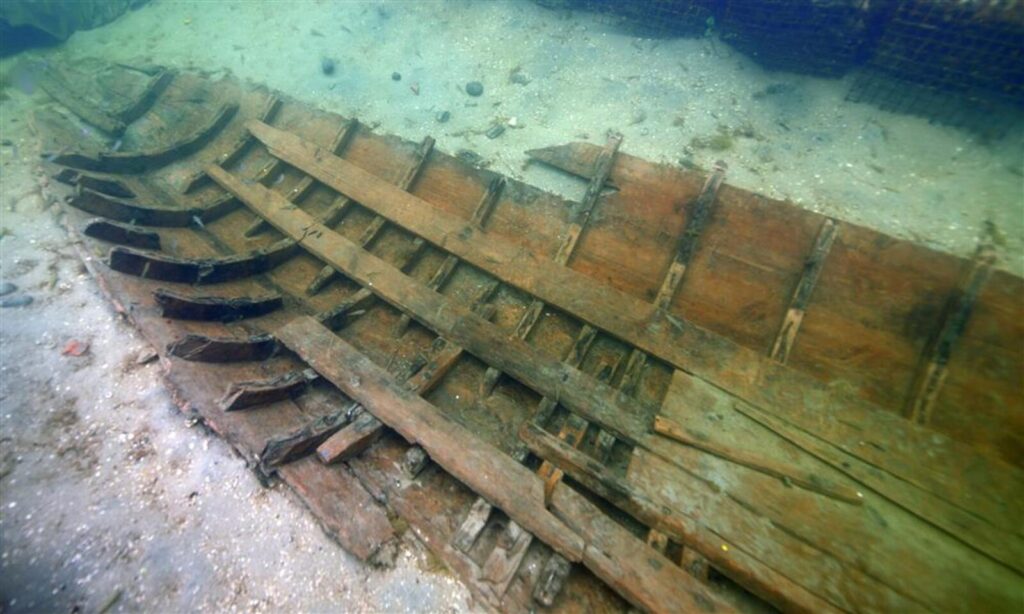
For more than 2,000 years, the remains of a warship rested beneath the waters off Phanagoria, an ancient city on the Black Sea. Sediment covered much of its surviving hull, but copper nails, metal fittings and a bronze ram endured alongside the timbers. The ram carried five-pointed stars and crescents, symbols that helped archaeologists connect the vessel with Mithridates VI Eupator.
That name would have needed little introduction in Rome during the first century BCE. Mithridates ruled Pontus, built a powerful kingdom around the Black Sea and spent decades fighting Roman expansion. Now, researchers have turned from his wars to the technology behind one of the vessels associated with his fleet, examining the metals that held the ship together and helped it survive years of service.
The results reveal more than the composition of a few ancient objects. They show shipbuilders choosing durable copper fastenings, experimenting with different alloys, reinforcing vulnerable parts of the hull, and casting a naval ram from a bronze mixture capable of enduring heavy use. The study offers an unusually close look at the practical engineering behind a Black Sea fleet that operated during one of Rome’s most difficult eastern wars.
A Warship Beneath Phanagoria
Underwater archaeologists encountered the surviving bottom section of the vessel in Phanagoria’s harbor in 2012. Approximately 16 meters of the hull remained beneath more than 1.5 meters of seabed deposits, enough for specialists to recognize construction features associated with a Hellenistic warship.
Two pieces of evidence tightened the chronology. Radiocarbon analysis placed the timbers around the middle of the first century BCE, while the bronze ram displayed emblems associated with Mithridates VI Eupator. Researchers subsequently transferred samples from the ship to the Kurchatov Institute for detailed scientific analysis.
The Institute of Archaeology of the Russian Academy of Sciences connects the ship with the dramatic events that engulfed Phanagoria in 63 BCE. Its account describes a vessel from Mithridates’ fleet that burned about 120 meters from the shore during a revolt against the king. Archaeological work at the city has also identified destruction connected with that uprising, including the residence associated with Mithridates.
The wreck therefore belongs to much more than the history of ancient shipbuilding. It sits inside the final chapter of a political and military struggle that had occupied Rome for a generation.
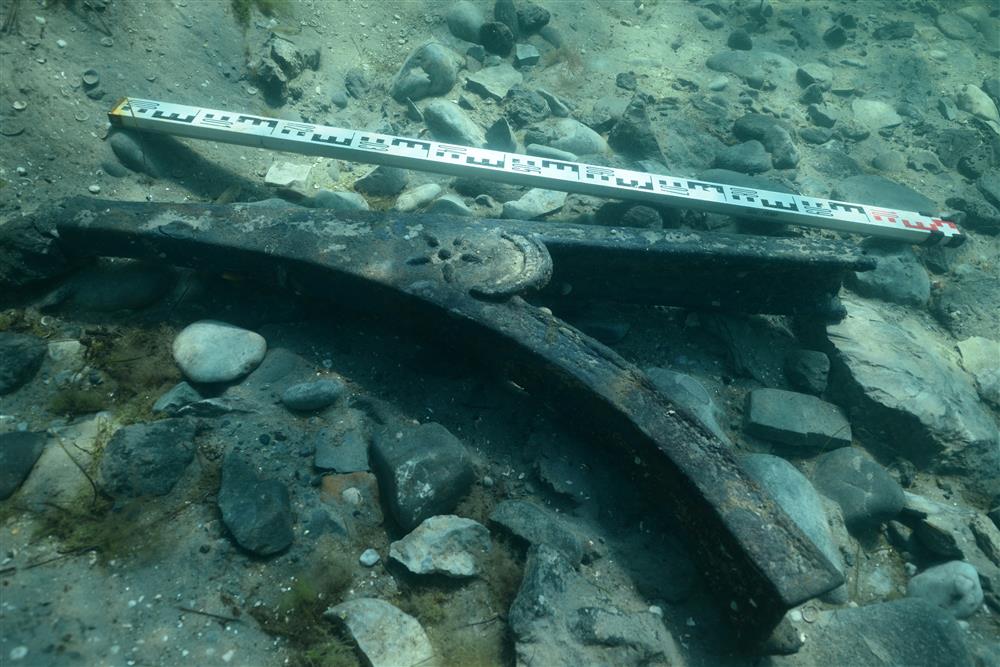
Naval ram and nails in situ. Credit: Institute of Archaeology, Russian Academy of Sciences.
The King Who Became One of Rome’s Most Persistent Enemies
Mithridates VI began his great confrontation with Rome in 88 BCE after years of tension over Roman intervention in Anatolia. The conflict developed into three Mithridatic Wars and eventually drew in some of Rome’s most important commanders, including Sulla, Lucullus and Pompey.
His forces moved quickly during the opening phase. Mithridates took control of much of the Roman province of Asia and extended the war into the Aegean world. He also relied heavily on naval power, sending forces aboard merchant ships and triremes and contesting Roman allies at sea. Appian records one such episode near Rhodes, where Rhodian ships attacked a scattered Mithridatic force during a storm, capturing some vessels and ramming or burning others.
The conflict also produced one of the most notorious episodes of Mithridates’ reign. According to Appian, the king sent coordinated orders to cities in Asia to kill Romans and Italians living there. At Ephesus, people who sought sanctuary at the Temple of Artemis were dragged away and killed, while Appian describes similar violence at Pergamon, Adramyttium, Caunus and Tralles. Ancient casualty totals vary enormously and remain difficult to verify, but the episode itself became a defining part of the Roman memory of Mithridates.
That history helps explain why a single warship from his world carries such weight. The Phanagoria vessel offers something ancient literary sources cannot: a physical piece of the military system that supported his long resistance.
Twenty-Two Nails Tell a Bigger Story
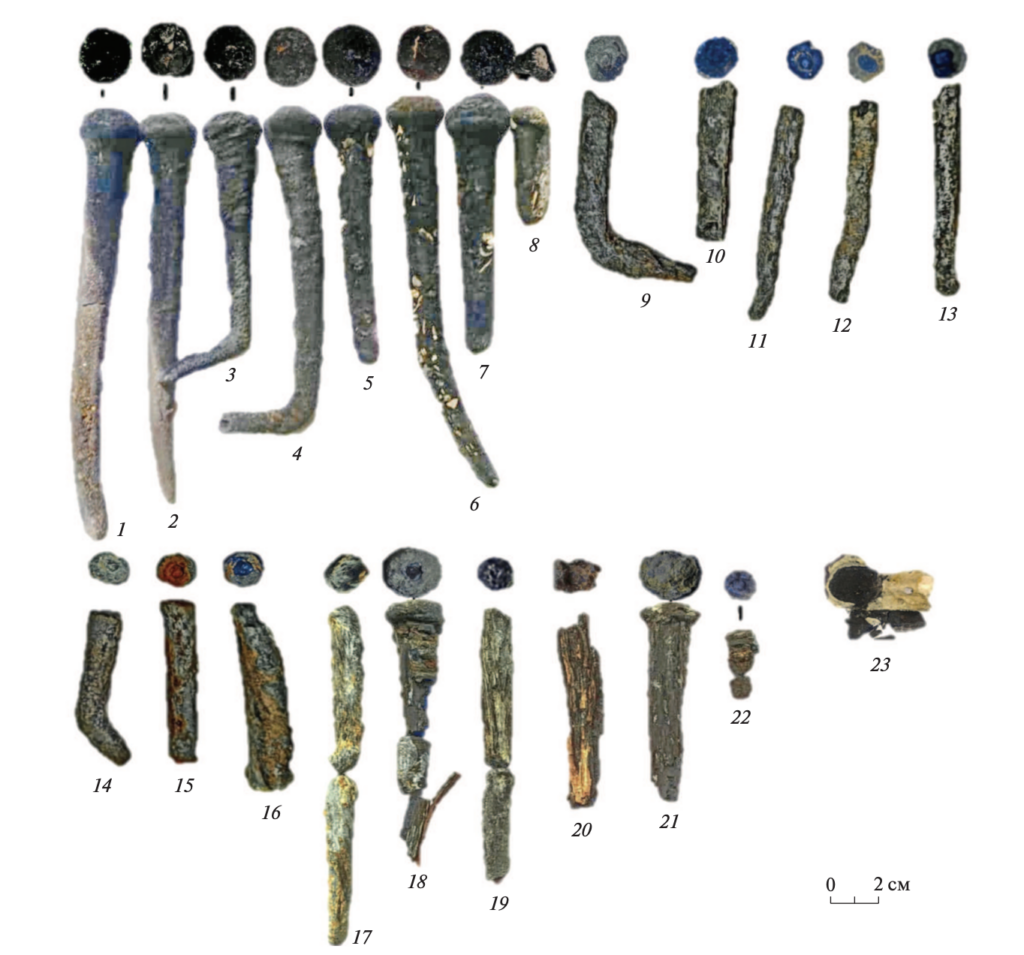
The new research concentrated on 23 metal objects recovered from the wreck and the bronze naval ram. Twenty-two samples came from nails or nail fragments, while another consisted of a small strip of gray metal pierced by a nail. Researchers examined the ram separately in the conservation laboratory of the Phanagoria Historical and Archaeological Museum-Reserve.
The nails varied considerably in size. The largest surviving example measured about 14 centimeters, while the smallest reached roughly 8 centimeters. Their shafts tapered toward the point, and corrosion had transformed their original appearance so extensively that the team needed several analytical techniques to understand what remained beneath the altered surfaces.
Researchers used scanning electron microscopy, energy-dispersive X-ray microanalysis, X-ray fluorescence, X-ray diffraction, and neutron-radiation analysis. These methods allowed them not only to identify the metals but also to distinguish corrosion products from the original material and search for trace elements that might reveal something about ores, alloying, or recycled metal.
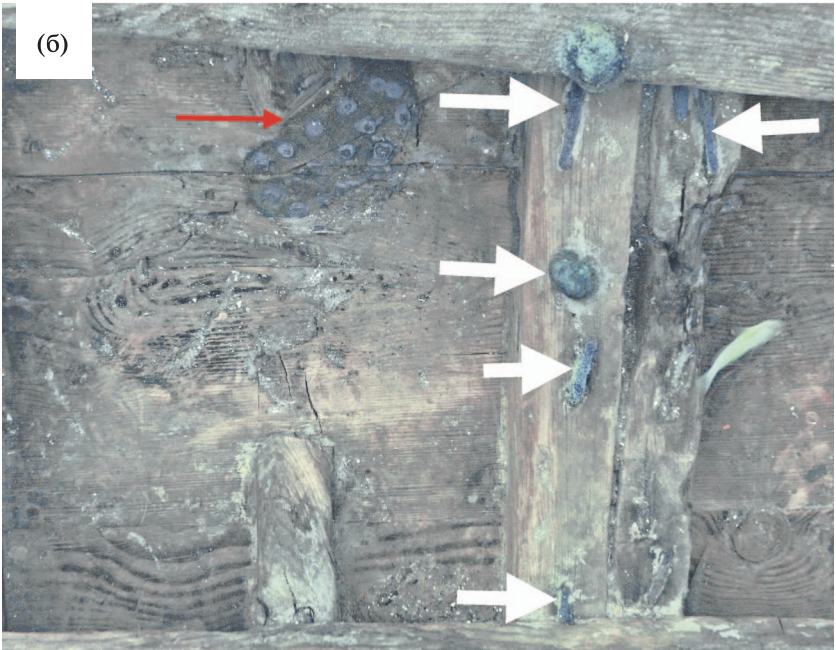
One nail proved particularly revealing. Neutron analysis allowed the team to reconstruct its original dimensions even though corrosion had swollen its apparent thickness to almost three times the original diameter. The calculation placed the original shaft diameter at approximately 0.34 centimeters, close to the hole preserved in the lead plate recovered from the ship.
Copper Instead of the Cheaper Option
The analysis divided the nails into two broad groups. Some came from essentially pure copper, while others contained copper mixed with additional metals. The researchers identified possible copper-lead-antimony, copper-antimony, copper-lead and copper-zinc-antimony combinations, although they caution that the small sample sizes require care when identifying exact alloys.
Some of those additional elements may reflect deliberate alloying. Others, including nickel, cobalt, iron and silver at low concentrations, could have entered the metal with the original ore or survived through repeated cycles of melting and reuse.
That possibility adds a distinctly human dimension to the wreck. The nails may preserve traces not only of metallurgical knowledge but also of workshop practices in which craftsmen reused available metal, adjusted material properties and selected different fastenings for particular tasks.
The broader choice matters even more. Iron nails already offered ancient shipbuilders a cheaper option, yet the builders of this vessel continued to use copper and copper alloys. The researchers interpret that decision as part of a strategy aimed at durability and long service life, particularly when combined with evidence for careful repairs.
Lead, Resin and a Hull Built to Survive
The small gray metal strip turned out to consist primarily of oxidized lead. Its form suggests that it may once have covered or reinforced part of the hull, possibly concealing the head of a nail beneath the lead.
Greek and Roman shipbuilders sometimes covered hull bottoms with lead sheathing to protect timber against marine organisms such as shipworms. They also used lead plates as reinforcing patches where parts of the hull needed additional strength. On the Phanagoria ship, however, researchers found no evidence that the accessible portions of the hull carried a continuous lead covering.
Instead, earlier research had identified another protective system involving realgar, resin, and wax. The new study suggests that lead plates may have reinforced only specific areas, including joints between wooden components, while the chemical coating protected much of the outer surface.
That combination suggests a flexible maintenance strategy rather than a single construction formula. The shipbuilders could protect wood chemically, strengthen weak points mechanically, and replace or repair individual components as the vessel aged.
A Bronze Ram Made for Impact
The most visually striking object from the wreck measures 89 centimeters long, 44 centimeters high, and weighs 15.6 kilograms. Its relief decoration includes five-pointed stars and crescents, the features that helped connect the ship with the world of Mithridates VI.
The metal analysis adds another layer to the object. Researchers determined that the ram consists of roughly 91 percent copper, 4.7 percent tin, and 4.3 percent lead, producing a tin-lead bronze that combines workable casting properties with resistance to wear.
For the researchers, that composition also argues against interpreting the ram as a purely decorative fitting. They conclude that the alloy could withstand impacts and help protect the keel during a collision or grounding, supporting a practical role for the object.
The point matters because ancient naval equipment often survives without the wooden vessel that once carried it. At Phanagoria, archaeologists have both the metal ram and a substantial portion of the ship itself, allowing researchers to study how such an object fitted into a larger engineering system.
The Engineering Behind a Long War
The study does not claim that this single vessel represents every ship that served Mithridates or the Bosporan Kingdom. It does, however, offer unusually detailed evidence for the materials and maintenance choices available to Black Sea shipbuilders in the first century BCE.
Copper nails cost more than iron ones, yet they resisted deterioration differently in a marine environment. Lead reinforced selected areas. Protective compounds shielded exposed timber. Craftsmen worked with several copper alloys and may also have recycled older metal into new fittings. Together, those decisions created a vessel that its builders expected to keep operational for years rather than a ship intended for a short campaign.
The researchers argue that the Bosporan Kingdom devoted considerable attention to maintaining the combat readiness of its fleet. In their interpretation, durable fastenings and careful repairs could keep vessels functional for many decades.
That conclusion brings the story back to Mithridates. Roman writers remembered the king through battles, massacres, defeats, and his refusal to disappear after repeated setbacks. The wreck at Phanagoria preserves another part of that struggle beneath the Black Sea: the work of shipwrights, metalworkers and repair crews who built and maintained the vessels on which such wars depended.
Greshnikov, E. A., Olkhovsky, S. V., Trunkin, I. M., Gunchina, O. L., Govor, L. I., Strepetov, A. N., & Kurkin, V. A. (2026). Исследования состава металлических изделий фанагорийского корабля I в. до н.э. [Study of the composition of metal objects from the Phanagoria ship of the 1st century BCE]. Российские нанотехнологии, 21(1), 130–137. https://doi.org/10.56304/S1992722325600758
