
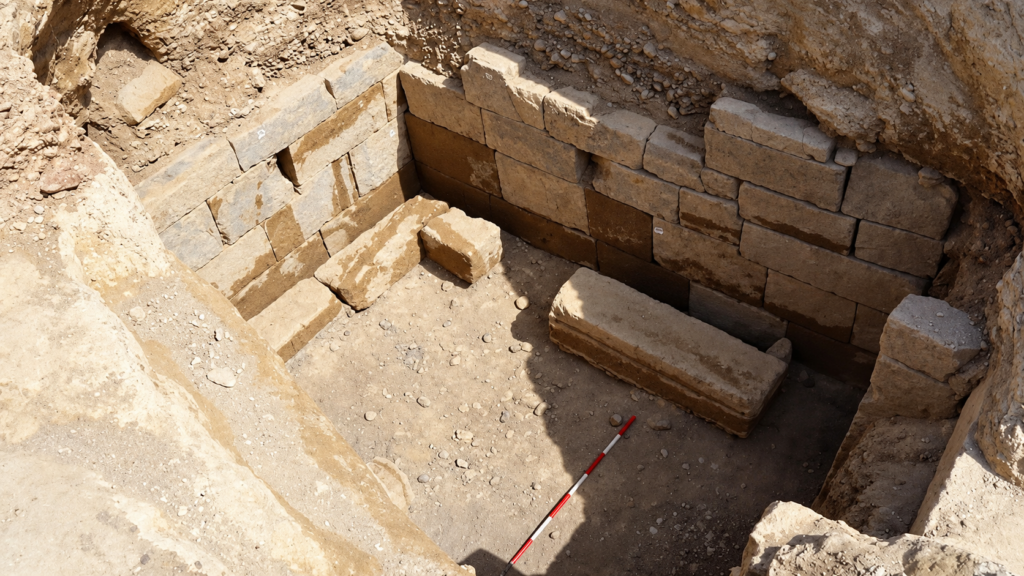
Archaeologists in Italy have uncovered a monumental 2,600-year-old Etruscan tomb containing gold ornaments, weapons, chariot components, and an exceptionally rare woman’s shoe. Despite repeated looting, parts of the burial complex remained remarkably well preserved, offering an unusual glimpse into the wealth and funerary traditions of an ancient Mediterranean elite.
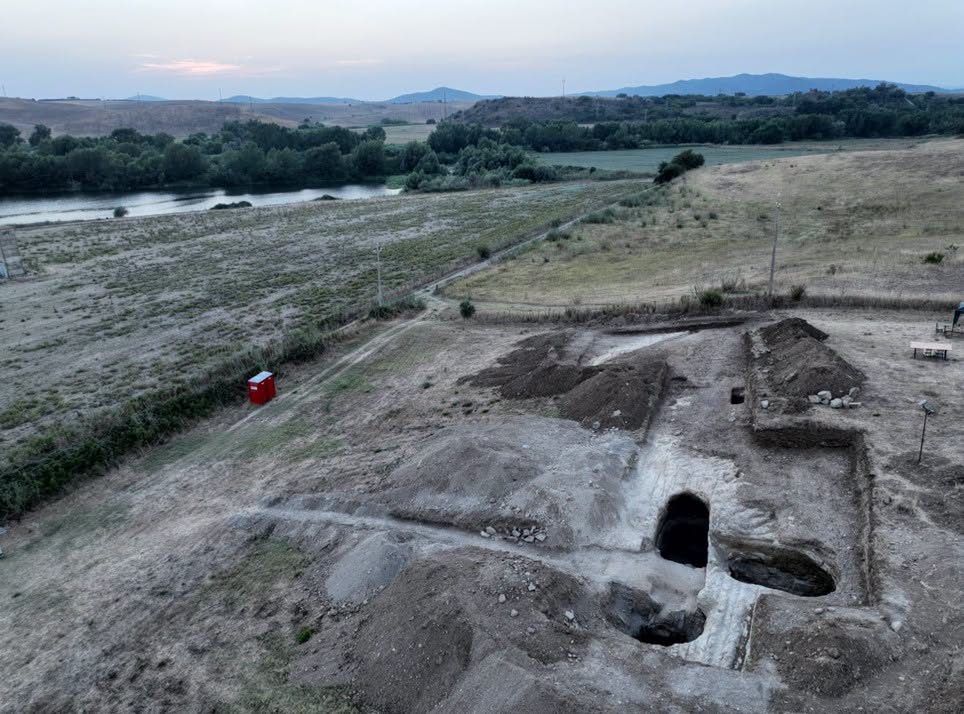
The discovery was made in the Polledrara necropolis at Vulci, an important Etruscan city in central Italy. Announced by Italy’s archaeological authorities on September 22, the tomb dates to the late seventh century BC, when Vulci enjoyed considerable prosperity and maintained extensive connections across the Mediterranean.
A Monumental Tomb Hidden Within a 19th-Century Discovery
The burial complex emerged during the 2026 excavation campaign of the international Ritorno a Vulci project. Archaeologists were investigating the so-called Gsell Tumulus, a monumental funerary mound first identified by the École française de Rome in 1889 but never completely excavated.
The latest investigations identified the tumulus’s circular enclosure and brought to light a substantial burial structure known as the Tomba della Camera di pietra, or Tomb of the Stone Chamber.
The monument contains three funerary chambers. Its main chamber was cut into natural deposits associated with the ancient course of the Fiora River, while retaining walls constructed from blocks of nenfro, a local volcanic stone, demonstrate the scale of the original construction.
Although illegal excavations repeatedly disturbed the tomb during the twentieth century, the collapse of its roofs and internal structures inadvertently protected portions of the burial assemblage. Numerous objects survived beneath the fallen material, some still resting in their original positions.
Gold, Weapons and a Rare Woman’s Shoe
As archaeologists explored the three chambers, they recovered an unusually varied collection of objects reflecting the wealth and Mediterranean connections of Vulci’s aristocracy.
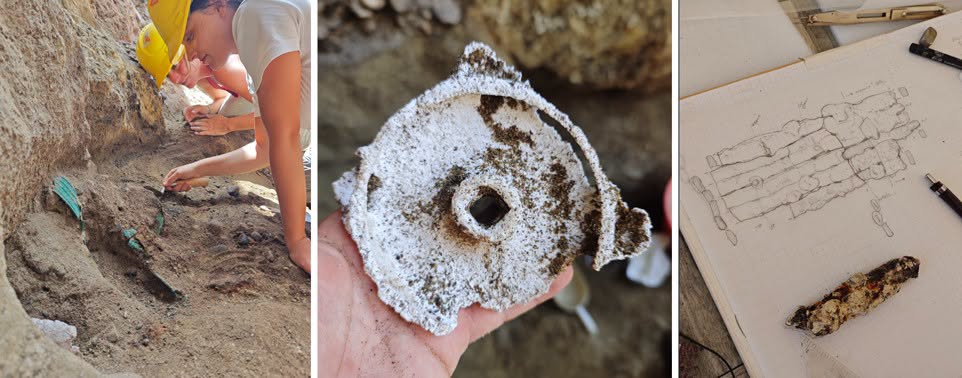
The assemblage includes Greek pottery produced in Athens and Corinth, alongside locally manufactured decorated vessels and distinctive black bucchero ceramics. Weapons and components belonging to a chariot were also recovered, together with iron roasting spits, gold and bronze sheets, and finely worked objects made from bone and ivory.
Among the personal possessions was a rare woman’s shoe, an unusual survival that offers a particularly intimate connection to the people associated with the burial.
The presence of such varied objects illustrates the elaborate funerary customs of wealthy Etruscan families. However, the identity of those buried in the complex has not yet been established, and the discovery of a woman’s shoe alone does not establish the identity of an individual occupant.
The importance of the assemblage lies not simply in its valuable materials but in the archaeological context that survived alongside them. Unlike many objects removed from Etruscan tombs during earlier excavations, these finds can be studied in relation to their original architectural and depositional settings.
An Ancient Banquet Preserved Beneath the Collapse
Some of the most revealing discoveries came from the tomb’s lateral chambers, where objects associated with aristocratic dining survived in exceptional condition.
Archaeologists found a bronze tripod associated with a lamp made from alabaster-like gypsum. The lamp may have originated in the eastern Mediterranean, possibly in the region of Naucratis in Egypt or on the Greek island of Rhodes.
Nearby lay an elaborate banquet service belonging to the rare local ceramic tradition known as Polledrara Ware.
The collection includes shallow drinking or offering bowls, pouring vessels, water jars, and large mixing bowls decorated with polychrome designs. Several remained in their original positions, providing evidence for how the vessels had been arranged before the chamber collapsed.
Other finds included bucchero pottery, a grater associated with wine preparation, and a large polychrome bowl decorated in the Ionian Wild Goat Style.
Together, these objects provide insights into the ceremonial importance of dining and drinking among Vulci’s elite. The combination of locally produced pottery and imported goods also illustrates the city’s participation in the cultural and commercial networks connecting Etruria with the wider Mediterranean.
A New Discovery Could Shed Light on the Famous Isis Tomb
The significance of the newly excavated burial extends beyond the Gsell Tumulus. Researchers believe it could also help reinterpret one of Vulci’s most celebrated nineteenth-century discoveries: the Tomb of Isis.
Discovered in 1839 by Lucien Bonaparte and his wife Alexandrine in an area close to the Gsell Tumulus, the Isis Tomb yielded extraordinary objects that eventually entered the British Museum’s collections.
Its assemblage has long attracted scholarly attention, although questions remain about the provenance and association of some objects attributed to it.
The newly excavated tomb provides a valuable opportunity to examine comparable funerary contexts from Vulci with the benefit of modern archaeological documentation. Similarities in chronology and material culture may help researchers better understand the burial rituals, artistic production, and exchange networks of the Etruscan aristocracy.
The Ritorno a Vulci project, launched in 2023, is directed by Laura Maria Michetti, Alessandro Conti, and Christian Mazet. It brings together researchers from Sapienza University of Rome, the École française de Rome, and the British Museum, working with Italian heritage authorities and the Fondazione Vulci.
Following the 2026 investigations, the tomb and its surrounding enclosure were covered again to protect their remains. Excavations are scheduled to resume in 2027, when further research will continue to reconstruct the history of one of ancient Etruria’s most prosperous cities.
Soprintendenza Archeologia Belle Arti Paesaggio Etruria Meridionale
