
12 December 2025 The Future is the Product of the Past

Five New Roman-Era Theatrical Masks Unearthed in Kastabala, Including a Rare Depiction of an Elderly Philosopher

Archaeological excavations in the ancient city of Kastabala, located in Türkiye’s southern Osmaniye province, have revealed five additional theatrical mask reliefs, offering new insights into the cultural identity of the region during the Roman period. The discovery was made in the city’s monumental theater, a structure believed to date back to the 1st century AD and constructed under Roman imperial influence.

The ongoing work is a joint project between the Osmaniye Provincial Directorate of Culture and Tourism and Osmaniye Korkut Ata University (OKÜ). Under the leadership of Associate Professor Faris Demir from the Archaeology Department, the excavation team continues to uncover important finds that shed light on the centuries-old history of the site, which stretches back approximately 2,700 years.

A New Batch of Mask Reliefs, Including a Philosopher

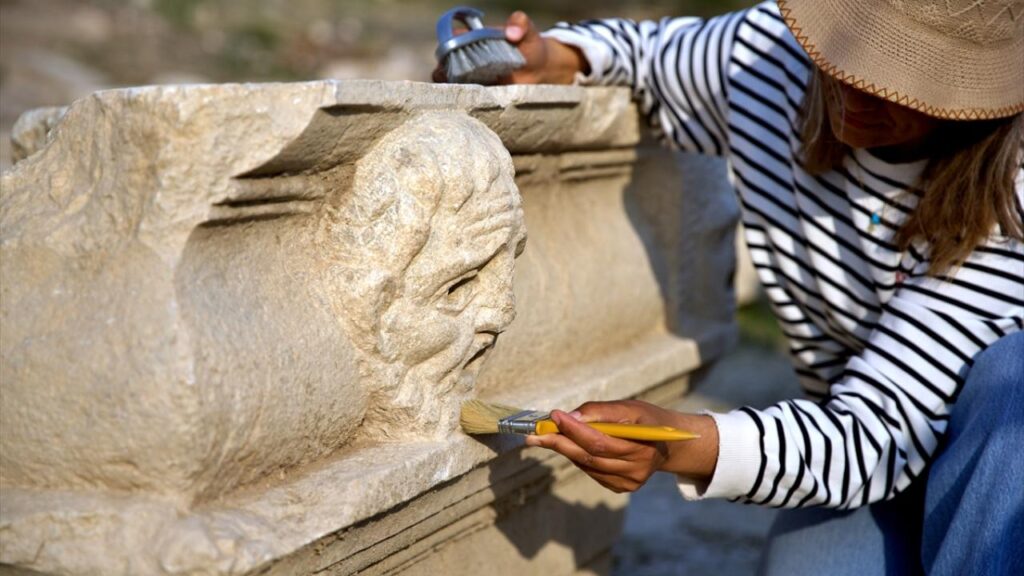
During the latest phase of excavations, researchers uncovered five mask reliefs—also known as theatrical face molds—one of which represents an elderly philosopher. According to Demir, this particular figure is especially significant, as it suggests that the theater served not only as a venue for performances but also as a center for philosophical and literary discussions.

“These reliefs show us that the theater wasn’t solely a place for entertainment,” Demir explained. “It functioned as a cultural hub where philosophical and literary dialogues were held. The newly discovered masks also highlight the artistic blend of Eastern and Western traditions that shaped Kastabala.”

Prior to this discovery, archaeologists had already unearthed several similar theatrical masks depicting characters from classical tragedy and comedy. With the five new additions, the total number of masks found at the site has now reached 36.


📣 Our WhatsApp channel is now LIVE! Stay up-to-date with the latest news and updates, just click here to follow us on WhatsApp and never miss a thing!!


Five New Theatrical Masks Unearthed in Kastabala, Including a Rare Depiction of an Elderly Philosopher
Five New Theatrical Masks Unearthed in Kastabala, Including a Rare Depiction of an Elderly Philosopher. Credit: AA

A Theater Built for Thousands

Demir noted that the ancient theater where the discoveries were made had an estimated seating capacity of 5,000 people, demonstrating the importance of the structure within the ancient city. Excavations have revealed numerous architectural elements from the stage building, many of which remain remarkably well-preserved. These findings provide hope that the theater may be partially or fully restored in the future.

“Recovering these architectural fragments allows us to envision the original structure of the stage building,” Demir said. “Our goal is not only to uncover and study this area but also to restore and preserve it for future generations.”

Kastabala: One of Anatolia’s Hidden Archaeological Treasures

Kastabala, also known in antiquity as Hierapolis ad Pyramum, is one of Turkey’s lesser-known but historically rich ancient cities. Situated near the Ceyhan (Pyramus) River, the settlement served as a strategic and cultural center throughout the Hellenistic, Roman, and Byzantine periods.

Several fascinating features distinguish Kastabala from many other ancient sites in Anatolia:

  1. A Sacred City Dedicated to Artemis Perasia

Kastabala was home to a unique sanctuary devoted to Artemis Perasia, a deity worshipped almost exclusively in this region. Ancient sources describe priestesses who were believed to walk barefoot over hot coals during rituals—an extraordinary cult practice that set Kastabala apart from other classical cities.

  1. A Well-Preserved Colonnaded Street

One of the city’s most striking remains is its lengthy colonnaded boulevard, which once served as a central axis connecting major public buildings. Even today, the standing columns give visitors a vivid sense of the city’s ancient grandeur.

Prior to this discovery, archaeologists had already unearthed several similar theatrical masks depicting characters from classical tragedy and comedy.
Prior to this discovery, archaeologists had already unearthed several similar theatrical masks depicting characters from classical tragedy and comedy. Credit: AA
  1. A Fortress Overlooking the Ancient Landscape

A medieval fortress sits atop the rocky hill that dominates the site. While later in date, it demonstrates Kastabala’s continued strategic importance long after the Roman era.

  1. Its Location on a Major Ancient Trade Route

Kastabala once lay on a key route linking Cilicia to central Anatolia. This made it a vibrant center of commerce, culture, and military movement throughout antiquity.

A Growing Archaeological Legacy

The newly discovered masks deepen the story of Kastabala as a place where art, philosophy, and ritual intersected. They also highlight the city’s role as a melting pot of diverse cultural influences. For archaeologists, each find brings them closer to reconstructing the ancient city’s identity and reviving its long-lost structures.

Demir emphasized that the team’s ongoing work represents a commitment not only to scientific research but also to cultural preservation.

“With every new architectural piece and every new relief, we’re piecing together the history of this magnificent theater,” he said. “Our ultimate aim is to restore the stage building and ensure that Kastabala continues to live on as a cultural heritage site.”

Cover Image Credit: AA

Related Articles

Morocco team announces 1.3 million years major Stone Age find

29 July 2021

29 July 2021

A multinational team of archaeologists announced the discovery of North Africa’s oldest Stone Age hand-ax manufacturing site, going back 1.3...

Rare Ancient Mosaics Seized in Türkiye: Crowned Sea Goddess and Mythical Creatures Uncovered in Smuggling Plot

2 September 2025

2 September 2025

In a decisive cultural heritage protection operation, gendarmerie officers in the Nurdağı district of Gaziantep province in southeastern Türkiye seized...

Pharaonic Hieroglyphic Inscription of Ramses III Found in Southern Jordan

20 April 2025

20 April 2025

In a remarkable archaeological breakthrough, a hieroglyphic inscription bearing the royal cartouche of Pharaoh Ramses III (1186–1155 BC) has been...

Riddle of Former Crater Lakes in the Highest Mountains of the Sahara Solved

18 August 2025

18 August 2025

An interdisciplinary research team, led by scientists from the Free University of Berlin and the Max Planck Institute for Meteorology,...

From Destruction to Discovery: Ancient Greek Tombstone Discovered in Libya After Storm ‘Daniel’

2 March 2025

2 March 2025

The Libyan Antiquities Authority has officially confirmed that an ancient artifact uncovered in the torrents caused by Storm “Daniel” in...

The Amazon rainforest was once home to ancient cities – A vast network of 2,500-year-old garden cities

12 January 2024

12 January 2024

Aerial surveys have revealed the largest 2,500-year-old ancient cities in the Amazon, hidden for thousands of years by lush vegetation...

A Newly Found 12,000-year-old Burial in Türkiye May Belong to a Female ‘Shaman’

28 July 2024

28 July 2024

A recently published study suggests that a woman buried in the upper reaches of the Tigris River in south-eastern Türkiye...

4500-year-old tiger-patterned ritual weapon uncover in east China

4 April 2023

4 April 2023

Archaeologists discovered an extremely rare stone relic, an axe-shaped weapon used for rituals in ancient China, engraved with a tiger...

An 1800-year-old inscription was discovered in Hadrianaupolis indicating the existence of the Asclepius cult

5 September 2022

5 September 2022

An inscription pointing to the existence of the cult of Asclepius was found in the ancient city of Hadrianaupolis, which...

The Mysterious Stone Structure Overlooking Ani: A Hidden Monument Raising New Questions

14 November 2025

14 November 2025

A lone stone structure standing silently on a windswept hill near Kars has begun to draw growing curiosity. Rising from...

New study says earliest recorded kiss occurred 4500 years ago in Mesopotamia

18 May 2023

18 May 2023

The University of Copenhagen according to researchers, humanity’s earliest recorded kiss occurred around 4,500 years ago in the ancient Middle...

An Unusual Artifact Points to Roman Britain Rituals Linked to Fertility, Painted Dog Penis Bone Found in England

9 January 2025

9 January 2025

In a Roman quarry shaft in Surrey, England, archaeologists have discovered one of the most unusual human and animal remains...

From Caves to Mounds: The Enigmatic Burial Practices of the Southern Jê in Brazil

25 February 2025

25 February 2025

A groundbreaking study published in the Journal of Anthropological Archaeology sheds light on the enigmatic burial practices of the Southern...

New fortification walls discovered in the ancient city of Pergamon

14 February 2022

14 February 2022

2,500-year-old fortification walls were found in the Ancient City of Pergamon (Bergama), which was included in the World Heritage List...

The earliest human remains 11,000-year-old discovered in northern Britain

25 January 2023

25 January 2023

An international team of archaeologists at the University of Central Lancashire (UCLan) has discovered 11,000-year-old human remains in the Heaning...