
9 June 2026 The Future is the Product of the Past

Not as Seductive as It Seems: The Truth About a 4,500-Year-Old Egyptian Beadnet Dress

A remarkable 4,500-year-old beadnet dress is reshaping what we know about ancient Egyptian fashion, ritual practices, and even modern interpretations of the past. Drawing on insights from museum collections and recent science reporting, this intricate garment tells a story that goes far beyond its delicate appearance.

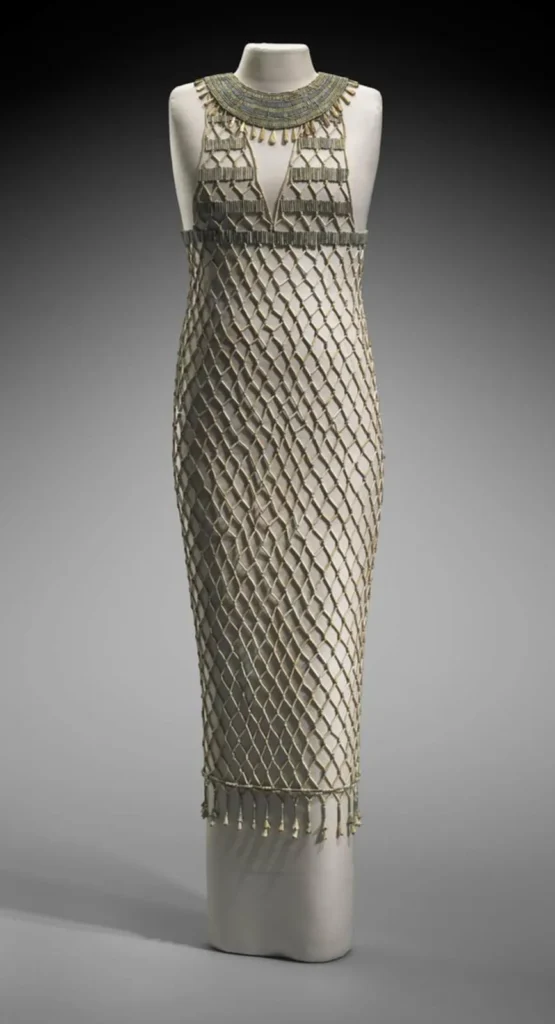
One of the most fascinating examples comes from the Museum of Fine Arts, Boston, where archaeologists reconstructed a beadnet dress discovered in 1927 in a tomb at Giza. The garment belonged to a woman who lived during the reign of King Khufu (c. 2551–2528 BCE). Although the original linen threads had decayed, approximately 7,000 faience beads remained in place, allowing experts to carefully rebuild the dress. According to the MFA Boston, the beads were originally vibrant shades of blue and green, designed to imitate precious stones like lapis lazuli and turquoise.

These colors were not merely decorative. As highlighted in Live Science reporting, blue and green held deep symbolic meaning in ancient Egypt, often representing the Nile River, fertility, and rebirth—key elements in beliefs about the afterlife. This suggests that the beadnet dress may not have been everyday clothing, but instead a funerary garment crafted specifically for burial rituals.
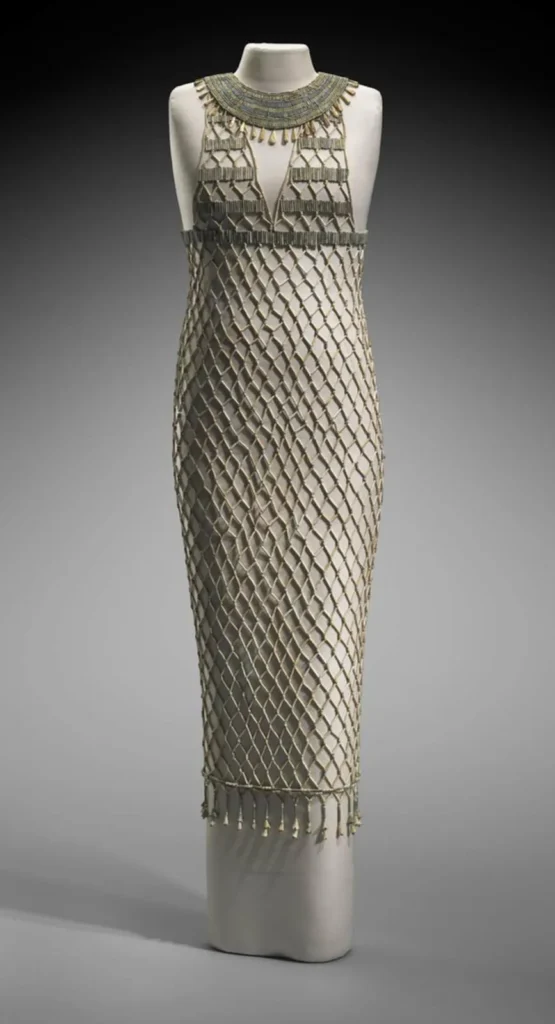
Credit: Museum of Fine Arts, Boston – Public Domain

The design itself is equally striking. Featuring a diamond-patterned net structure, a fitted bodice, and a fringed hem adorned with shells, the dress reflects both technical skill and artistic sophistication. Experts believe such garments were typically worn over linen dresses rather than directly on the body, challenging earlier assumptions about their use.

A second important example, held at University College London’s Petrie Museum, offers further clues. This beadnet dress, dating to around 2400 BCE, was reconstructed in the 1990s after being excavated decades earlier. It includes 127 shells along its fringe, each plugged with small stones to create a rattling sound when the wearer moved. This detail has led researchers to suggest the dress may have been worn for dancing or ceremonial performances.


📣 Our WhatsApp channel is now LIVE! Stay up-to-date with the latest news and updates, just click here to follow us on WhatsApp and never miss a thing!!


However, interpretations of these garments have evolved significantly over time. Early Egyptologists sometimes described beadnet dresses as exotic or even erotic, partly influenced by ancient texts such as a story about King Sneferu requesting women to wear nets instead of clothing. Yet modern researchers caution against taking such narratives at face value. As noted by UCL Museum sources, the story was meant to portray the king’s behavior as unusual and inappropriate—not typical of Egyptian society.
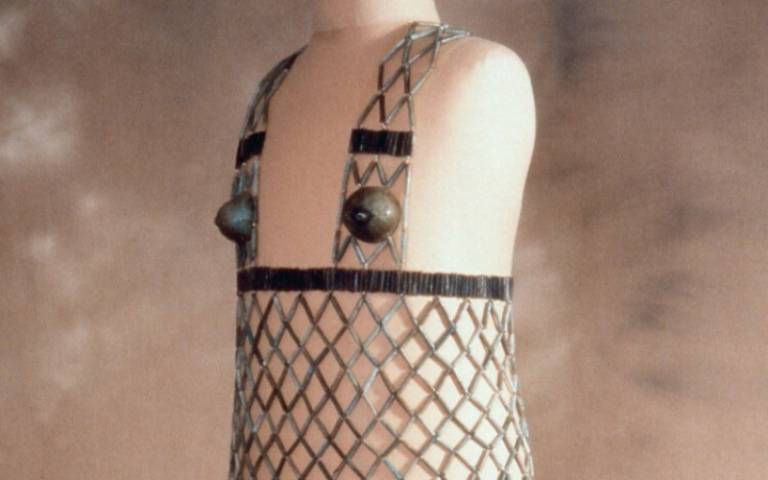
Credit: Petrie Museum

Experimental archaeology has also played a key role in reshaping our understanding. When clothing specialist Janet Johnstone created a replica of the Petrie Museum dress, she discovered it was too heavy to be worn directly on bare skin. Additionally, its flexible net design meant it could fit a wide range of body shapes and ages, suggesting practicality rather than purely aesthetic or provocative intent.

These findings highlight an important point: our interpretations of ancient artifacts are often influenced by modern perspectives. What may appear “exotic” today could have had entirely different cultural meanings thousands of years ago.

Today, only about two dozen beadnet dresses are known to exist worldwide, making them exceptionally rare. Despite their scarcity, they provide valuable insights into Old Kingdom Egypt, revealing a culture that combined artistry, symbolism, and craftsmanship in sophisticated ways.

Ultimately, the ancient Egyptian beadnet dress stands as more than just a piece of clothing. It is a window into how people expressed identity, honored the dead, and engaged with deeply held beliefs about life and the afterlife. As ongoing research continues to challenge earlier assumptions, this iconic garment reminds us that history is not fixed—it is constantly being rediscovered and reinterpreted.

Cover Image Credit: Museum of Fine Arts, Boston – Public Domain

Related Articles

Storms uncover precious marble cargo from a 1,800-year-old Mediterranean shipwreck in Israel

15 May 2023

15 May 2023

Numerous rare marble artifacts have been found at the site of a 1,800-year-old shipwreck in shallow waters just 200 meters...

46 Ice Age Animals Found in a Northern Norway Cave: “Extremely Rare” Discovery Reveals a Frozen Past

22 October 2025

22 October 2025

A remarkable discovery in northern Norway has uncovered the remains of 46 species from the last Ice Age — from...

Otto the Great’s Tomb Marble Did Not Come from Italy or Greece, New Research Reveals

19 December 2025

19 December 2025

A major archaeological discovery in Germany is reshaping long-held assumptions about one of Europe’s most iconic imperial monuments. The tomb...

Theater of Perinthos Ancient City to be unearthed

9 August 2021

9 August 2021

The theater area in the Ancient City of Perinthos, whose history dates back to 600 BC, will be unearthed during...

New Discoveries on the İsland of Skokholm

29 March 2021

29 March 2021

New discoveries dating back 9000 years have been found in Skokholm, located in the Celtic Sea two miles off the...

2,000-Year-Old Roman Stele Decorated with an Eagle and Greek Inscriptions Found in Manbij, Syria

23 August 2025

23 August 2025

A striking Roman-era stele carved from black basalt, featuring a detailed eagle clutching a wreath and adorned with Greek inscriptions,...

18,000-Year-Old Evidence of Human Brain Consumption Found in Poland’s Maszycka Cave

22 February 2026

22 February 2026

New scientific research has uncovered compelling evidence that prehistoric humans practiced cannibalism—including the consumption of human brains—around 18,000 years ago...

First Local Aramaic Inscription of the Ancient Kingdom of Sophene Discovered, Dating to the Hellenistic Period

30 January 2026

30 January 2026

A groundbreaking archaeological discovery in eastern Türkiye is reshaping historians’ understanding of the ancient Kingdom of Sophene, a little-known Hellenistic-era...

Three-Year-Old Discovers 3,800-Year-Old Canaanite Seal at Archaeological Site of Tel Azekah

2 April 2025

2 April 2025

At the site of the famous battle between David and Goliath, a three-year-old girl named Ziv Nitzan discovered a scarab-shaped...

A Glorious Temple, inside which Sacrifices Were Performed, was Found in the Sanctuary of Artemis Amarysia on Greek Island of Euboea

13 January 2024

13 January 2024

Archaeologists excavating at the Artemis Amarysia sanctuary in Amarynthos on the Greek island of Euboea have revealed new insight into...

1,000-Year-Old Kufic-Inscribed Tombstone Unearthed at Dowlatshahi Mosque in UNESCO-Listed Yazd, Iran

29 July 2025

29 July 2025

In a remarkable archaeological discovery, a nearly 1,000-year-old Kufic-Inscribed tombstone has been unearthed during restoration efforts at the Dowlatshahi Mosque,...

4,500-Year-Old Dog Teeth-Adorned Bags Found in Germany May Have Been Elite Baby Carriers

11 July 2025

11 July 2025

Archaeological excavations near Krauschwitz reveal rare decorated leather bags buried with women and infants—shining new light on Neolithic burial customs...

Karahantepe; It will radically change the way we look at the Neolithic Age

1 June 2022

1 June 2022

Findings on settled village life in the ongoing excavations in Karahantepe will profoundly change our knowledge of the Neolithic Age....

Tajik Buddha in Nirvana – the Largest in the World: 42 feet long and 9 feet high

31 December 2023

31 December 2023

In the past, while Taliban soldiers in Afghanistan destroyed two immense statues of Buddha, art historians in neighboring Tajikistan meticulously...

2,300-Year-Old Scythian Tomb Unearthed in Moldova with Rare Incense Burner

18 May 2026

18 May 2026

A rescue excavation near the village of Gura Bîcului in Moldova has revealed a 2,300-year-old Scythian burial that is still...