
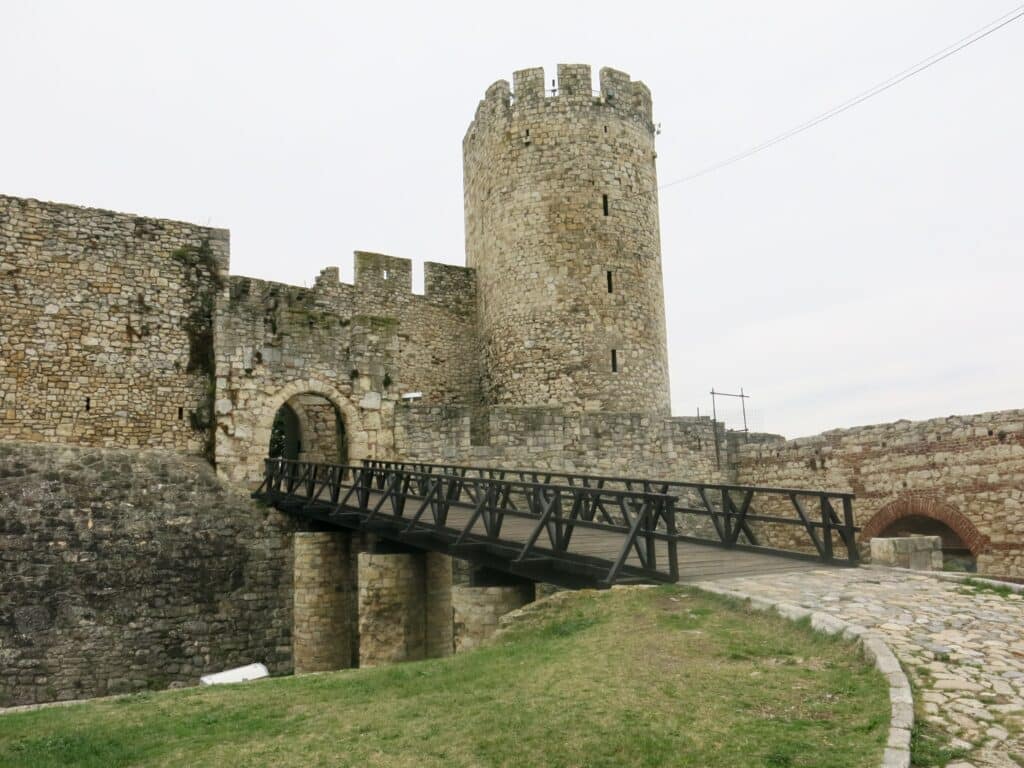
Camels are not the animals most readers expect to find in medieval Belgrade, Serbia. Yet bones recovered from Belgrade Fortress show that they were present there between the 15th and 17th centuries, offering rare evidence of long-distance movement through the Central and Western Balkans.
The remains, recovered during excavations in 2014 in front of the East Gate of the Lower Town, have now been examined as part of the first zooarchaeological study of animal bones from the fortress. Among the 271 analyzed specimens, researchers identified camel bones from Late Medieval layers dated to the 15th–17th centuries AD.
According to the study, these bones represent the first osteological evidence of camels from the medieval period in the Central and Western Balkans. Their presence at Belgrade Fortress suggests that the site was not only a military and administrative stronghold, but also a point of contact in wider systems of trade, transport, and mobility.
Camels at the Meeting Point of the Sava and Danube
Belgrade Fortress occupies one of the most strategic positions in southeastern Europe, at the confluence of the Sava and Danube rivers. For centuries, this location connected river routes, land corridors, and frontier zones between the Balkan Peninsula and the Carpathian Basin.
The site has a long history of occupation, from prehistoric activity to Roman Singidunum and later medieval fortifications. During the Roman period, Singidunum served as the base of Legio IIII Flavia Felix, stationed there from AD 86 to control the Danube frontier and support regional military infrastructure.
By the Late Medieval period, the fortress remained a major defensive and administrative center. Its position made it a natural checkpoint for traffic along the Danube and across the Balkans. The newly identified camel remains fit into this broader picture of movement through a heavily connected frontier landscape.
What the Animal Bones Reveal
The study compared animal remains from Roman layers dated to the 1st–2nd centuries CE with those from Late Medieval layers dated to the 15th–17th centuries AD.
The Roman assemblage was dominated by cattle, sheep, and goats, with smaller numbers of pig bones and wild animals. The age profiles suggest that some animals were slaughtered while still young, probably for meat consumption.
The Late Medieval assemblage was more diverse. It included sheep, goats, cattle, equids, and camels. Most of these animals appear to have survived into adulthood, which may point to their use for secondary products and labor, including milk, wool, traction, or transport.
The camel bones were confirmed using collagen peptide mass fingerprinting, known as ZooMS. This method analyzes protein markers preserved in bone collagen and can help identify animal species even when bones are fragmented or difficult to distinguish by shape alone.
An Unexpected Animal in Medieval Belgrade
Camels are not expected animals in a standard medieval livestock economy of the Central and Western Balkans. Finding their bones at Belgrade Fortress places the site within a wider world of transport, exchange, and mobility.
The find does not necessarily mean that camels were common in medieval Serbia, nor does it prove the existence of a local camel-breeding tradition. A more cautious interpretation is that camels reached the fortress through long-distance movement, most likely connected with trade, military logistics or transport networks.
In medieval and early modern Eurasia, camels were valued as pack animals because they could carry heavy loads over long distances. Their presence in a fortress context at Belgrade may reflect the movement of caravans, merchants, military supplies, or administrative traffic through the region.
For archaeologists, this is important because animals are often direct evidence of economic behavior. Written sources may describe routes, armies, or trade, but bones can show which animals were physically present in a place and how they were used.
A Small Find with Wider Implications
The researchers stress that the assemblage is modest in size, and the Late Medieval material comes from a mixed fill context with broad radiocarbon ranges. For that reason, the results should be treated carefully.
Still, the camel remains offer a rare and valuable signal. They suggest that Belgrade Fortress was integrated into wider networks that extended beyond local animal husbandry and everyday food production.
The contrast between the Roman and Late Medieval animal assemblages also points to changing economic patterns over time. In the Roman period, the animal economy appears more focused on common domestic livestock and meat supply. In the Late Medieval period, the greater diversity of species, including camels, suggests a more complex urban and military environment shaped by movement, labor, and exchange.
The discovery adds a new dimension to the history of Belgrade Fortress. Long known for its walls, gates, and military role, the site now also preserves evidence of animals that moved through the Balkans as part of broader systems of trade and transport.
A few camel bones cannot reconstruct an entire network on their own. But at a fortress placed between rivers, roads, and political frontiers, they are enough to show that medieval Belgrade was connected to a world much larger than its walls.
Marković, N., Bikić, V., Bulatović, J., Ivanović, M., Marić, M., & Buckley, M. (2026). Animal economy at Belgrade Fortress during the Roman and Late Medieval period: Zooarchaeological analysis from the Lower Town. Journal of Archaeological Science: Reports, 73, Article 105860. https://doi.org/10.1016/j.jasrep.2026.105860
Cover Image Credit: Mickey Mystique – Public Domain
