

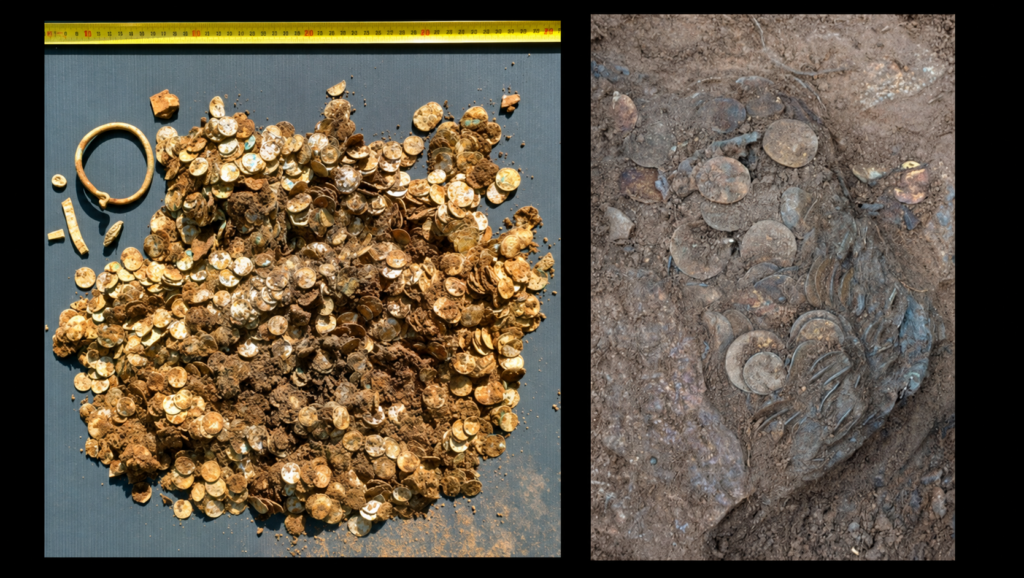
Thousands of silver coins buried in two birch bark containers have emerged from the ground near Sysmä in southern Finland, forming what archaeologists describe as the largest known Late Iron Age coin hoard ever found in the country.
Metal detector enthusiast Kalle Lappinen discovered the first traces of the hoard near the village center of Sysmä on September 3, 2026. Archaeologist Esko Tikkala of Lahti City Museums inspected the site the following day and supervised the recovery of the deposits.
The scale quickly became apparent. Together, the coins weigh about 4.5 kilograms, although researchers have yet to clean, separate and count them. The final total could run into several thousand coins, while their exact dates and origins will only become clear after numismatic study.
But the coins were not buried alone.
Alongside them lay a fragment of hacksilver, a silver bracelet, a silver fitting and a silver bead. Someone had divided the material between two birch bark containers, placed them among stones about 45 centimeters below the surface and roughly 12 meters apart.
That detail makes the discovery more than simply a record-breaking pile of silver. Organic materials from prehistoric contexts rarely survive well in Finland, and the preserved birch bark containers may help archaeologists understand how the valuables were packed and deliberately concealed. Lahti Museums director Tuulia Tuomi has highlighted their preservation as one of the particularly unusual aspects of the discovery.
A Finnish Record Broken After More Than a Century
Until now, the benchmark for a Viking Age coin hoard in Finland came from Nousiainen, where a cache discovered in 1895 contained around 1,700 coins and other objects weighing approximately 2.2 kilograms.
The Sysmä discovery therefore weighs roughly twice as much. Its final coin count remains unknown, but even before conservation begins, the difference places it in a category of its own within Finland.
The broader Baltic world produced still larger concentrations of Viking Age silver. The famous Spillings Hoard, discovered on the Swedish island of Gotland in 1999, contained about 67 kilograms of silver, including more than 14,000 coins. That extraordinary find reflects Gotland’s exceptional position in Viking Age exchange networks, while the new Sysmä discovery stands out within the very different archaeological record of inland Finland.
Sysmä Was Already on the Viking Age Silver Map
The location also has context. Archaeological collections already contain Viking Age silver coins found in Sysmä, including part of a Samanid dirham or imitation dating to the early tenth century. Other finds from the area include silver imitations based on Byzantine coin types.
These earlier discoveries show that silver currency with connections far beyond Finland had already reached the Sysmä region during the Viking Age. Researchers cannot yet say whether the newly recovered thousands of coins tell the same story: their surfaces first need to be cleaned and individual pieces identified.
That work could prove crucial. Viking Age silver moved across enormous distances, and coins found around the Baltic can originate from the Islamic world, Western Europe and other regions. Silver was also valued by weight, which helps explain why hoards often combine coins, jewellery and deliberately cut pieces of silver rather than containing currency alone.
For Lappinen, however, the discovery began with the familiar uncertainty of metal detecting. Most signals lead to modern debris rather than archaeology. He recalled an initial “sense of disbelief” when the scale of what lay beneath the ground became clear.
The unanswered questions now belong to the laboratory. The exact number of coins, where they were minted, when the two containers were buried, and whether both deposits represent a single event remain to be established. What is already certain is simpler: a patch of ground near Sysmä concealed a concentration of Viking Age silver unlike any previously documented in Finland.
