12 January 2026 The Future is the Product of the Past

Egypt unearths 2,300-year-old remains of Greco-Roman town in Alexandria

An Egyptian archeological team discovered the ruins of a Greco-Roman residential and commercial town in the north coast city of Alexandria on Friday.

The discovery was found by an Egyptian archaeological team during nine months of digs in the city’s central Al-Shatby neighborhood, according to a statement from Egypt’s Ministry of Tourism and Antiquities.

The head of Egypt’s Supreme Council of Antiquities, Mostafa Waziri, said initial studies showed “a main road and adjacent streets linked by a sewage network.”

According to research, the settlement was in use from the second century BC until the fourth century A.D.

Archaeologists discovered pottery pots, and some statues, more than 40 wells, and tanks cut into the rock and a network of water cisterns, the statement said.


📣 Our WhatsApp channel is now LIVE! Stay up-to-date with the latest news and updates, just click here to follow us on WhatsApp and never miss a thing!!


Waziri said that the expedition discovered rest houses for travelers and tourists waiting for licenses to enter the town, as well as homes utilized as tax collection facilities.
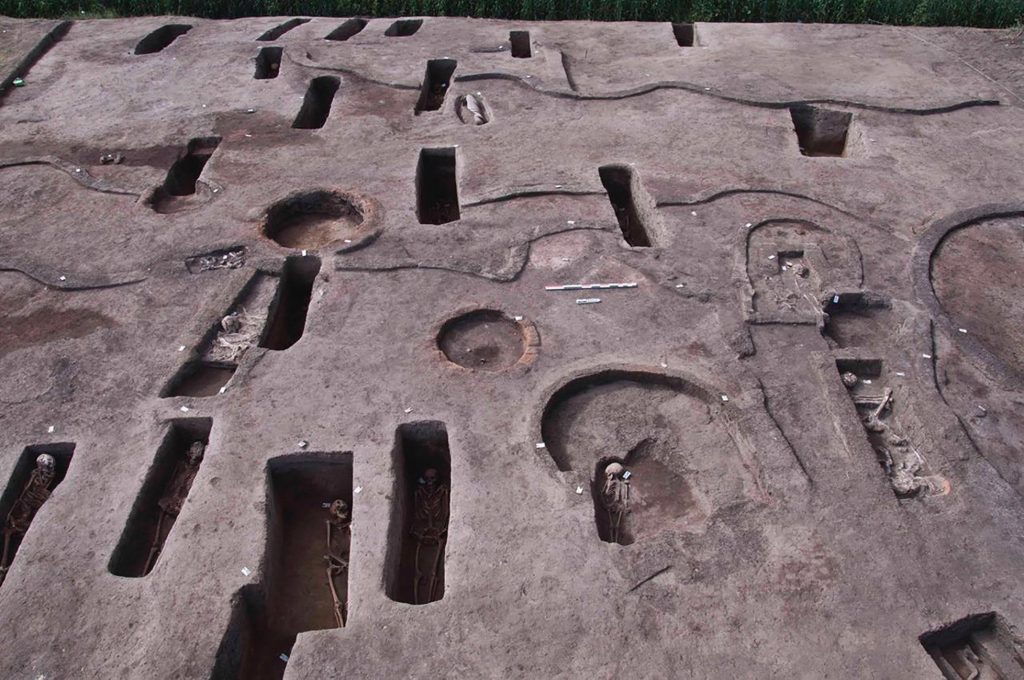
This photo provided by the Egyptian Tourism and Antiquities Ministry on Tuesday, April 27, 2021, shows ancient burial tombs unearthed recently, some with human remains, in the Koum el-Khulgan archeological site, in the Nile Delta province of Dakahlia, around 150 kilometers (93 miles) northeast of Cairo, Egypt. (Egyptian Tourism and Antiquities Ministry via AP, File)

He noted that the preliminary studies on the discovered district revealed that “it was composed of main street and several branch roads that are all connected with sanitation network.”

Meanwhile, Khaled Abu Hamad director-general of Alexandria Antiquities Authority said the town had a big market, shops for selling pots, and workshops for making statues.

He added that nearly 700 coins and plates in different shapes and a large number of fishing tools have been found in the discovered town.

“Excavation work on the old town took nine months,” said Abu Hamad, stressing the importance of the district in connecting the trade movement between the east and the west.

Cover Photo: An Egyptian archeological mission has unearthed on Friday remains of a residential and commercial town dating back to the Greco-Roman era in the north coast city of Alexandria. /Xinhua
Related Articles

Researchers decipher enigmatic ancient ‘Unknown Kushan Script’

13 July 2023

13 July 2023

A research team at the University of Cologne’s Department of Linguistics deciphered a writing system belonging to the Kushan Empire,...

Neo-Assyrian Writing Boards: The Role of Beeswax, Orpiment, and Carbon Black in 7th Century BC Writing Techniques

13 April 2025

13 April 2025

Recent scientific investigations into the writing boards excavated from the ancient Assyrian city of Nimrud have shed new light on...

Kurt Tepesi: The Silent Sentinel in the Shadows of Göbeklitepe and Karahan Tepe – Unearthing the Forgotten Sister

31 May 2025

31 May 2025

In the arid plains of southeastern Anatolia, a quiet giant slumbers. While Göbekli Tepe has dazzled archaeologists and the global...

Mosaic Discovered in Illegal Dig in Zile Points to Ancient Roman Public Structure

12 July 2025

12 July 2025

Zile, a district in the Tokat province of northern TĂŒrkiye, has long been recognized as one of Anatolia’s most historically...

Drought accelerated Hittite Empire’s collapse

9 February 2023

9 February 2023

Researchers have offered new insight into the abrupt collapse of the  Hittite Empire in the Late Bronze Age, with an...

High school student discovered a 1500-year-old ancient Magical Mirror

9 August 2023

9 August 2023

 A High school student discovered an ancient “magical mirror” meant to ward off the evil eye in an archaeological excavation...

Buried Secrets: How a Roman Sailor’s Gravestone Resurfaced in a New Orleans Yard

9 October 2025

9 October 2025

A routine yard cleanup in New Orleans turned into an international archaeological mystery when a homeowner uncovered a 2nd-century Roman...

Neanderthals too may have Developed a System of Numerical Notation

2 June 2021

2 June 2021

People developed numbers tens of thousands of years ago, according to archeological findings. Scholars are now investigating the first comprehensive...

Farmer Found an Ice Age Cave Under His Field

30 March 2021

30 March 2021

A naturally formed cave was found near the town of Kraƛnik in southeastern Poland, used by humans during the Ice...

Archaeologists find Viking Age shipyard in Swedish island

15 June 2022

15 June 2022

Archaeologists from Stockholm University have discovered a Viking Age shipyard at Birka on the island of Björkö in Lake MÀlaren,...

Archaeologists have uncovered the first human representations of the people of mythical Tartessos

19 April 2023

19 April 2023

Archaeologists representing Spain’s National Research Council (CSIS) excavating at the site of Casas del Turunuelo have uncovered the first human...

A Mysterious ‘Buddha Bucket’ Survived 1,000 Years in a Viking Grave

25 December 2025

25 December 2025

A Mysterious “Buddha Bucket” Survived 1,000 Years in a Viking Grave — and despite spending a millennium beneath layers of...

A submerged stone bridge constructed 5600 years ago shed light on the human colonization of the western Mediterranean

31 August 2024

31 August 2024

An interdisciplinary research team, led by University of South Florida (USF) geology Professor Bogdan Onac, has examined an ancient submerged...

Knife and Lost Armor: First-Ever Verified Artifacts from Emperor Nintoku’s 5th-Century Kofun Tomb Revealed

13 August 2025

13 August 2025

In a discovery that is already rewriting the history of Japan’s ancient Kofun period, researchers have confirmed the existence of...

Early Imperial cemetery in NĂźmes, in the south of France

4 October 2022

4 October 2022

Inrap archaeologists excavating at NĂźmes in southern France have uncovered a cemetery dating to the first to second centuries AD...