
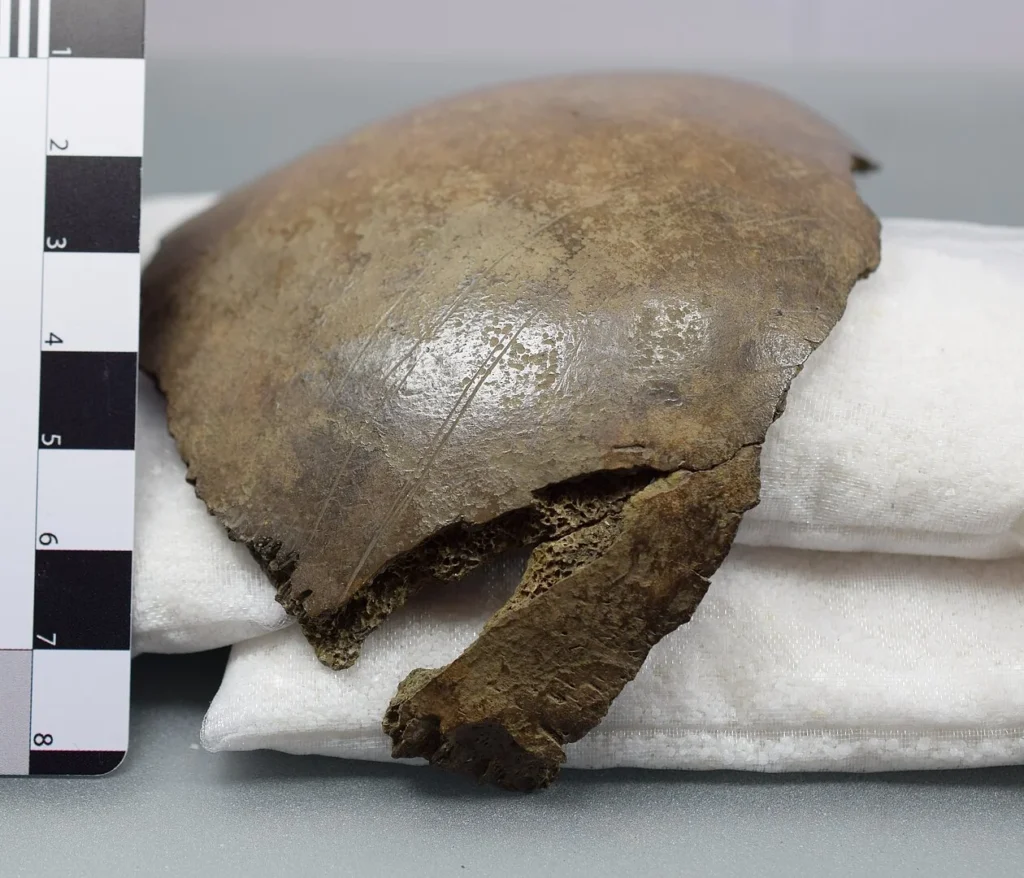
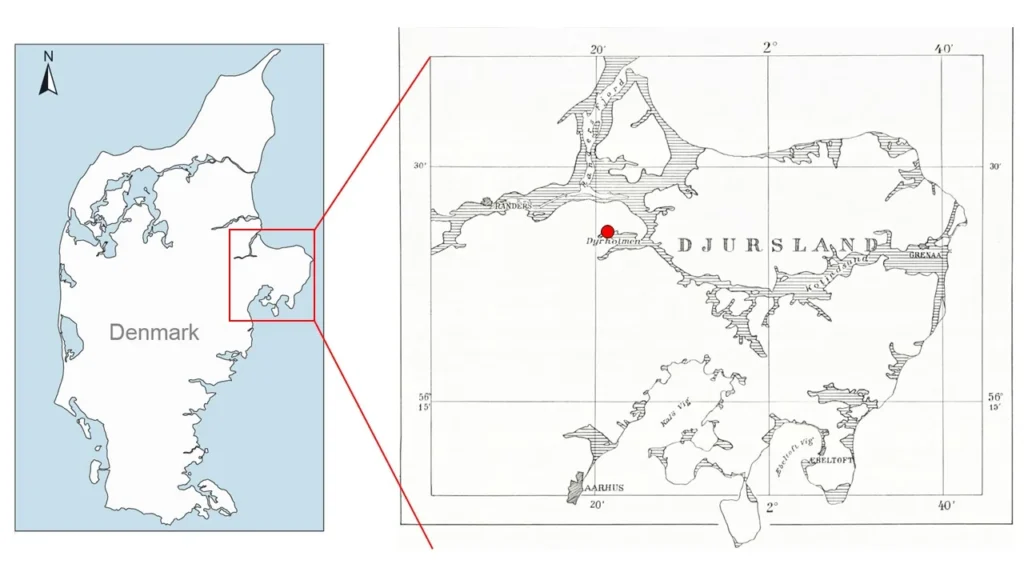
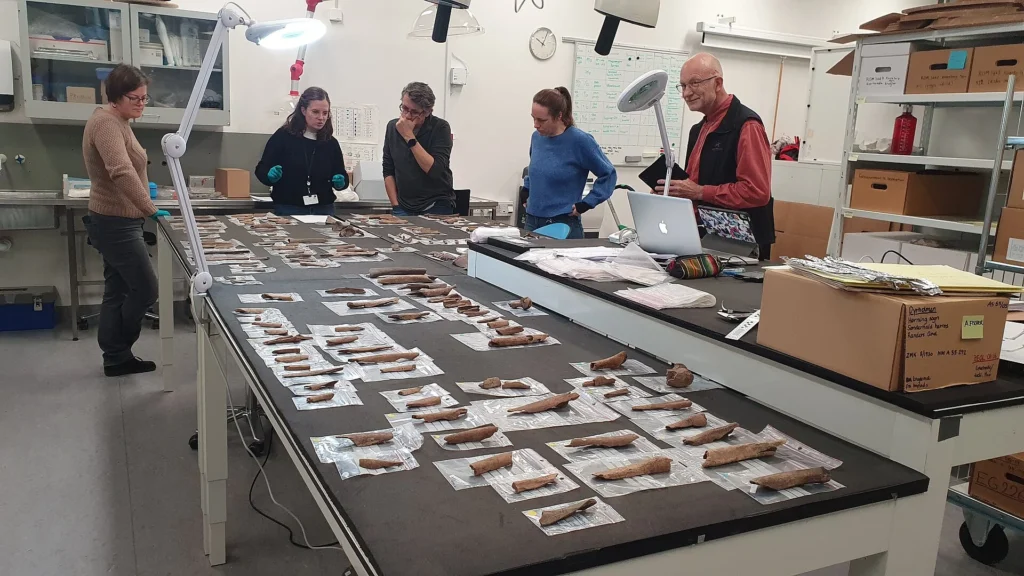
Along the vanished shore of a prehistoric fjord in eastern Jutland, archaeologists are returning to one of Denmark’s most unsettling Stone Age mysteries: about 160 scattered human bones from the Dyrholm site, many of them marked by cutting, splitting, fresh fractures and other signs of unusual treatment. The material was first excavated in the 1920s and 1930s, then again in the 1970s, but Kiel University’s ROOTS Cluster says a modern reanalysis is now overdue.
A Stone Age site with an unusual human record
Dyrholm was occupied repeatedly over a long period, from the late Mesolithic Ertebølle Culture, roughly 5400 to 3950 BCE, into the early Neolithic Funnel Beaker Culture, around 3950 to 3400 BCE. That makes the site especially important because it covers the centuries around one of northern Europe’s major turning points: the shift from hunter-gatherer-fisher lifeways toward farming communities.
The human bones were not found as complete burials. They were loose, scattered across a large part of the excavated area and mixed into a rich archaeological deposit that also contained abundant animal remains. Radiocarbon dates suggest that the human bone depositions did not happen in a single episode, but may have taken place over several hundred years.
Cut marks, fractured bones and a child’s skull
What makes Dyrholm so striking is not simply the presence of human remains. It is what appears to have happened to them.
According to the ROOTS research description, many bones show cut marks, impact scars, signs of defleshing, longitudinal splitting and fresh fractures that may indicate marrow extraction. One child’s skull displays marks interpreted as possible scalping. Some bones also bear traces of carnivore gnawing, adding another layer of complexity to the site’s formation.
Such evidence has led some earlier researchers to suggest prehistoric cannibalism at Dyrholm. That possibility is powerful, but it remains difficult. Cut marks and broken bones can point to violent death, butchery, ritual treatment, secondary burial practices, post-mortem manipulation, animal disturbance or several of these processes combined.
This is why the new project matters. Rather than treating Dyrholm as a sensational “cannibalism site,” the Kiel-led team aims to revisit the material with modern methods and a broader interpretive frame.
Cannibalism, ritual or something more complex?
The cannibalism interpretation has a long history in Danish archaeology. A 2023 study on loose human bones from the Danish Mesolithic notes that such remains have been discussed for more than 150 years. Two explanations often dominated earlier debates: bones from disturbed graves, or traces of cannibalistic meals. More recent interpretations have widened the field to include ritual behavior and post-mortem manipulation of bodies.
That wider view is important for Dyrholm. The human remains may represent practices that do not fit modern expectations of burial. In some Mesolithic societies, the dead may have been handled in stages. Bodies could have been exposed, moved, disarticulated or incorporated into meaningful places in the landscape. Sørensen’s work argues that viewing loose human bones only as disturbed graves or cannibalism is too limited, and that alternative burial customs, including treatment on platforms or in trees, should also be considered.
Dyrholm’s location strengthens that possibility. Coastal zones, river mouths and fjord landscapes were not just places to live and gather food. In many prehistoric societies, watery edges functioned as charged spaces where daily life, death and ritual could overlap.
A thousand-year window into changing lives
Dyrholm also sits at a crucial cultural boundary. The late Ertebølle world was rooted in coastal hunting, fishing and gathering, while the Funnel Beaker period brought new ceramics, farming practices, domestic animals and different ritual traditions. Organic residue studies of Early Neolithic Danish vessels show that dairy fats appeared from the onset of the Funnel Beaker Culture, while aquatic foods continued to be processed in pottery for another millennium. In other words, the transition was not a clean replacement of one way of life by another.
That makes the Dyrholm bones more than a forensic puzzle. They may preserve evidence of how communities understood the body, death and ancestry during a period of deep social change.
The international project is led by Prof. Dr. Berit V. Eriksen, with researchers including Prof. Dr. Ben Krause-Kyora, Dr. Katharina Fuchs, Dr. John Meadows, MA Julia Hochholzer and Dr. Anders Fischer. The team is also working with Danish institutions responsible for the finds and archives, including the National Museum of Denmark, Museum Østjylland, the University of Copenhagen’s Department of Forensic Medicine and the Zoological Museum.
For now, Dyrholm does not offer an easy answer. That is precisely why it is so compelling. These bones may reveal violence, ritual, survival, reverence or fear. Perhaps they reveal several of these things at once. What they clearly show is that Stone Age Denmark was not a simple world of peaceful coastal foragers. It was a human world, complex, symbolic and sometimes deeply unsettling.
Cover Image Credit: Cut-Marked Human Bones in Denmark. ©J. Hochholzer – University of Kiel
