
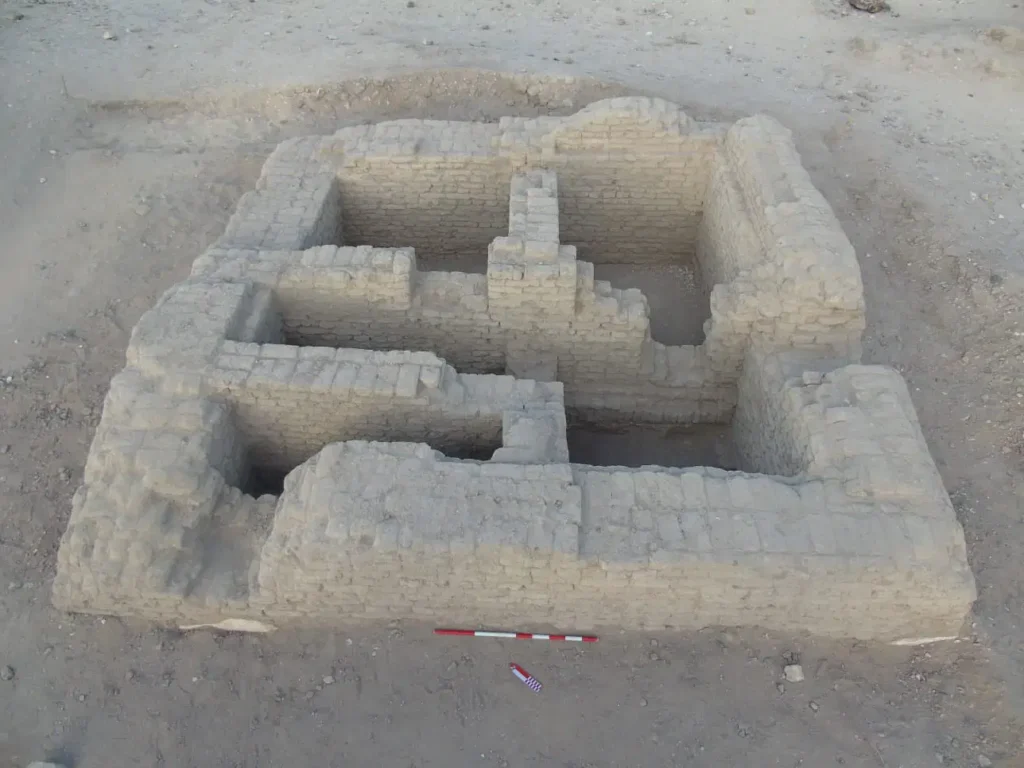
Archaeologists in Upper Egypt have uncovered the remains of a remarkably well-preserved monastic residential complex dating back to the Byzantine period, shedding new light on early Christian monastic life in the Sohag region. The discovery was made by an Egyptian archaeological mission from the Supreme Council of Antiquities during ongoing excavations at the Al-Qariah Bil-Dueir site in the Tama district of Sohag Governorate.
According to Egypt’s Minister of Tourism and Antiquities, Sherif Fathi, the find highlights the richness and diversity of Egypt’s cultural heritage across different historical eras. He emphasized that the discovery supports the ministry’s broader efforts to promote cultural tourism and draw attention to lesser-known archaeological sites in Upper Egypt.
Evidence of an Organized Monastic Community
Mohamed Ismail Khaled, Secretary-General of the Supreme Council of Antiquities, explained that the uncovered structures provide valuable insight into monastic life during the Byzantine period. Excavations revealed architectural remains made of mudbrick that point to a stable, well-organized settlement inhabited by a community of monks.
The mission identified several rectangular mudbrick buildings oriented from west to east, ranging in size from approximately 8 × 7 meters to 14 × 8 meters. Many of the buildings include rectangular halls, along with rooms that feature apsidal or prayer-niche-like forms characteristic of early Christian worship spaces. Small vaulted rooms were also discovered and are believed to have served as monks’ cells or devotional chambers used for private prayer and meditation.
Traces of plaster, wall niches, recessed shelves, and mortar-layer flooring indicate a carefully planned architectural layout. Some structures include southern courtyards that functioned as central gathering spaces, with main entrances leading into them. Archaeologists also identified small circular buildings interpreted as communal dining areas where monks may have gathered for shared meals.
Discovery of a Byzantine-Period Church
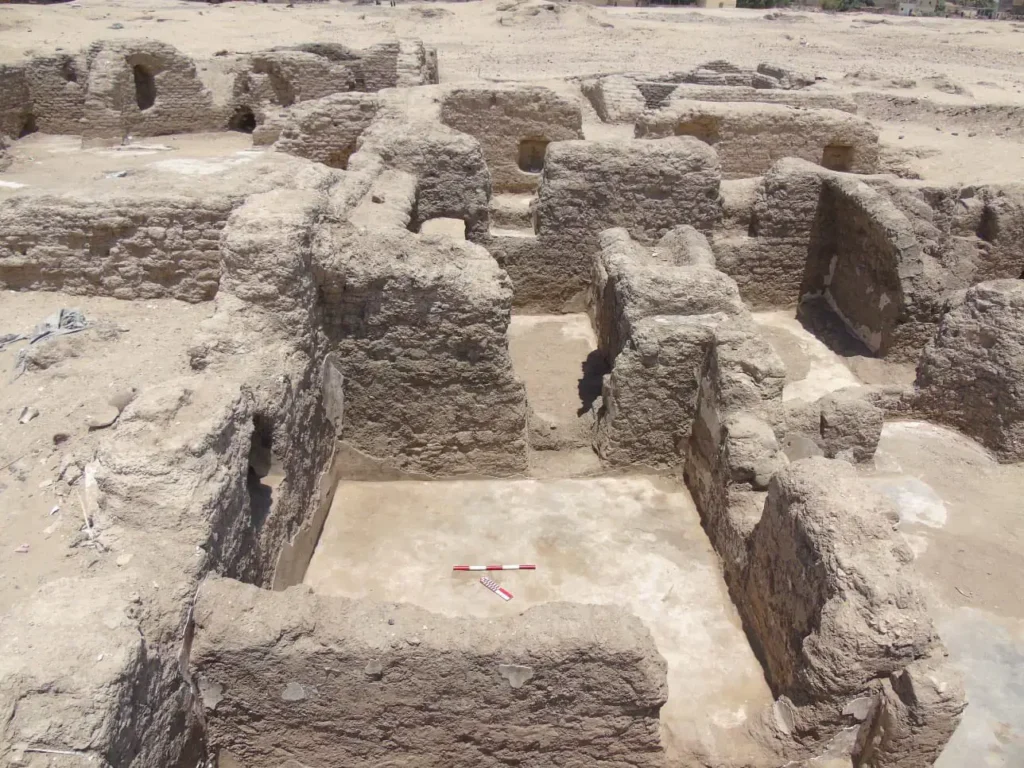
Sohag Antiquities Director Mohamed Nagib reported that the team also uncovered a larger mudbrick structure measuring around 14 × 10 meters, aligned on an east-west axis and believed to have served as the main church of the monastery. The church was divided into three principal sections — the nave, choir, and sanctuary — reflecting typical Byzantine-era ecclesiastical architecture.
Within the nave, archaeologists found unbaked brick pillar bases, which suggest that the church may once have supported a central dome. The sanctuary, located at the eastern end of the building, features a semicircular layout flanked by two side chambers, consistent with church designs common in late antiquity.
Additional discoveries at the site include red-brick and limestone basins coated with red mortar, which may have been used for water storage or production-related activities linked to the monastery’s daily operations.
Artifacts Reveal Daily and Spiritual Life
The excavation also yielded an array of artifacts that help reconstruct everyday life within the monastic settlement. These include storage amphorae, some bearing inscribed letters, numbers, or names etched onto their shoulders. The team also found ostraca — pottery fragments used as writing surfaces in antiquity — inscribed in Coptic, along with domestic tools, stone fragments from architectural elements, and engraved limestone slabs featuring Coptic script.
According to mission director Walid El-Sayed, these finds provide rare evidence of literacy, administrative organization, and religious practice among monastic communities in Upper Egypt during the Byzantine era.
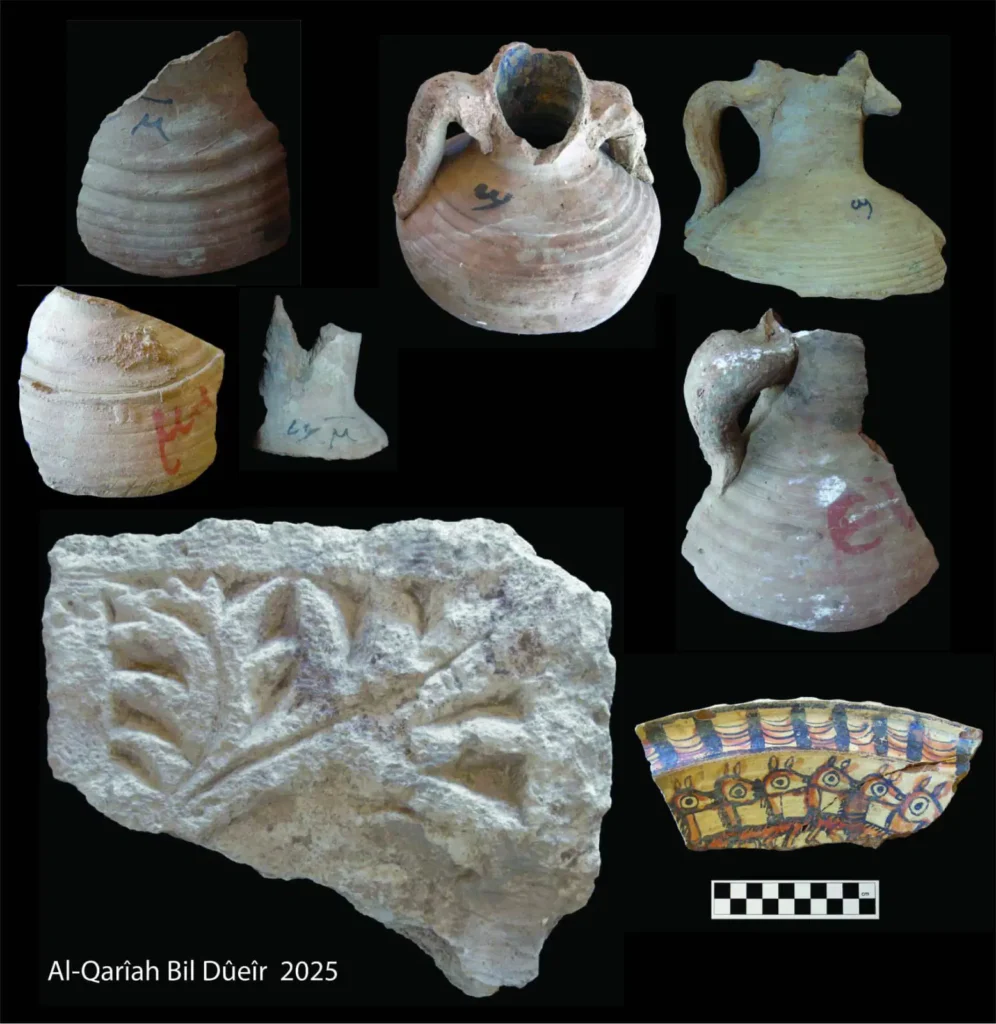
The various archaeological finds recovered at the site. Credit: Ministry of Tourism and Antiquities.
Byzantine Influence in the Sohag Region
The Sohag region holds particular importance in the history of early Christianity and monasticism. During the Byzantine period (4th–7th centuries CE), Upper Egypt became a major center of Christian monastic culture, home to influential communities that shaped spiritual traditions across the Eastern Mediterranean.
Nearby Sohag stand two of Egypt’s most significant monastic landmarks — the White Monastery and the Red Monastery — associated with Saint Shenoute and the Shenoutean monastic federation. These institutions played a key role in the development of Coptic Christian theology, education, and communal monastic organization.
The newly discovered complex adds to this broader historical picture, offering physical evidence of how monastic settlements were structured and how monks lived, prayed, worked, and interacted with their environment. The architectural features — from apsidal prayer rooms to communal dining spaces — reflect Byzantine-era religious life as it adapted to the Egyptian context.
A New Window into Egypt’s Christian Heritage
Researchers argue that the discovery not only enriches archaeological understanding of Sohag’s past but also underscores the continuity of monastic traditions in the region. Many of these traditions have survived for centuries and remain integral to Coptic Christian identity in Egypt today.
As investigations at Al-Qariah Bil-Dueir continue, archaeologists hope to uncover further details about the monastery’s social structure, economic activities, and connections to neighboring religious centers.
This discovery strengthens the growing recognition of Upper Egypt as a key historical landscape where Byzantine, Coptic, and Egyptian cultural influences converged — leaving behind a unique architectural and spiritual legacy.
Egypt’s Minister of Tourism and Antiquities
Cover Image Credit: Egypt’s Minister of Tourism and Antiquities
