
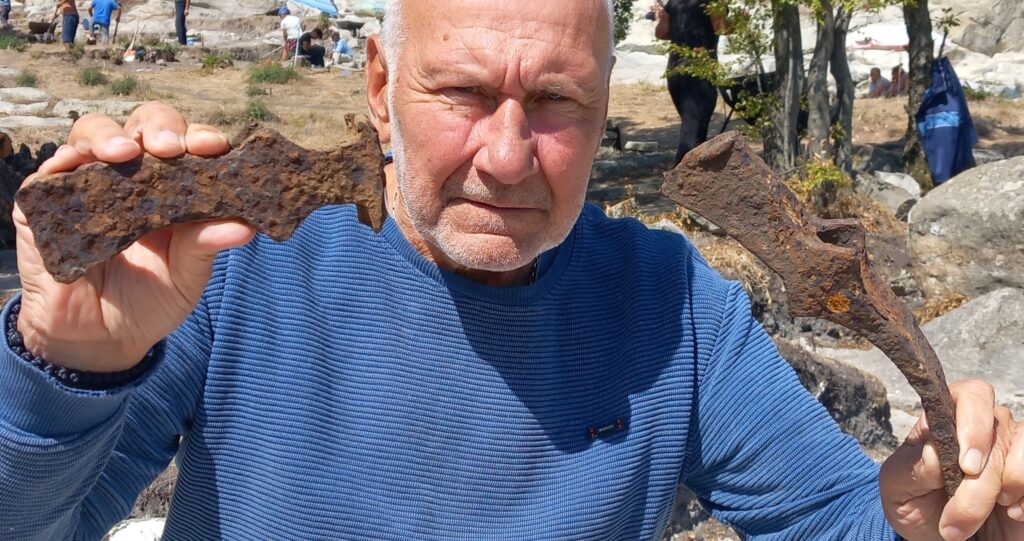
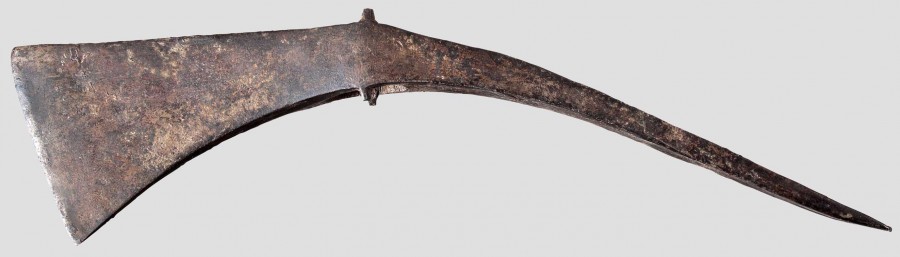
Two remarkably preserved iron tools discovered near the nearly 1,700-year-old Roman fortress at the ancient rock city of Perperikon in Bulgaria reveal a side of Roman military life that often remains overshadowed by battles and conquests. Known as dolabrae, these versatile implements helped legionaries cut wood, dig trenches, construct fortifications, and even fight when conventional weapons proved ineffective.
The discoveries come alongside a well-preserved Roman spearhead found at Perperikon. In a detailed account shared with Arkeonews, archaeologist Professor Nikolay Ovcharov explains how the objects illuminate the engineering skills and military organization that allowed Roman soldiers to build and defend strategically important settlements.
Together, the finds offer a glimpse into the lives of men who wielded tools as frequently as weapons.
Two Iron Tools with Multiple Purposes
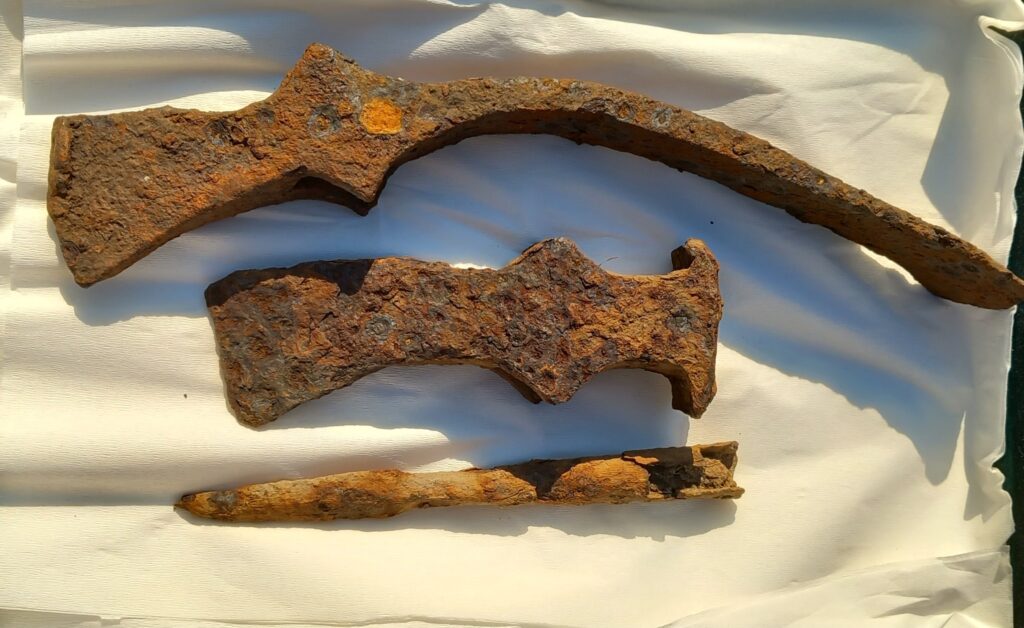
The two newly discovered dolabrae combine several functions in a single iron head. Each features an axe-like blade at one end and a pointed or hammer-like working surface at the other. A central opening once accommodated a long, sturdy wooden handle.
The Romans derived the name dolabra from the Latin verb dolare, meaning to cut or trim. Its design allowed a soldier to perform tasks that would otherwise require several separate implements.
One edge could cut branches, wooden stakes, or roots, while the pointed end could loosen hard soil, break stone, and damage masonry. Variations of the tool also incorporated adze-like blades for shaping timber.
The discoveries are particularly significant because earlier investigations at Perperikon and in its surroundings have uncovered iron wedges and other stonemasonry tools. Craftsmen used these implements to split large blocks of stone and produce the carefully shaped architectural elements that appear throughout the ancient city.
The new dolabrae add to this evidence of practical engineering skills, although their discovery does not establish that they were used to construct a particular building.
Why Roman Soldiers Needed More Than Swords
A Roman legionary’s responsibilities extended far beyond the battlefield. When an army reached a new location, its soldiers often had to transform unfamiliar terrain into an organized and defensible camp.
They cleared vegetation, dug ditches, raised earthworks, erected wooden palisades, prepared tent spaces, and secured supplies of water and firewood. The dolabra played an important role in this demanding work, making it one of the most useful tools available to soldiers on campaign.
The first-century historian Flavius Josephus described Roman infantrymen carrying a variety of equipment, including axes, saws, digging tools, baskets, and provisions. Such accounts illustrate the logistical demands of Roman campaigning, but they do not mean that every soldier carried every item.
Ovcharov notes that equipment could be distributed among the eight men of a contubernium, the Roman army’s basic tent-sharing unit. Heavier implements could also travel with the army’s baggage train.
This organization helped Roman forces establish camps, prepare roads, and maintain defensive positions far from their permanent bases. Their ability to build military infrastructure was an important part of their effectiveness.
When an Engineering Tool Became a Weapon
Although the dolabra primarily served as a working tool, its heavy iron head and sharp edges could make it dangerous in close combat.
The Roman historian Tacitus recorded an episode during the Gallic revolt of AD 21 that demonstrates this unusual military application. Roman soldiers encountered heavily armored gladiators known as crupellarii, whose protective equipment resisted conventional attacks.
The Romans responded by using axes and picks to strike their opponents’ armor, attacking it much as workers might break through a wall. The episode does not establish the dolabra as a standard Roman battle weapon, but it shows how soldiers could adapt familiar equipment to unexpected situations.
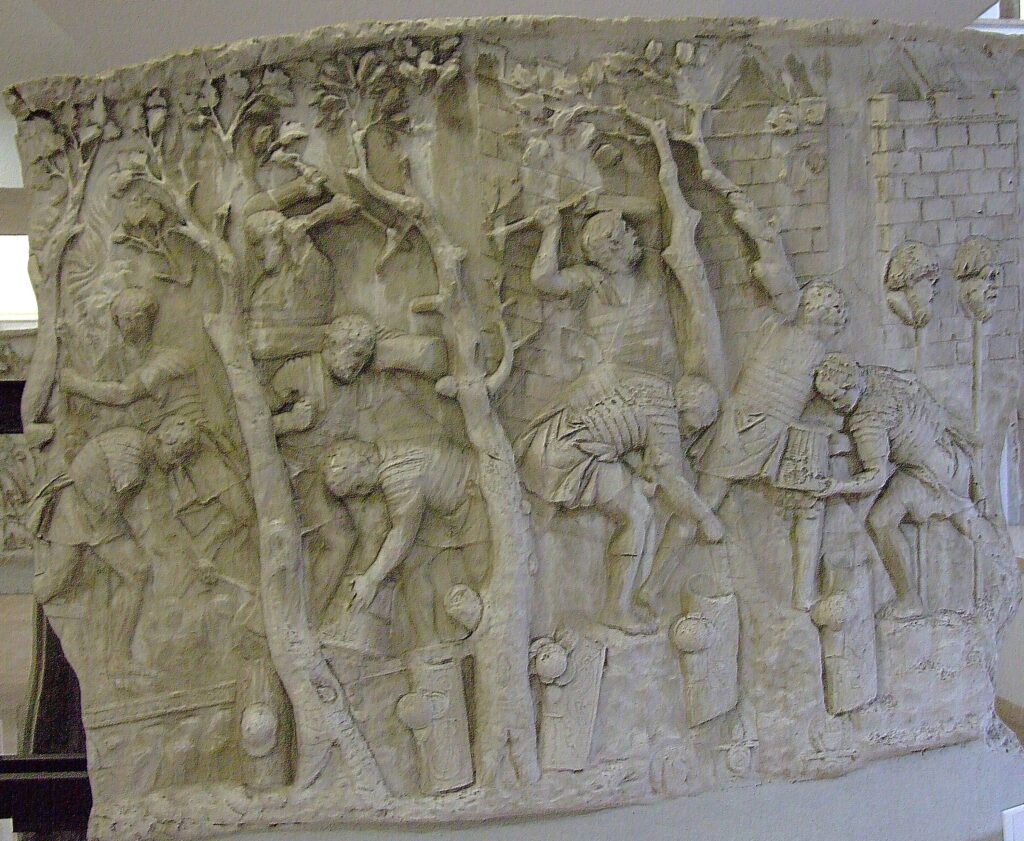
Roman art offers further evidence of the tool’s everyday use. Trajan’s Column in Rome, completed in the early second century AD, depicts soldiers undertaking construction and other activities during military campaigns.
These scenes help researchers understand how legionaries carried and used their equipment. They also illustrate a fundamental characteristic of Roman military life: the same men who fought battles were responsible for much of the labor that supported their army.
A Roman Spearhead Adds Another Piece to the Story
The recent discoveries also include a well-preserved iron spearhead that Ovcharov identifies as belonging to the hasta type. Unlike the pilum, which Roman soldiers primarily used as a throwing weapon, the hasta served as a long thrusting spear.
Its substantial iron head was typically mounted on a wooden shaft approximately 2.4 meters long, often made from ash. The weapon allowed infantrymen to engage opponents while maintaining some distance.
The hasta played an important role in early Roman military organization. During the Republican period, the hastati initially carried spears before adopting the pilum and gladius, while the triarii, experienced soldiers who occupied the third line of battle, retained the hasta.
Although its role changed during the Imperial period, long thrusting spears returned to prominence in the late Roman army alongside longer swords known as spathae.
For Ovcharov, the Perperikon spearhead complements the newly discovered engineering tools. Together, the objects illustrate two closely connected aspects of military life: the construction of defensive positions and the weapons used to protect them.
The Fortress That Faced the Goths
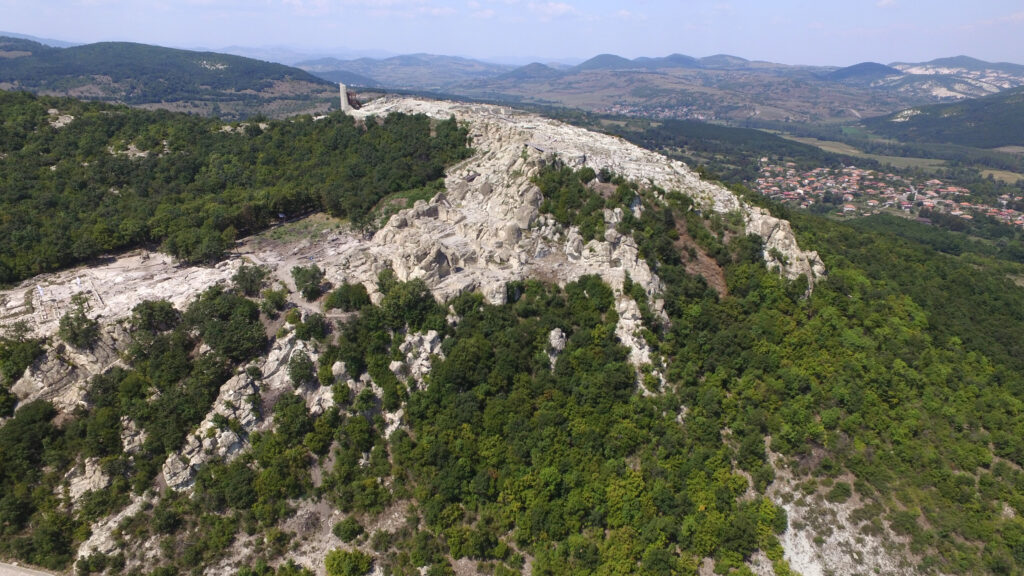
Perperikon occupies a commanding position in Bulgaria’s Eastern Rhodope Mountains. Its rock-cut architecture, monumental buildings, and extensive defensive structures reflect centuries of occupation and development.
During the third and fourth centuries AD, the settlement acquired impressive temples and mausoleums. Ovcharov dates the construction of its powerful Roman fortress wall to the end of the third century, when the empire faced growing threats along its frontiers.
He interprets the military finds as further evidence of a substantial and experienced Roman garrison stationed at the fortified settlement.
Yet Perperikon’s defenses could not protect it indefinitely. According to Ovcharov’s account, Gothic forces captured and burned the city in AD 378, following Emperor Valens’ disastrous defeat at the Battle of Adrianople.
The newly discovered tools and spearhead cannot be linked directly to that particular attack. Nevertheless, they provide valuable evidence for understanding Roman military activity at a settlement whose history involved both construction and conflict.
Perperikon’s surviving stone architecture still dominates the surrounding landscape. The latest finds bring attention to the soldiers and skilled workers behind those structures, reminding us that Roman military power depended not only on the weapons its armies carried but also on their ability to build the defenses they were called upon to protect.
Source: Original article and photographs provided directly to Arkeonews by Prof. Nikolay Ovcharov. More of his writings can be found on his author page at 168 Chasa.
