

A rare 13th-century seal found at Perperikon belonged to one of the Byzantine world’s most powerful women — and carries an unusual image of Christ standing as the “Redeemer.”
Archaeologists excavating the ancient rock city of Perperikon in southern Bulgaria have discovered the personal lead seal of Empress Irene Laskarina, one of the most powerful women of the 13th-century Byzantine world. More than a rare piece of imperial regalia, the seal may be surviving evidence of high-level correspondence during a crucial period of diplomacy between the Bulgarian Empire and the Byzantine successor state centered at Nicaea.
Excavation director Prof. Nikolay Ovcharov announced the discovery, while sigillography specialist Dimitar Stoimenov identified the inscription. Comparable seals of Irene are known from major collections, including Dumbarton Oaks in Washington and the Hermitage Museum in St. Petersburg. According to Ovcharov, however, the Perperikon seal is the only known example to have emerged from an archaeological excavation rather than an old collection.
That context makes its location particularly significant. In the 1230s, Perperikon stood in a strategically important region of the Eastern Rhodopes at a time when Bulgaria and Nicaea were negotiating an alliance that would reshape the political balance of southeastern Europe.
The Empress’s Seal Bears a Rare Christ the Redeemer
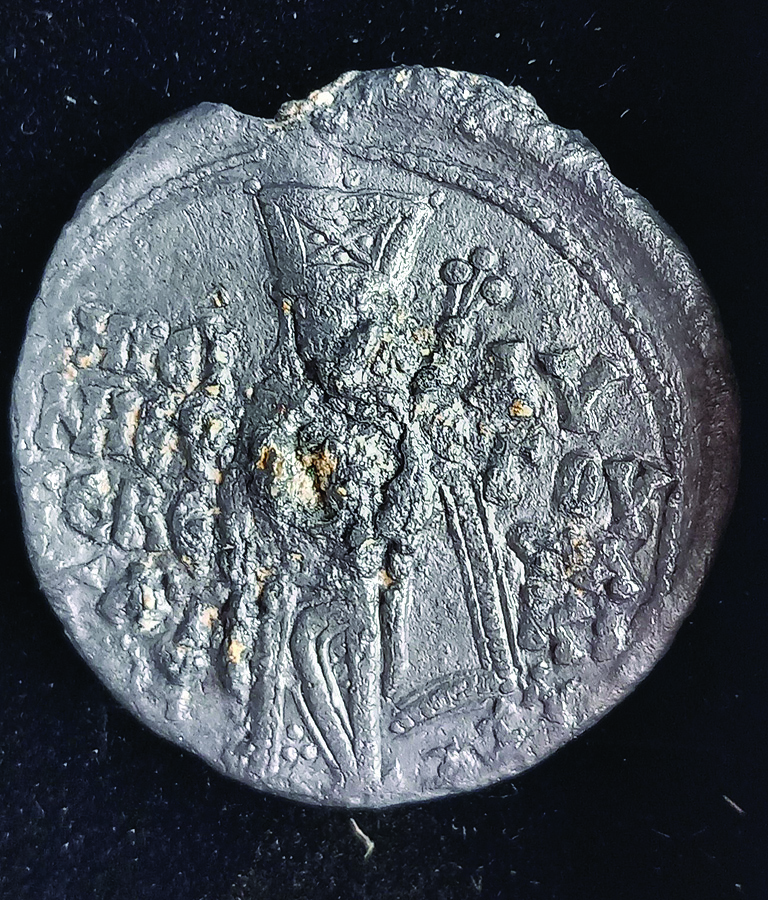
The exceptionally well-preserved lead seal carries a full-length image of Irene on one side. She appears standing on an oval platform, wearing a high imperial crown and the ceremonial loros, while holding a sceptre.
The inscription identifies her as “Irene Komnene, most pious Augusta,” according to Ovcharov’s account of the find.
The reverse is equally striking. It shows Christ standing frontally in the rare iconographic type known as Lytrotes, or “the Redeemer.” He is depicted full-length with a cruciform halo, raising one hand in blessing and holding the Gospels in the other.
What makes the image noteworthy is not simply the presence of Christ. Images of Christ were well established on Byzantine imperial seals. Irene’s seal, however, uses a much rarer representation of Christ as Lytrotes, a type that appears only infrequently in Byzantine sigillography. Ovcharov described the iconography as “exceptionally rare.”
The combination of Irene’s imperial portrait, her formal titulature, and this unusual representation of Christ identifies the object as her personal seal, the kind attached to official correspondence to authenticate the sender and secure the document.
The letter itself has not survived. That leaves the seal with an unresolved question at its center: what was one of the Byzantine world’s most powerful women writing to Perperikon about?
Irene stood at the center of an imperial dynasty
Irene’s importance went far beyond her marriage to an emperor. Born into the Laskaris dynasty, she was the daughter of Theodore I Laskaris, founder and emperor of the Empire of Nicaea, and through her mother descended from Emperor Alexios III Angelos. She married John III Doukas Vatatzes, who ruled Nicaea from 1222 to 1254, and their son later became Emperor Theodore II Laskaris.
In other words, Irene was the granddaughter, daughter, wife, and mother of emperors.
But lineage alone does not explain her political importance. Byzantine historian George Akropolites portrays Irene as an intelligent and commanding imperial figure who participated actively in affairs of state. He describes a woman interested in intellectual discussion, respected for her judgment and capable of displaying the authority expected at the highest level of imperial government.
Her position became especially important after 1204, when crusaders captured Constantinople and established the Latin Empire. Byzantine political power fragmented, and Nicaea emerged as the strongest of the states seeking eventually to recover Constantinople.
By the 1230s, Irene and John III Vatatzes were operating in a Balkan world dominated by competing powers: the Latin Empire, Nicaea, Epirus and the rapidly expanding Bulgarian Empire.
A seal from a decisive moment in Balkan history
The political situation changed dramatically in 1230, when Bulgarian Tsar Ivan Asen II defeated Theodore Komnenos Doukas of Epirus at the Battle of Klokotnitsa. The victory transformed Bulgaria into the dominant power across much of the Balkans and made Ivan Asen II a ruler whom Nicaea could not ignore.
John III Vatatzes consequently had a strong interest in reaching an agreement with Bulgaria. Irene appears to have played an active role during the diplomatic process that followed.
Negotiations intensified between 1233 and 1235. At their center were two closely connected issues: a dynastic marriage and the status of the Bulgarian Church.
The proposed marriage united Irene’s son and heir, Theodore Laskaris, with Elena Asenina, the young daughter of Ivan Asen II. The two children married in 1235, linking the ruling houses of Nicaea and Bulgaria.
At almost the same time, another major agreement took shape. Bulgaria sought recognition of an independent patriarchate, restoring an ecclesiastical status that carried enormous political significance. In 1235, following negotiations between the two powers, a church council at Lampsacus recognized the Bulgarian patriarchate with the participation and consent of the Orthodox ecclesiastical leadership.
Irene therefore stood close to both developments. She was not simply the emperor’s wife observing diplomatic negotiations from the sidelines; she was the mother of the Nicaean heir whose marriage sealed the alliance.
It is within this narrow historical window that Ovcharov believes the Perperikon seal may belong.
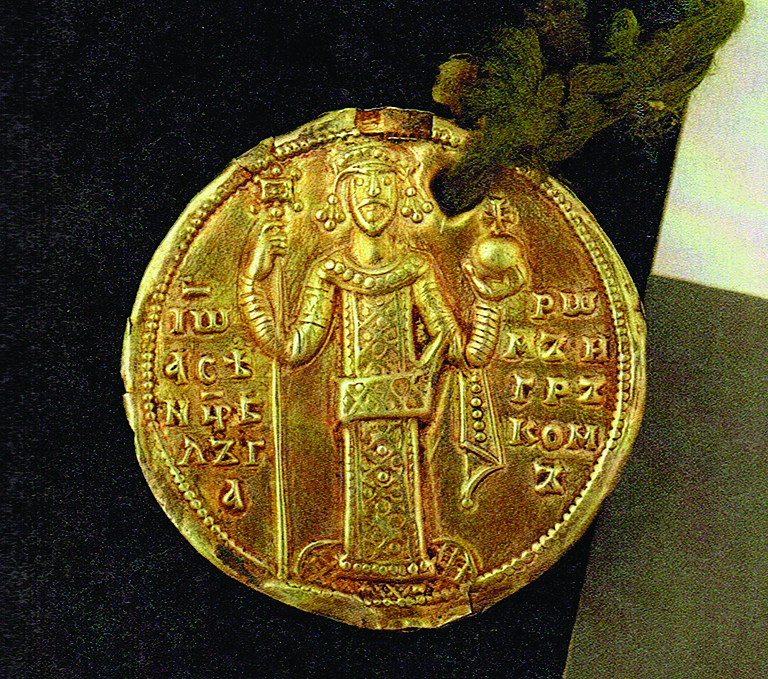
The great Bulgarian Tsar Ivan Asen II depicted on his famous gold seal. Credit: Prof. Nikolay Ovcharov – Trud
What was Irene writing to Perperikon?
The answer remains unknown, and the surviving evidence does not allow the contents of Irene’s letter to be reconstructed.
Ovcharov has proposed two possibilities.
By the 13th and 14th centuries, Perperikon had developed into an important fortified center controlling part of the region historically known as Achridos in the Eastern Rhodopes, a contested frontier zone between Bulgaria and Byzantium. The city also had a longstanding ecclesiastical role, with a bishop associated with the settlement from Late Antiquity onward.
One possibility, therefore, is that Irene’s correspondence concerned support from the local ecclesiastical authorities during the negotiations over recognition of the Bulgarian patriarchate.
Another possibility is more directly dynastic. The letter may have concerned preparations surrounding the marriage of Theodore Laskaris and Elena Asenina, perhaps requiring assistance or instructions for authorities in the region.
Neither explanation can yet be proved.
A Lost Letter, but a Surviving Imperial Connection
What the seal does establish is that a document carrying Irene’s personal imperial authority reached Perperikon during one of the most politically charged periods of the 13th century. The letter disappeared, but the object once used to authenticate it remained in the ground for nearly eight centuries.
The discovery also adds Irene to an extraordinary group of medieval rulers whose seals have been recovered at Perperikon. Previous finds include seals associated with Byzantine emperors Anastasius I, Constantine IX Monomachos and Andronikos II Palaiologos, as well as a gold seal of Bulgarian Tsar Ivan Alexander.
Together, they underline Perperikon’s importance not merely as a fortress or regional settlement, but as a place connected to the political and administrative networks of successive empires.
For Irene’s seal, however, the unresolved question gives the discovery particular weight. Archaeologists now know that correspondence from one of the most powerful women of the medieval Byzantine world reached Perperikon. What she ordered, requested or negotiated in that missing letter remains unknown.
Note: For a more detailed account of the discovery and its historical context, excavation director Prof. Nikolay Ovcharov has also published his own analysis in the Bulgarian newspaper Trud.
