
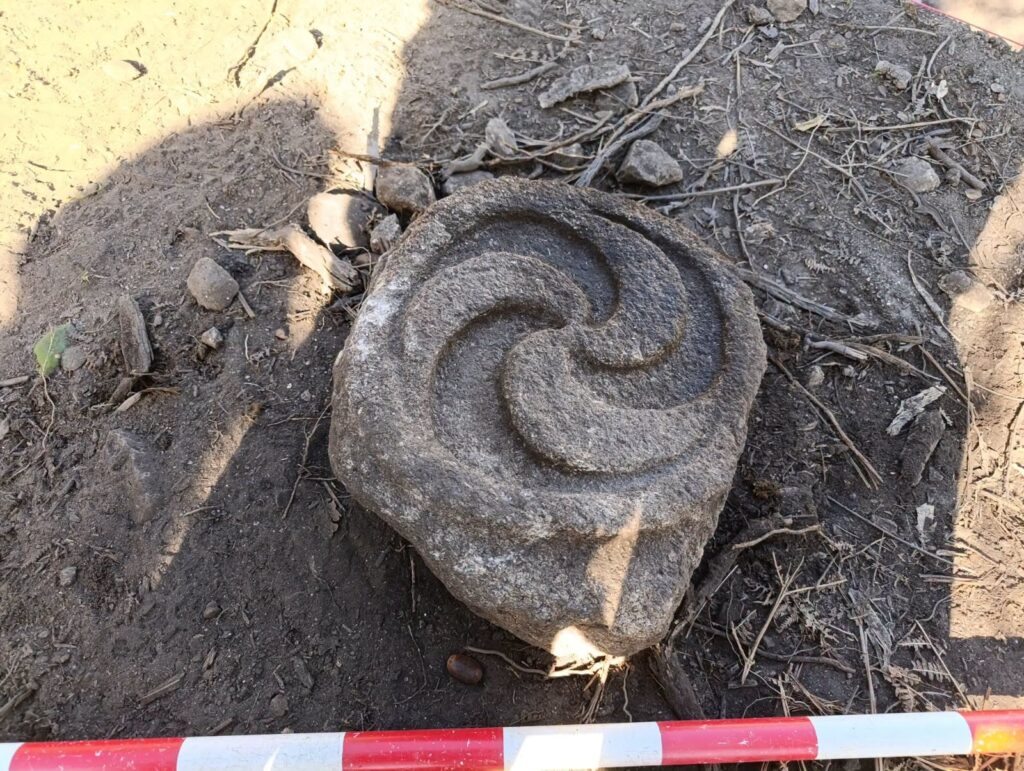
Archaeologists investigating an ancient hilltop settlement in northwestern Spain have discovered an unusual granite stone bearing two distinct carvings, one on each side.
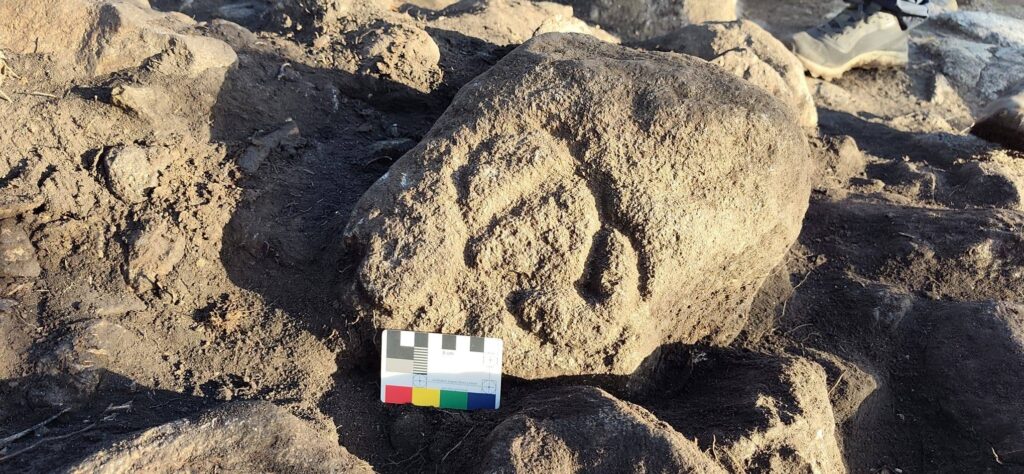
One face features a remarkably well-preserved triskele, a three-armed motif known from ancient European art, while the reverse carries a more roughly executed petroglyph. The discovery has raised an intriguing question: were both designs carved during the same period, or was the stone altered and reused by different generations?
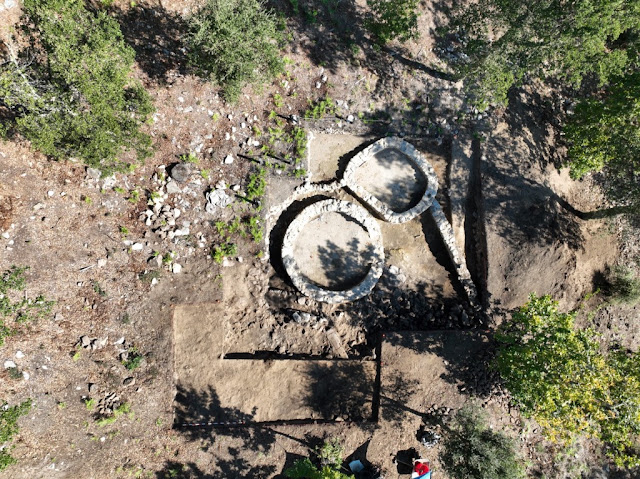
The stone was recovered from the remains of a large circular building at Castro do Pico da Bandeira, near A Guarda in Galicia. The structure was occupied around the period of increasing Roman influence in northwestern Iberia, although the carvings themselves have not yet been securely dated. Archaeologists consider the combination of motifs particularly unusual, with no closely comparable example currently known from Galicia.
Two Carvings on a Single Stone
The discovery was made during excavations conducted by Árbore Arqueoloxía e Restauración, with archaeologist Nerea Vilariño directing the investigation. According to archaeologist Benito Vilas, the stone initially attracted attention because of the engraving visible on one side. When the team turned it over, they discovered the more carefully executed triskele, whose carved surface had apparently been protected beneath the rubble of the collapsed structure.
The granite piece measures approximately 30 centimeters across, although published reports give slightly different measurements. Its triskele consists of three curved arms extending counterclockwise from a central point, forming a motif associated with the artistic traditions of ancient Europe. The opposite face contains a less refined carving whose precise design and meaning remain under investigation.
The two carvings differ noticeably in their execution. The triskele was carefully shaped, while the petroglyph on the reverse appears much rougher. Archaeologists are now trying to determine whether both designs were made at the same time or whether the stone was carved again at a later date.
Vilas has noted a possible comparison with an engraved stone associated with an Iron Age bathing complex at Briteiros in northern Portugal. That example also carries a petroglyph on its reverse, although its archaeological context and decorative features differ from those of the Galician discovery. The comparison suggests a potential avenue for further investigation rather than evidence that the two objects served the same purpose.
A Larger Building with an Uncertain Past
The stone was discovered during a broader investigation of Castro do Pico da Bandeira, situated on Mount Torroso near A Guarda. Archaeological work resumed at the site in 2022 after approximately a century without comparable excavations, while the current research program began in 2025. The latest campaign, promoted by the Salcidos communal landowners’ association, is examining a substantial circular building that differs noticeably from two smaller structures identified during previous investigations.
Excavations have revealed stone slabs that may have formed part of the building’s entrance, architectural fittings, Roman amphora fragments, and several objects described locally as amarradoiros, made from orthogneiss. The precise purpose of these objects remains uncertain, and further analysis will be needed to determine how they relate to activities carried out inside the structure. The amphora fragments may also help researchers investigate the settlement’s connections with wider exchange networks, although their provenance has not yet been established.
The building appears to have been occupied between the first century BC and the first century AD, when indigenous communities in northwestern Iberia were experiencing growing Roman influence. Its dimensions and the variety of recovered materials have led the excavation team to consider whether it may have belonged to a household of greater standing within the settlement. However, more than half of the structure remains unexcavated, making any definitive interpretation premature.
The excavations have also provided new details about the building’s layout and the activities that may have taken place inside it. Stone slabs near the entrance, pottery fragments, and other objects suggest that the structure underwent different phases of use. With much of the building still unexcavated, archaeologists hope to learn more about its history and how the carved stone came to be there.
The Triskele in Ancient Iberian Art
The triskele, also known as the triskelion, is a geometric motif consisting of three curved arms extending from a central point. It appears in different artistic traditions across ancient Europe and was particularly prominent in Celtic-influenced decorative art. In northwestern Iberia, triskeles formed part of the artistic repertoire of the Castro culture, which developed during the Iron Age and continued into the Roman period.
Examples of similar geometric decoration have been documented at settlements including Santa Trega and Briteiros, where craftspeople carved stone with triskeles, four-armed motifs, spirals and interlacing patterns. Such designs appeared on architectural elements, including lintels and decorated stone slabs. At Briteiros, elaborate carvings also adorned the monumental entrance stones known as pedras formosas, associated with Iron Age bathing structures.
Some researchers have interpreted circular and rotating motifs as possible references to the sun, celestial movement or religious beliefs. However, their original significance remains uncertain because the communities that produced them left no surviving written explanations of their symbolism. Archaeologists therefore rely on the location of the carvings, their architectural settings and comparisons with other finds to investigate their possible functions.
The Pico da Bandeira discovery adds an unusual example to this regional tradition. Although triskeles are already known from northwestern Iberia, the presence of a different petroglyph on the reverse makes this particular stone distinctive. Determining when the two designs were carved will be important for understanding whether they belonged to the same decorative tradition or reflect separate phases of the stone’s use.
The Next Steps at Pico da Bandeira
Archaeological work at Pico da Bandeira is continuing under a research program supported by the Salcidos communal landowners’ association. The current campaign involves a team of three to four specialists and about 25 working days devoted to excavation, documentation, and examining recovered materials. Their work includes recording the architectural remains and studying the objects found inside the large circular building.
The granite stone will undergo further examination to establish the characteristics and possible chronology of its two carvings. Researchers will also study the Roman amphora fragments and other recovered objects to investigate the building’s use and the settlement’s connections with surrounding communities. The amphora fragments may provide evidence of trade contacts if their origins can be identified.
The project also includes conservation work on the exposed structures, which require protection after excavation. Once the archaeological documentation is completed, the team plans to consolidate vulnerable remains to reduce deterioration caused by weather and environmental conditions. These measures form part of the wider effort to preserve Pico da Bandeira while continuing research into its occupation during the Iron Age and early Roman period.
